Jul 17, 2026·7 min read
Take Rate (Platform Fee Share)
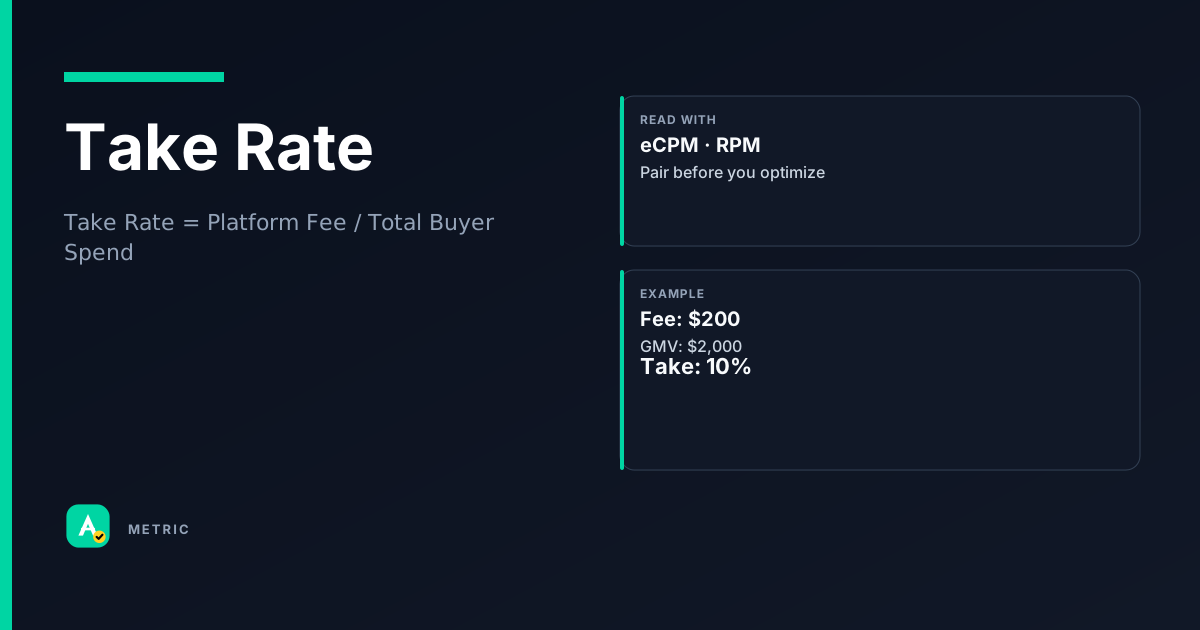
Take Rate is the percentage of transaction value that an ad platform (SSP, exchange, ad network) retains as its fee. It explains the gap between what an advertiser spends and what a publisher nets. For publishers, take rate is the cost of accessing demand; for advertisers, it is part of the spread between gross CPM and net working media.
What Take Rate Is
Take rate is the platform’s share of every dollar that moves through an ad transaction. If an advertiser pays $1.00 CPM and the publisher receives $0.85, the take rate is 15%. That 15% covers the exchange’s auction technology, data processing, payment processing, and margin.
In programmatic advertising, take rate is not a single number — it varies by:
- Auction type (first-price vs. second-price mechanics change how fees are deducted)
- Deal type (private marketplace deals often carry different fee schedules than open auction)
- Buyer type (some platforms charge different rates for DSPs vs. direct advertisers)
So what: Take rate is the core unit of marketplace economics. A publisher who only watches eCPM without subtracting take rate will overestimate true yield. An advertiser who only watches gross CPM without adding platform fees will undercount true cost.
How It Is Calculated
Take Rate = (Platform Fee) / (Total Buyer Spend)
Where:
- Platform Fee = total amount the exchange or SSP retains (all deductions, including tech fees, data fees, and margin)
- Total Buyer Spend = gross amount advertisers paid for the inventory (before any deductions)
Important caveats
- Fee stacking — A single impression may pass through multiple intermediaries (DSP → exchange → SSP). Each layer takes its own fee. The “total take rate” is the sum of all intermediary fees, not just one platform’s slice.
- Net vs. gross definitions — Some platforms report take rate as a percentage of gross spend; others report it as a percentage of net spend. Always confirm which denominator is used.
- Minimum CPM floors — When a publisher sets a hard floor, the platform may still deduct its fee on top, effectively making the take rate a percentage of the floor price, not the clearing price. This can inflate the effective fee rate.
- Data and bidstream fees — Some exchanges charge separate data access fees that are not reflected in the headline take rate. Check the platform’s fee disclosure for line-item charges.
How to Read It in a Dashboard
Take rate is rarely shown as a standalone KPI in standard dashboards. Instead, it is inferred by comparing buyer-side cost (e.g., gross CPM from the DSP) with publisher-side revenue (e.g., RPM from the ad server).
What to look for:
- A widening gap between eCPM and RPM over time → take rate is increasing (or fee stacking is growing)
- A sudden drop in publisher net revenue with flat eCPM → the platform may have changed its fee structure or added a new deduction
- Consistent take rate above 30-40% → investigate whether multiple intermediaries are each taking a cut without adding value
Always pair take rate with:
What Usually Moves This Metric
Take rate is not a lever a publisher or advertiser can pull directly — it is set by the platform. But you can influence which platform you use and how you route demand.
Levers for publishers:
- Header bidding vs. waterfall — Header bidding often reduces take rate by letting multiple SSPs compete on the same impression, driving up the clearing price and diluting the fee percentage
- Direct deals — Bypass the open exchange entirely; take rate on a direct IO is typically 0% (or a fixed service fee)
- SSP consolidation — Fewer intermediaries means fewer layers of fee stacking
- Negotiated fee caps — Large publishers can negotiate a maximum take rate with their SSP partners
Levers for advertisers:
- Direct publisher buys — Eliminate exchange fees by buying direct from the publisher’s ad server
- DSP fee transparency — Some DSPs offer a “clean” CPM that passes through the exchange fee without markup
Tradeoffs
- Lower take rate ≠ higher net yield if the cheaper platform has lower fill rate or lower bid density. A 10% take rate on a $1.00 CPM yields $0.90; a 20% take rate on a $2.00 CPM yields $1.60. Do not optimize take rate in isolation.
- Aggressive fee negotiation can lead to deprioritized demand — some SSPs may route higher-fee inventory to buyers first
- Direct deals eliminate take rate but also eliminate access to programmatic demand pools; the net yield may be lower if direct CPMs are weak
Formula
Check whether the platform defines 'Total Buyer Spend' as gross spend (including all fees) or net spend (after some deductions). Definitions vary by vendor.
Scenarios
The hidden fee stack
A publisher sees eCPM of $3.50 in their ad server but RPM of only $2.45. The gap is $1.05 — a 30% take rate. What happened: The impression passed through three intermediaries: a DSP (10% fee), an exchange (12% fee), and an SSP (8% fee). The fees compounded. What they did: Consolidated to one SSP with a negotiated 15% all-in fee. RPM rose to $2.98. Takeaway: Fee stacking is invisible unless you compare gross eCPM to net RPM. Map every intermediary in your path.
First-price auction fee shift
After an exchange moved from second-price to first-price auctions, a publisher’s take rate jumped from 12% to 18% even though the headline fee schedule stayed the same. Cause: In first-price, the clearing price is higher, so the same percentage fee yields a larger absolute deduction. Fix: Renegotiate the fee percentage downward to align with the new auction dynamics. Takeaway: Take rate percentage is not stable across auction types. Re-baseline after any auction-mechanism change.
The zero-fee fallacy
A publisher switched to a “zero-fee” exchange expecting 100% of buyer spend. RPM actually dropped 15%. What happened: The zero-fee exchange had lower bid density and weaker demand — buyers were not bidding as aggressively. The publisher lost more in lower CPMs than they saved in fees. Takeaway: Zero take rate is not automatically better. Gross revenue before fees matters more than the fee percentage alone.
Common pitfalls
Assuming take rate is the only cost
Take rate excludes data fees, minimum CPM floor surcharges, and bidstream access fees. A platform with a low headline take rate may charge separately for audience segments or real-time bid data, making the total cost higher.
- What to do instead: Request a full fee schedule including all line-item charges. Calculate total cost of platform as (total fees + data fees) / total buyer spend.
Optimizing take rate without context
A publisher who pushes for the lowest take rate without considering fill rate, bid density, or viewability will likely see net revenue drop. A low take rate on low-quality demand is worse than a moderate take rate on premium demand.
- What to do instead: Optimize for net RPM (revenue per thousand impressions after all fees) — that is the single number that captures both take rate and demand quality.
Confusing take rate with margin
Take rate is a fee on transaction value, not profit margin. An exchange with a 20% take rate may still be unprofitable if its infrastructure costs are high. Conversely, a 5% take rate may be very profitable if the platform runs lean. Take rate is a revenue share, not a profitability metric.
- What to do instead: Use take rate to compare platform costs, not to judge platform health. For profitability analysis, look at the platform’s operating margin separately.
Summary
Take rate is the unavoidable cost of accessing programmatic demand — but it is only one piece of the yield puzzle.
- For publishers: Compare net RPM, not gross eCPM, to measure true yield. Consolidate intermediaries to reduce fee stacking.
- For advertisers: Include take rate when calculating true CPM; a low gross CPM may hide high platform fees.
- For everyone: Always ask for a full fee disclosure. Take rate is the headline; data fees, minimums, and surcharges are the fine print.
Quick check
Confirm you understood this article.
boolean
Take rate is the percentage of transaction value that the platform retains as a fee.
Select an answer to continue
References
- IAB Programmatic Fee Transparency Guidelines — conceptual reference on fee disclosure best practices
- Google Ad Manager Help Center — conceptual reference on revenue share and fee calculation
- Marketplace economics teaching (exchange take rates) — conceptual reference on two-sided marketplace fee structures
For learning only. Not advice on bids or spend.
You may also like
Metrics
Cost Per Mille (CPM)
CPM (Cost Per Mille) is the price an advertiser pays for 1,000 ad impressions.
CostMetrics
Effective Cost Per Mille (eCPM)
eCPM (effective cost per mille) is the revenue a publisher earns per thousand ad impressions, r…
RevenueMetrics
Revenue per Mille (RPM)
RPM (Revenue per Mille) measures how much a publisher earns per thousand page views or sessions.
RevenueMetrics
Conversion Rate (CVR)
Conversion rate (CVR) measures how often a click (or visit) leads to a desired action — a purch…
Performance