Jul 17, 2026·7 min read
Cost Per Mille (CPM)
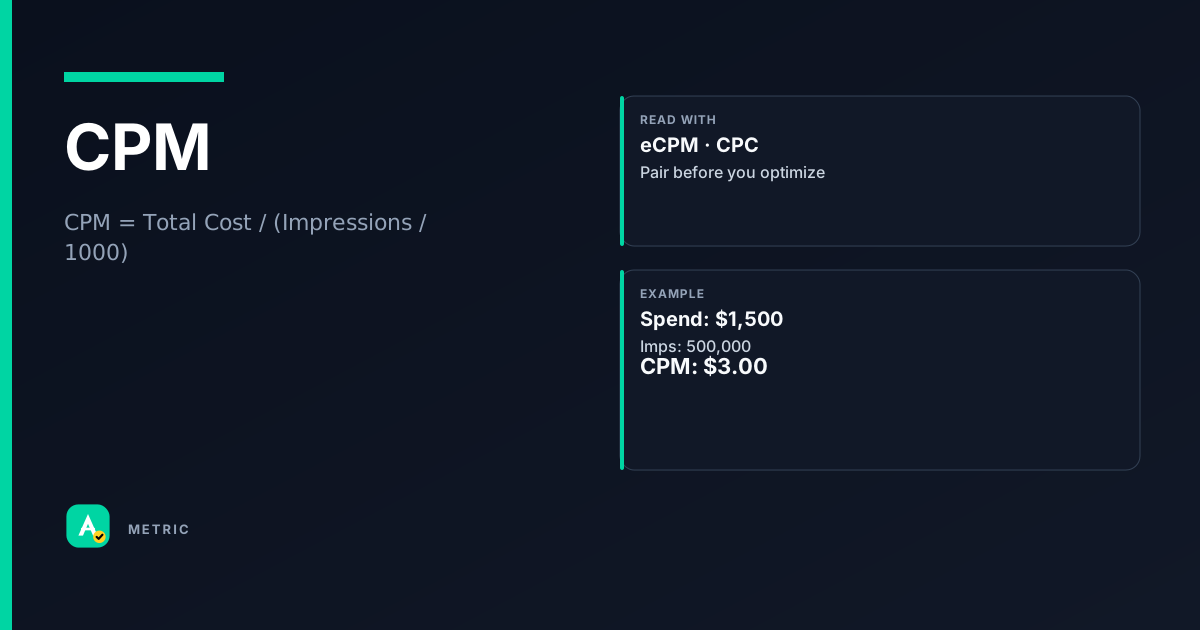
CPM (Cost Per Mille) is the price an advertiser pays for 1,000 ad impressions. It is the standard currency for brand-awareness and reach campaigns where the goal is eyeballs, not clicks. CPM is an advertiser-side cost metric — do not confuse it with eCPM, which is the publisher’s revenue per thousand impressions.
What CPM is
CPM stands for Cost Per Mille (Latin for “thousand”). It represents the cost an advertiser incurs to deliver 1,000 ad impressions, regardless of whether users click, convert, or ignore the ad.
CPM is the default pricing model for display, video, and native campaigns that prioritize reach and frequency over direct response. It is the simplest metric to budget against: if you want 500,000 impressions and the CPM is $10, you spend $5,000.
Key distinction
- Advertiser CPM = cost per 1,000 impressions bought.
- Publisher eCPM = revenue per 1,000 impressions sold.
They are not the same number. An advertiser paying $12 CPM may generate only $8 eCPM for the publisher after platform fees and revenue shares.
So what: CPM is your go-to metric when the campaign objective is brand visibility. It tells you nothing about engagement or conversion efficiency — that is where CPC or CPA come in.
How it is calculated
CPM = Total Cost / (Impressions / 1000)
Or equivalently: CPM = (Total Cost / Impressions) × 1000
Example
- Campaign spend: $5,000
- Impressions served: 625,000
- CPM = $5,000 / (625,000 / 1000) = $5,000 / 625 = $8.00
Caveats
- Billed vs. served impressions — Most platforms (Google Ads, Meta) bill on served impressions, but some programmatic deals use viewable impressions. Always confirm which denominator is used.
- Platform fees — The CPM you see in the UI may include or exclude platform fees. Check the definition in the Google Ads Help Center for the “Avg. CPM” column.
- Rounding — CPM is typically rounded to two decimal places. Small rounding differences compound at scale.
How to read it in a dashboard
A single CPM number is meaningless without context. You need to compare it against:
- Benchmark CPM for your industry and format (e.g., video CPM is typically higher than display CPM).
- Historical CPM for the same campaign or audience segment.
- Paired metrics to judge efficiency.
What to pair with CPM
- Viewability rate — A low CPM is not a bargain if 40% of impressions are never seen.
- Click-through rate (CTR) — For brand campaigns, CTR is secondary, but a cratering CTR may indicate poor placement or audience mismatch.
- Frequency — If CPM is low but frequency is 8.0, you are paying less per thousand but annoying users.
Common mistake: Celebrating a $2 CPM drop without checking whether viewability also dropped. That is not a win — it is cheap garbage inventory.
So what: Read CPM in the context of reach quality. A $12 CPM with 75% viewability is often better than a $6 CPM with 30% viewability.
What usually moves this metric
Levers that increase CPM
- Targeting precision — Narrow audiences (in-market, custom intent) command higher CPM because competition is tighter.
- Ad format — Video, rich media, and interactive formats carry higher CPM than standard display.
- Placement quality — Premium publisher inventory, above-the-fold, and app placements cost more.
- Seasonality — Q4 holiday period drives CPM up 20–50% in many verticals.
Levers that decrease CPM
- Broad targeting — Wide demographics or run-of-network inventory.
- Lower viewability thresholds — Accepting below-the-fold or smaller ad units.
- Ad exchange auctions — Switching from guaranteed deals to open auction can lower CPM (but also lower placement control).
Tradeoffs
Cheaper CPM ≠ better campaign. The classic mistake is optimizing CPM in isolation. A home-services advertiser once switched from premium placements ($15 CPM, 80% viewability) to budget inventory ($6 CPM, 35% viewability). Their cost per thousand impressions halved, but cost per viewable impression actually rose. They paid more for unseen ads.
So what: Optimize for viewable CPM (CPM / viewability rate) or cost per completed view for video. Do not chase raw CPM down.
Formula
Platforms may use served or viewable impressions as the denominator. Check vendor definition.
Scenarios
Brand awareness campaign with low CPM but poor viewability
Setup: A CPG brand runs a display campaign targeting broad demographics. CPM is $4.50 — well below industry average. The dashboard shows 500,000 impressions delivered.
What happened: The low CPM came from remnant inventory: below-the-fold placements on low-traffic sites. Viewability rate was 28%.
What they did: Switched to a whitelist of top-200 publisher sites. CPM rose to $9.80, but viewability hit 72%. Cost per viewable impression actually dropped.
Takeaway: Raw CPM is a vanity metric if viewability is ignored. Optimize for cost per viewable impression.
Video campaign CPM spike during holiday season
Setup: A streaming service runs YouTube TrueView ads year-round. In November, CPM jumps from $12 to $18.
What happened: Holiday ad demand increased competition for the same audience segments. The platform’s auction pushed up prices.
What they did: Shifted 30% of budget to non-holiday-relevant targeting (e.g., fitness content) where CPM remained $13. They also increased frequency caps to avoid over-serving the same users.
Takeaway: Seasonal CPM spikes are normal. Adjust targeting mix and frequency caps rather than pausing campaigns.
CPM vs. eCPM confusion in a programmatic deal
Setup: An advertiser buys a private marketplace (PMP) deal at $15 CPM. The publisher reports $11 eCPM.
What happened: The advertiser assumed the publisher was overcharging. In reality, the $4 gap came from the DSP’s data fee, ad-serving fee, and a 10% platform margin.
What they did: Audited the deal terms and confirmed the $15 CPM was the all-in cost. The publisher’s $11 eCPM was correct after deductions.
Takeaway: Advertiser CPM and publisher eCPM will never match. Understand the fee stack before accusing the publisher.
Common pitfalls
Confusing CPM with eCPM
CPM is what you pay; eCPM is what the publisher earns. They are related but not equal due to platform fees, data costs, and revenue shares.
- Use CPM for advertiser budgeting.
- Use eCPM when evaluating publisher inventory value.
- Never compare them directly without accounting for the fee stack.
Optimizing CPM in isolation
A falling CPM looks good but may signal low-quality inventory, poor viewability, or accidental broad targeting.
- Always pair CPM with viewability rate and frequency.
- If CPM drops and CTR also drops, you are likely reaching less relevant users.
- Set a floor: do not buy inventory below a minimum viewability threshold.
Assuming CPM applies equally across all formats
Video CPM, display CPM, and native CPM are not comparable. Each format has different production costs, user attention patterns, and supply constraints.
- Benchmark within the same format and placement type.
- Do not celebrate a $5 display CPM if your video CPM is $15 — the formats serve different objectives.
Summary
CPM is the bedrock metric for reach-focused campaigns, but it is dangerous when read in isolation. Always pair it with viewability, frequency, and format context.
- Use CPM for brand-awareness budgeting; use CPC or CPA for conversion campaigns.
- Never confuse advertiser CPM with publisher eCPM.
- Optimize for viewable CPM, not raw CPM.
Quick check
Confirm you understood this article.
boolean
CPM stands for Cost Per Mille and represents the cost per 1,000 impressions.
Select an answer to continue
Related metrics
References
- IAB — Standard Media Buying Terminology (conceptual reference for CPM definition)
- Google Ads Help — About Avg. CPM column (https://support.google.com/google-ads/answer/2454071)
- MRC — Viewability guidelines (conceptual reference for viewable impression standards)
For learning only. Not advice on bids or spend.
You may also like
Metrics
Cost per click (CPC)
Cost per click (CPC) measures the average price an advertiser pays each time someone clicks the…
CostMetrics
Effective Cost Per Mille (eCPM)
eCPM (effective cost per mille) is the revenue a publisher earns per thousand ad impressions, r…
RevenueMetrics
Impression
An impression is counted each time an ad is fetched and displayed to a user, per the platform’s…
DeliveryMetrics
Engagement Rate (ER)
Engagement Rate measures how often people interact with your ad after seeing it.
Engagement