Jul 17, 2026·8 min read
Reach (Unique Reach)
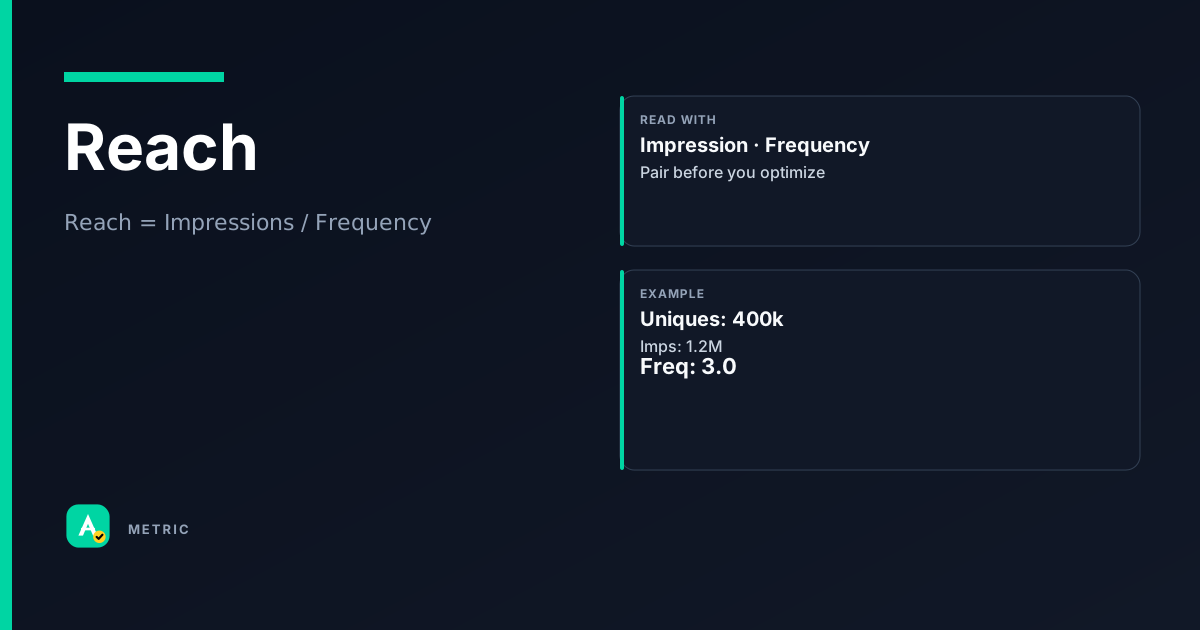
Reach is the estimated number of unique people who saw your ad at least once during a reporting period. It is the core metric for brand awareness campaigns because it answers "how many different people did we touch?" Reach is not the same as impressions — one person seeing your ad three times counts as 1 reach and 3 impressions. Platforms like Meta and Google Ads model reach using probabilistic cross-device graphs, so the number is always an estimate, not a census count.
What it is
Reach is the count of unique users exposed to an ad at least once in a defined time window. It strips out duplication so you can gauge the breadth of your campaign.
Reach is always paired with frequency (average times each person saw the ad) and impressions (total exposures). The relationship is simple: impressions = reach × frequency.
What reach is NOT
- Reach ≠ impressions. A campaign with 1M impressions could have 500K reach (frequency = 2) or 100K reach (frequency = 10).
- Reach ≠ unique cookies or device IDs. Modern platforms use probabilistic models to de-duplicate across browsers and devices, especially after privacy changes like ITP and ATT.
- Reach is not a guarantee of attention. A user counted in reach may have scrolled past the ad in 200ms.
So what? If your goal is awareness, optimize for reach. If your goal is conversion, chasing reach alone can waste budget on users who never intend to buy.
How it is calculated
Reach is not directly calculated from a simple formula — it is estimated by the ad platform using user-level data, cookies, device IDs, and probabilistic modeling. However, the relationship with impressions and frequency is definitional:
Reach = Impressions / Frequency
Caveats
- Platform estimation. Meta and Google Ads report reach based on their own identity graphs. Numbers can differ by 10–20% between platforms for the same campaign.
- Time window matters. Reach accumulates over time. A 7-day reach number is always larger than a 1-day reach number for the same campaign.
- Cross-device deduplication. If a user sees an ad on mobile and later on desktop, most platforms attempt to count them once. Privacy restrictions make this increasingly approximate.
- Incremental reach. When buying across publishers, true unique reach requires a third-party measurement partner (e.g., Nielsen, Comscore). Platform-reported reach is walled-garden reach.
So what? Never compare reach numbers across platforms without understanding their methodology. Always use the same platform's reach for campaign-to-campaign comparison.
How to read it in a dashboard
A single reach number tells you little. You need context:
- Reach vs. target audience size. If your target is 1M women 25–45 and reach is 800K, you have 80% penetration. If reach is 200K, you are under-delivering.
- Reach growth over time. A flat reach curve after the first few days means you are hitting the same users repeatedly — you need new creative or audience expansion.
- Reach + frequency together. High reach with frequency < 2 is typical for awareness. Low reach with frequency > 5 suggests you are burning budget on a small audience.
What to pair it with
- Impressions: total volume context.
- Frequency: tells you if reach is being bought efficiently.
- CPM: cost per 1,000 impressions — but watch out: a low CPM can hide poor reach if frequency is high.
Easy mistake: A media buyer sees reach = 500K and impressions = 2.5M and celebrates. But frequency = 5.0 means the same 500K people saw the ad five times. If the goal was awareness, they wasted budget on over-exposure. Always check frequency alongside reach.
What usually moves this metric
Audience expansion
- Broad targeting (e.g., no interest narrowing) increases reach but may lower relevance.
- Lookalike audiences can extend reach to users similar to your converters.
- Retargeting shrinks reach (by definition — you target only past visitors).
Creative variety
- Multiple ad formats (video, image, carousel) can appeal to different user segments and increase reach.
- Refreshing creative every 1–2 weeks prevents frequency from climbing without new reach.
Budget and bid strategy
- Higher budget generally increases reach, but with diminishing returns as the platform exhausts the addressable audience.
- Reach objective (e.g., Meta's "Reach" buying goal) optimizes delivery to unique users rather than actions.
- Frequency cap (e.g., 2 per day) directly limits how many times one user sees the ad, forcing the platform to find new users.
Tradeoffs
- Reach vs. relevance. Broad targeting maximizes reach but can lower CTR and conversion rate. A home-services advertiser once set no audience narrowing, got 2M reach, but zero conversions — the ad reached people in different states who couldn't use the service.
- Reach vs. frequency. Pushing reach often means accepting lower frequency. For brand awareness that's fine. For retargeting, you want higher frequency on a smaller reach.
- Reach vs. CPM. Buying cheap inventory (low CPM) can inflate impressions but not reach if the same cheap users see the ad repeatedly. A low CPM with flat reach is a red flag.
When you should NOT chase this metric: If your campaign goal is direct response (purchases, sign-ups), optimizing for reach alone will waste budget on users with no purchase intent. Use conversion-focused bidding instead.
Formula
Platforms estimate reach using identity graphs; the formula is definitional, not computational.
Scenarios
The awareness campaign that hit a wall
A CPG brand ran a video campaign with a $50K weekly budget. After day 3, reach was 1.2M. By day 7, reach was only 1.4M — almost no growth.
What happened: The platform exhausted the addressable audience within the narrow targeting (women 25–35, interest: organic food). The remaining budget was spent showing the ad 6+ times to the same users.
What they did: Expanded targeting to "food & drink" interest and added a second creative variant. Reach grew to 2.1M by day 10.
Takeaway: Flat reach after a few days means you are over-serving a small audience. Broaden targeting or refresh creative.
The low-CPM trap
A DTC brand bought programmatic display at a $2.50 CPM — well below their usual $8 CPM. Impressions hit 4M, but reach was only 300K. Frequency = 13.3.
What happened: The cheap inventory came from a single low-quality exchange with a small user pool. The DSP kept serving the same users because the bid price was low enough to win every auction.
What they did: Added a frequency cap of 3 per week and diversified supply sources. CPM rose to $5, but reach increased to 800K at frequency 2.5.
Takeaway: Low CPM can hide terrible reach. Always check reach and frequency together.
Cross-platform reach overcount
A retailer ran identical campaigns on Meta and Google Display. Meta reported reach = 500K, Google reported reach = 400K. The brand's third-party measurement (Nielsen) showed total unique reach = 620K.
What happened: The platform numbers double-counted users who saw the ad on both platforms. Each platform only knows its own users.
What they did: Used Nielsen for cross-platform deduplication. Adjusted media mix to favor the platform that contributed more incremental reach.
Takeaway: Platform-reported reach is walled-garden reach. For true unique reach across publishers, use a third-party measurement partner.
Common pitfalls
Reach equals unique users
Many beginners think reach is a precise count of real people. In reality, platforms use probabilistic models, especially after privacy changes. A user clearing cookies or switching devices may be counted as two people.
What to do instead: Treat reach as a directional trend metric, not an absolute truth. Compare reach changes within the same platform, not across platforms.
High reach always means success
A campaign with 10M reach but zero conversions is not a success — it means the ad reached the wrong people. Reach without relevance is waste.
What to do instead: Always pair reach with a downstream metric (CTR, conversions, brand lift). If reach is high but action is low, your targeting or creative is off.
You can optimize for reach and CPM simultaneously
A common Slack message: "Let's lower CPM by buying cheaper inventory and increase reach by broadening targeting." These levers often conflict. Cheap inventory often comes from small user pools, limiting reach.
What to do instead: Pick one primary goal. If reach is the goal, accept a higher CPM. If CPM is the goal, accept lower reach. Trying to optimize both usually delivers neither.
Summary
Reach is the bedrock metric for brand awareness, but it is easily misinterpreted without frequency and context.
- Always read reach alongside frequency — impressions / reach = frequency.
- Platform reach is estimated, not counted; use it for trend analysis, not absolute truth.
- For cross-publisher campaigns, invest in third-party measurement for true unique reach.
Quick check
Confirm you understood this article.
single
If a campaign has 1,000,000 impressions and an average frequency of 4.0, what is the reach?
Select an answer to continue
Related metrics
References
- Meta Ads Help — Reach and frequency estimation methodology (conceptual reference)
- Google Ads Help — Reach reporting (conceptual reference)
- Think with Google — Measurement resources: https://www.thinkwithgoogle.com/ (conceptual reference)
- IAB / MRC — Digital audience measurement guidelines (conceptual reference)
For learning only. Not advice on bids or spend.
You may also like
Metrics
Cost Per Mille (CPM)
CPM (Cost Per Mille) is the price an advertiser pays for 1,000 ad impressions.
CostMetrics
Frequency (Average Frequency)
Frequency measures how many times, on average, a unique user saw your ad during a campaign peri…
DeliveryMetrics
Impression
An impression is counted each time an ad is fetched and displayed to a user, per the platform’s…
DeliveryMetrics
Session RPM (Revenue Per Mille Sessions)
Session RPM (Revenue Per Mille Sessions) measures estimated earnings per thousand user sessions.
Revenue