Jul 17, 2026·7 min read
Frequency (Average Frequency)
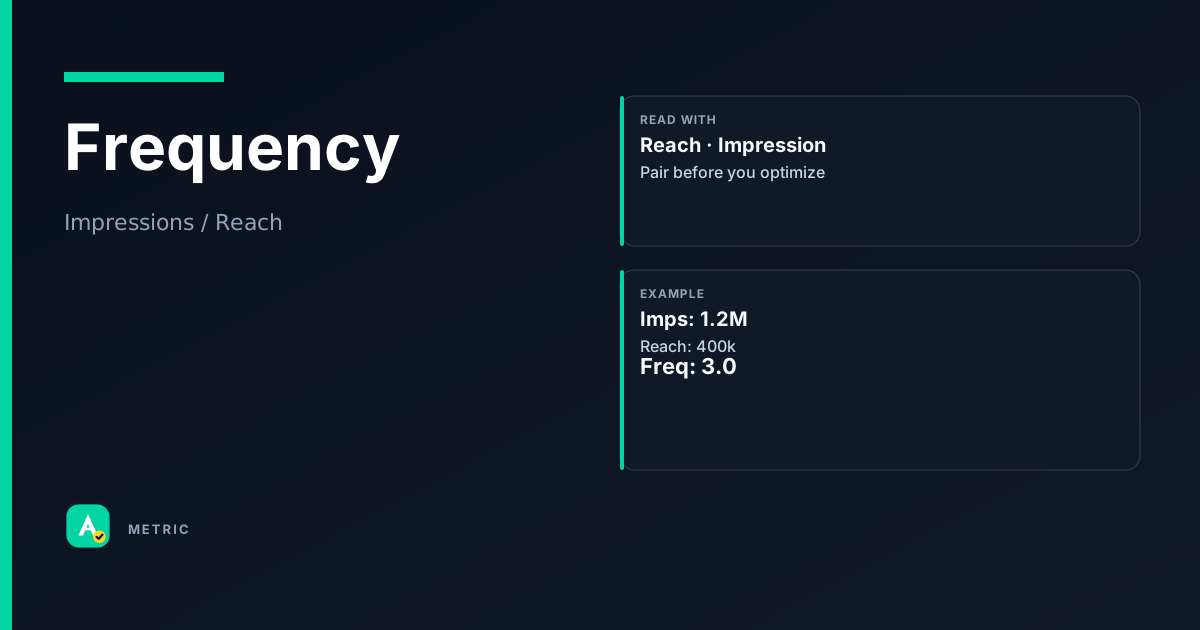
Frequency measures how many times, on average, a unique user saw your ad during a campaign period. It is calculated as impressions divided by reach. High frequency can boost brand recall but also drives fatigue and rising CPA/CPC. Frequency is the lever you pull to balance reach and impression volume.
What it is
Frequency tells you the average repetition of your ad exposure per unique user. If your campaign delivered 100,000 impressions to 25,000 unique users, average frequency is 4.
Frequency is not inherently good or bad — it depends on your objective. A brand-awareness campaign may want 3–5 exposures over a week; a direct-response campaign might want 1–2 before the user acts.
Common confusion
- Frequency is an average — half your audience may see the ad once, another segment sees it 7 times.
- It is not the same as “impressions per person” in a frequency distribution report; that breaks out the buckets (e.g., 1x, 2x, 3x+).
So what: Without frequency, you cannot judge whether your reach is shallow (many people, few times) or deep (fewer people, many times).
How it is calculated
Average Frequency = Impressions / Reach
Example: 500,000 impressions / 125,000 reach = 4.0 average frequency.
Caveats
- Deduplication window — Platforms define “unique” differently. Google Ads uses a cookie/device ID; Meta uses account-level dedup. Cross-device frequency is harder to measure.
- Time period matters — Frequency over a day vs. a month will differ. Always check the reporting window.
- Viewable vs. served — Some platforms count served impressions; others count viewable impressions. Check the metric definition in your dashboard.
- Average hides distribution — A frequency of 5 could mean everyone saw it 5 times, or 10% saw it 20 times and 90% saw it 1–2 times.
How to read it in a dashboard
A frequency of 1.0 means every impression went to a different user — maximum reach. A frequency of 10.0 means the average user saw the ad 10 times.
What to pair it with
- Reach — Is frequency high because reach is low? Or because you have high impression volume?
- Click-through rate (CTR) — If frequency rises and CTR drops, you are likely seeing ad fatigue.
- Cost per action (CPA) — Rising CPA alongside rising frequency often signals overexposure.
Easy mistake
Looking only at frequency without reach. A frequency of 3.0 on 1,000 reach is very different from 3.0 on 1,000,000 reach. Always read the pair.
What usually moves this metric
Levers that increase frequency
- Narrow targeting — Smaller audience pool gets more impressions per person.
- High impression volume — More impressions without expanding reach.
- No frequency cap — Letting the auction serve the same users repeatedly.
Levers that decrease frequency
- Frequency capping — Set a cap (e.g., 3 impressions per user per day) in Google Ads, Meta, or your DSP.
- Broaden targeting — Expand age, geography, or interest segments.
- Use reach-optimized buying — Some platforms offer “reach” or “brand awareness” objectives that prioritize unique users.
Tradeoffs
- Low frequency + high reach = good for awareness, but may not drive action.
- High frequency + low reach = cheap per impression, but rising CPA and fatigue.
- Optimal frequency is campaign-specific. A home-services advertiser might need 1–2 exposures; a CPG brand may want 5+. Do not chase a universal “best” number.
Formula
Platforms may use different deduplication windows and counting methods (served vs. viewable). Always check the vendor's definition.
Scenarios
The retargeting spiral
A travel brand retargets site visitors with a 10% discount ad. After week one, frequency hits 8.0 and CPA doubles.
- Cause: No frequency cap; the same 5,000 users saw the ad 40,000 times.
- Fix: Set a 3-impression daily cap and exclude converters.
- Takeaway: Retargeting without a cap burns budget and annoys users.
Brand awareness with low frequency
A new beverage brand runs a video campaign with broad targeting. Frequency is 1.2, reach is 2M, but brand lift is flat.
- Cause: Users saw the ad once and forgot it.
- Fix: Increase frequency to 3–4 over two weeks by narrowing targeting slightly or using a frequency goal.
- Takeaway: For brand recall, one exposure is rarely enough.
The distribution trap
A SaaS company sees average frequency of 3.0 and assumes it is fine. But a frequency distribution report shows 20% of users saw the ad 15+ times.
- Cause: Average hides the long tail of overexposed users.
- Fix: Apply a campaign-level frequency cap of 5 and review distribution reports weekly.
- Takeaway: Always check the distribution, not just the average.
Common pitfalls
Chasing a universal 'optimal frequency'
There is no single best frequency for all campaigns. The right number depends on objective, creative, channel, and audience.
- Do this instead: Run A/B tests with different caps (e.g., 2 vs. 5 vs. unlimited) and measure CPA, CTR, and brand lift.
Ignoring frequency when scaling impressions
A common Slack mistake: “Let’s double the budget to get more impressions.” Without expanding reach, you just double frequency.
- Do this instead: Before scaling, check if reach is plateauing. If yes, broaden targeting or increase creative rotation.
Confusing average frequency with frequency distribution
Average frequency of 4.0 does not mean everyone saw the ad 4 times. Some saw it once, some 10 times.
- Do this instead: Pull a frequency distribution report (buckets: 1x, 2x, 3x, 4x, 5x+) to see the real spread.
Summary
Frequency is the bridge between impressions and reach — it tells you how often your audience is exposed, not just how many times your ad was served.
- Always read frequency alongside reach and a performance metric (CTR or CPA).
- Use frequency caps to prevent fatigue, but test to find your campaign’s sweet spot.
- Remember that average frequency hides distribution — check the buckets.
Quick check
Confirm you understood this article.
single
If a campaign has 200,000 impressions and 50,000 reach, what is the average frequency?
Select an answer to continue
Related metrics
References
- Google Ads Help — Frequency capping and reach reporting (conceptual reference)
- Meta Ads Manager — Frequency and reach documentation (conceptual reference)
- Think with Google — Measurement resources on frequency and brand lift (conceptual reference)
- IAB / MRC — Digital ad impression measurement guidelines (conceptual reference)
For learning only. Not advice on bids or spend.
You may also like
Metrics
Click-through rate (CTR)
Click-through rate (CTR) measures how often people click your ad after seeing it.
EngagementMetrics
Impression
An impression is counted each time an ad is fetched and displayed to a user, per the platform’s…
DeliveryMetrics
Reach (Unique Reach)
Reach is the estimated number of unique people who saw your ad at least once during a reporting…
DeliveryMetrics
Effective Cost Per Mille (eCPM)
eCPM (effective cost per mille) is the revenue a publisher earns per thousand ad impressions, r…
Revenue