Jul 17, 2026·7 min read
Lifetime Value (LTV)
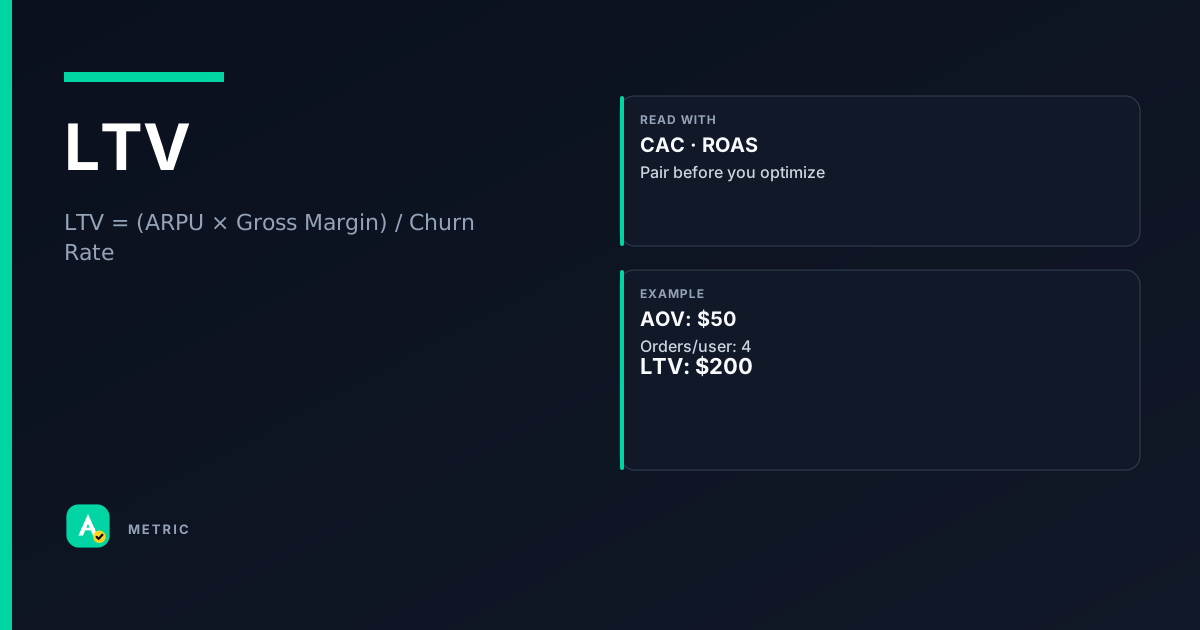
Lifetime Value (LTV) estimates the total net revenue a single customer (or cohort) will generate over the entire relationship with your business, often discounted to present value. It shifts focus from one-off transaction profit to long-term customer worth. LTV is the numerator in the LTV:CAC ratio, a core health metric for subscription and recurring-revenue models.
What LTV is and why it matters
LTV answers a simple question: How much profit will this customer produce from first click to churn? It is a forward-looking projection, not a historical sum. Most models use average revenue per user (ARPU), gross margin, and estimated retention period.
Why it matters for ad buying
If you only optimize for first-purchase ROAS, you may underbid on high-LTV segments that take longer to convert. A home-services advertiser once cut bids on users who requested quotes but didn't book immediately — those same users had a 3× higher LTV when they eventually converted. The easy mistake: treating LTV as a static number instead of a cohort-based forecast that changes as retention patterns shift.
So what: LTV lets you set cost-per-acquisition (CPA) targets that are sustainable. Without it, you are flying blind on customer quality.
How LTV is calculated
The simplest formula for a subscription or repeat-purchase model:
LTV = (ARPU × Gross Margin) / Churn Rate
Where:
- ARPU = Average Revenue Per User per period (e.g., monthly)
- Gross Margin = (Revenue – Cost of Goods Sold) / Revenue
- Churn Rate = % of customers who stop in a given period
Important caveats
- Discount rate matters. A dollar earned three years from now is worth less today. Many models apply a weighted average cost of capital (WACC) or a flat discount rate (e.g., 10% annually).
- Cohort-based is better. Aggregate LTV hides differences between acquisition channels. Always segment by source, campaign, or creative.
- Retention curves are rarely flat. Churn often decreases over time for mature cohorts. Using a single churn rate overestimates LTV for new users and underestimates it for loyal ones.
- Net vs. gross LTV. Gross LTV uses revenue; net LTV subtracts ongoing service costs. For ad decisions, net LTV is the relevant ceiling for CPA.
How to read LTV in a dashboard
A single LTV number is meaningless without context. Always compare it to CAC (customer acquisition cost). The classic teaching heuristic: LTV:CAC ≥ 3. This is not a universal law — some high-margin SaaS businesses thrive at 5×, while thin-margin retailers survive at 2×. The more important number for cash-constrained teams is payback period: how many months until cumulative gross profit covers CAC.
What to pair with LTV
- CAC — the ratio tells you if you are spending too much to acquire a customer.
- ROAS — short-term return vs. long-term value; a low ROAS with high LTV can be healthy.
- ARPU — the building block of LTV; watch for ARPU dilution from free-tier users.
Dashboard trap: A rising LTV can mask rising churn if the remaining customers spend more. Always check retention curves alongside LTV.
What usually moves LTV
LTV is not a direct bidder lever — it is an outcome of product, pricing, and retention strategy. But ad teams influence it through the quality of users they acquire.
Levers that raise LTV
- Target high-intent audiences. Users who search for comparison terms or visit pricing pages tend to retain longer.
- Improve onboarding. A user who completes a 'welcome flow' within 7 days has higher LTV in most subscription models.
- Reduce churn via re-engagement. Retargeting lapsed users with win-back offers can extend lifetime.
- Increase average order value (AOV). Upsells and cross-sells lift ARPU without raising CAC.
Levers that lower LTV (watch out)
- Aggressive discount acquisition. Free trials or deep discounts attract price-sensitive users who churn fast.
- Broad, low-intent targeting. Impressions-driven campaigns may bring volume but low retention.
Tradeoffs
Raising LTV by targeting only premium segments often shrinks addressable audience, raising CAC. The sweet spot is LTV:CAC ≥ 3 with a payback period under 12 months (or whatever your cash runway supports). If payback takes too long, even a great ratio can sink a startup.
Formula
Platforms like Google Ads do not calculate LTV natively; you must import it via offline conversion import or CRM data.
Scenarios
The free-trial trap
Setup: A meal-kit subscription service ran a $1 first-box offer. CAC was $40, LTV was $120 — ratio looked fine (3×).
- What happened: Most users churned after the discount box. Payback took 8 months; the company ran out of cash before recovering acquisition spend.
- What they did: Switched to a 30% discount (not 90%) and required a 2-week commitment. LTV rose to $180; payback dropped to 4 months. Takeaway: LTV:CAC ratio can mislead if payback period is ignored.
Segment blindness
Setup: A B2B SaaS company reported $5,000 blended LTV.
- What happened: Paid search had $8,000 LTV, but organic had $3,000 LTV. The team was underbidding on search because blended LTV looked average.
- What they did: Segmented LTV by channel and doubled search budget. Overall CAC stayed flat, but revenue grew 40%. Takeaway: Aggregate LTV hides your best acquisition channels.
The retention curve shift
Setup: A mobile game used a 12-month LTV model with a flat 8% monthly churn.
- What happened: After a feature update, churn for month 1–3 dropped to 5%, but month 4+ churn rose to 12%. The flat model missed this and overestimated LTV by 30%.
- What they did: Switched to a cohort-based retention curve. Re-forecast LTV and adjusted bid targets downward for users who showed early signs of late-stage churn. Takeaway: Use cohort-specific retention curves, not a single churn rate.
Common pitfalls
Treating LTV as a fixed number
LTV changes as retention, pricing, and margin evolve. A model built last year may be dangerously outdated.
- Refresh LTV calculations quarterly, or whenever you change pricing or onboarding.
- Use trailing 12-month cohorts, not lifetime-to-date averages.
Ignoring discount rate
A $1,000 LTV earned over 5 years is worth far less today. Without discounting, you overpay for acquisition.
- Apply a discount rate (e.g., 10–15% annually) to future cash flows.
- If you don't know your cost of capital, use a conservative 10% as a starting point.
Confusing LTV with total revenue
LTV should be net of variable costs (hosting, support, fulfillment). Gross LTV can make a low-margin business look healthy.
- Always use gross-margin-adjusted LTV for bid decisions.
- If you can't calculate margin per user, use a blended margin rate as a proxy.
Summary
LTV is the single most important metric for sustainable ad spend, but only when paired with CAC and payback period.
- Segment LTV by acquisition channel and cohort — never rely on a blended number.
- Use a discount rate and gross margin to avoid overvaluing future revenue.
- Refresh your model regularly; retention curves shift faster than most teams expect.
Quick check
Confirm you understood this article.
single
Which of the following is the most common teaching heuristic for a healthy LTV:CAC ratio?
Select an answer to continue
References
- Think with Google — measurement resources (conceptual reference on customer lifetime value frameworks)
- SaaS/app growth literature on LTV:CAC heuristics (teaching heuristic, not universal law)
- IAB measurement guidelines — conceptual reference on audience valuation and retention modeling
For learning only. Not advice on bids or spend.
You may also like
Metrics
Average Revenue Per User (ARPU)
ARPU (Average Revenue Per User) measures the revenue generated per user or subscriber over a sp…
ValueMetrics
Customer Acquisition Cost (CAC)
Customer Acquisition Cost (CAC) is the total cost of convincing a prospect to become a paying c…
ValueMetrics
Return on Ad Spend (ROAS)
Return on Ad Spend (ROAS) measures the revenue generated for every dollar spent on advertising.
PerformanceMetrics
Cost per click (CPC)
Cost per click (CPC) measures the average price an advertiser pays each time someone clicks the…
Cost