Jul 17, 2026·8 min read
Cost per click (CPC)
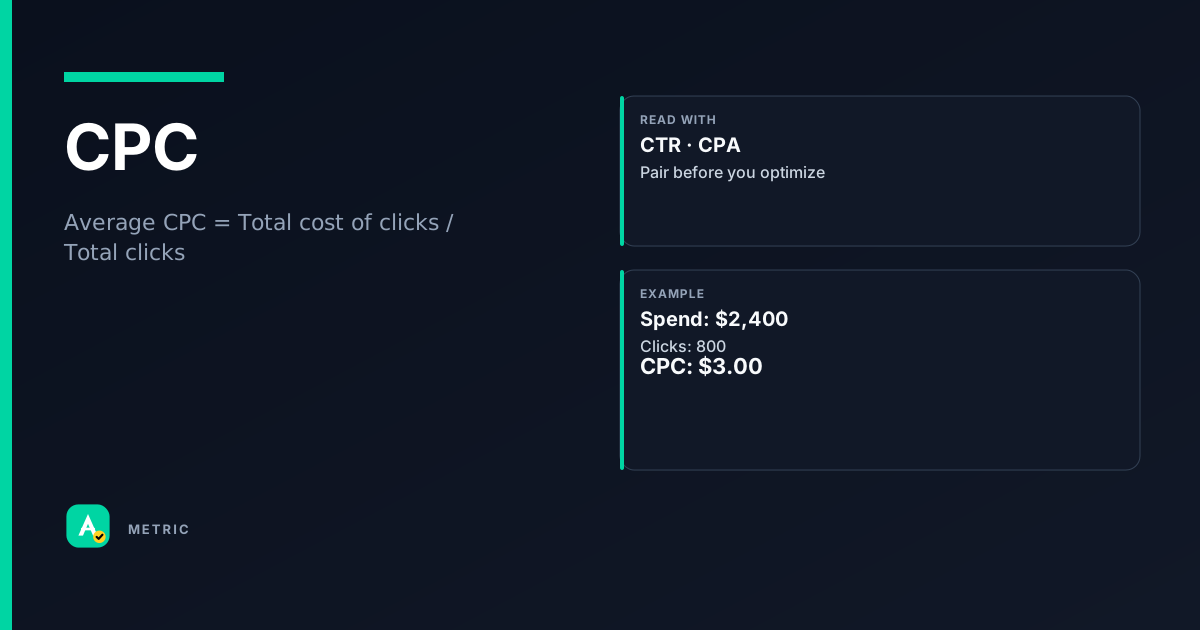
Cost per click (CPC) measures the average price an advertiser pays each time someone clicks their ad. It is a unit-economics metric, not a success metric. A low CPC is worthless if clicks don't convert; a high CPC can be profitable if conversion rates and order values justify it. Always pair CPC with CTR, CPA, and CPM to understand full auction dynamics.
What it is
Cost per click (CPC) is the amount an advertiser pays for a single click on a search, display, social, or video ad. In auction-based systems like Google Ads, the advertiser sets a max CPC bid — the most they are willing to pay. The actual amount charged (the actual CPC) is often lower, determined by the second-price auction mechanics of Ad Rank.
CPC is a cost metric, not a success metric. A cheap click that bounces is worse than an expensive click that buys. The number only becomes useful when paired with conversion rate and order value.
Common use cases
- Search campaigns: bidding on keywords with purchase intent.
- Shopping ads: paying per click to product pages.
- Retargeting: paying for clicks from users who already visited the site.
So what: CPC tells you the price of entry. It does not tell you if the entry was worth it.
How it is calculated
Average CPC = Total cost of clicks / Total clicks
This is the formula reported in Google Ads and most platforms. It is an average, so a campaign with 100 clicks at $1.00 and 1 click at $10.00 will show an average CPC of ~$1.09 — not $1.00.
Important caveats
- Actual CPC vs. max CPC bid — The platform charges less than your max bid when the auction allows. Your average CPC is almost always below your average max bid.
- Click quality adjustments — Some platforms apply quality-score modifiers that increase or decrease the actual CPC for the same bid.
- View-through clicks — In display, a click after a viewable impression may be counted differently. Check the platform's attribution window.
- Invalid clicks — Google Ads and other major platforms filter invalid clicks before reporting. The CPC you see excludes these, but your budget may still have been affected before the refund.
So what: The formula is straightforward, but the inputs (cost, clicks) depend on platform filters, attribution windows, and quality adjustments. Always read the vendor's definition before comparing CPC across platforms.
How to read it in a dashboard
When you see a CPC number in a dashboard, ask: Is this the average across the whole campaign, or a segment? A campaign-level CPC of $2.50 might hide a search term that costs $8.00 per click with zero conversions.
What to pair it with
- Conversion rate (CVR) — A high CPC is acceptable if CVR is high.
- CPA — If CPC is $3.00 but CPA is $30.00, the conversion rate is 10%. That may be fine or terrible depending on average order value.
- CTR — A very low CTR with a high CPC suggests the ad is irrelevant to the audience, wasting money.
Easy mistake
A common Slack message: "CPC dropped 30% — great optimization!" But the drop came from broad-match keywords that attracted cheap, irrelevant clicks. Conversions stayed flat. The cheaper CPC actually wasted budget.
So what: Never read CPC in isolation. Always view it alongside conversion metrics and segment by keyword, audience, or placement.
What usually moves this metric
Bid management
- Lower max CPC bid — Directly reduces average CPC, but may reduce impression share and click volume.
- Raise max CPC bid — Can increase CPC but also improve ad rank, potentially lowering actual CPC if quality score improves.
Quality Score (Google Ads)
- Higher Quality Score → lower actual CPC for the same bid. Improve ad relevance, landing page experience, and expected CTR.
- Lower Quality Score → higher actual CPC. The platform charges more because the ad is less likely to satisfy the user.
Targeting & audience
- Narrow targeting (exact match keywords, specific audiences) → higher CPC but often higher conversion rates.
- Broad targeting → lower CPC but more wasted clicks.
Auction dynamics
- More competitors → higher CPC. Seasonal peaks (holidays, election cycles) drive up costs.
- Ad rank thresholds — If you drop below a minimum threshold, your ad may not show at all, even at a low CPC.
Tradeoffs
- CPC vs. volume — Lowering bids reduces CPC but also reduces clicks. Total cost may drop, but so may total conversions.
- CPC vs. CPA — A lower CPC does not guarantee a lower CPA if conversion rate also drops. Optimize for CPA, not CPC.
- CPC vs. impression share — A very low CPC may leave budget unspent. Check impression share to see if you are leaving money on the table.
So what: The fastest lever is bid adjustment, but the most sustainable lever is Quality Score. Never optimize CPC alone — optimize for the full funnel.
Formula
Google Ads reports average CPC, not the max CPC bid. Actual CPC is often lower due to second-price auction mechanics.
Scenarios
The cheap-click trap
A home-services advertiser saw CPC drop from $4.00 to $2.50 after switching to broad match. The team celebrated.
- What happened: Broad match brought cheap clicks from users searching for DIY tips, not service bookings. Conversion rate fell from 5% to 1%.
- What they did: Reverted to phrase match, added negative keywords, and raised bids on high-intent terms. CPC went back to $4.00, but CPA dropped 40%.
- Takeaway: A lower CPC is not a win if it dilutes conversion quality.
Quality Score rescue
A SaaS company had a max CPC bid of $5.00 but was paying $4.80 actual CPC with low impression share.
- What happened: Quality Score was 4/10 due to poor landing page relevance.
- What they did: Rewrote ad copy to match the keyword, redesigned the landing page to load faster and include the offer from the ad. Quality Score rose to 8/10.
- Result: Actual CPC dropped to $2.90 even though the max bid stayed at $5.00. Impression share doubled.
- Takeaway: Improving Quality Score is the only lever that lowers CPC and improves performance simultaneously.
Seasonal CPC spike
A retailer saw CPC on "winter coats" jump from $1.50 to $4.00 in November.
- What happened: Competitors increased bids for holiday traffic. The retailer's max bid was fixed at $2.00, so impression share collapsed.
- What they did: Raised max bid to $4.50, but also added negative keywords for "cheap" and "used" to filter low-intent traffic. CPC averaged $3.80, but conversion rate was high enough to keep CPA within target.
- Takeaway: During competitive periods, accept higher CPC if the conversion economics still work. Do not cap bids blindly.
Common pitfalls
Optimizing CPC in isolation
Treating a low CPC as the goal leads to wasted budget on irrelevant clicks.
- What to do instead: Set CPA or ROAS targets. Let the platform's automated bidding optimize for those. Monitor CPC only as a diagnostic, not a KPI.
Comparing CPC across channels
Search CPC, display CPC, and social CPC are not directly comparable. A $5.00 search click may convert at 10%, while a $0.50 display click may convert at 0.5%.
- What to do instead: Compare CPA and ROAS across channels, not CPC.
Ignoring the difference between max CPC and actual CPC
Setting a max CPC bid of $10.00 does not mean you will pay $10.00 per click. But if you see average CPC close to your max bid, you are likely in a highly competitive auction with low Quality Score.
- What to do instead: Check the bid simulation report (Google Ads) to see how changes in max bid affect CPC, clicks, and conversions.
Summary
Cost per click is a unit-economics metric, not a success metric. It tells you the price of entry, not the value of the visitor.
- Always pair CPC with conversion rate and CPA.
- Lower CPC is not always better — cheap clicks that do not convert are wasted budget.
- The most sustainable way to lower CPC is to improve Quality Score, not to cut bids.
Quick check
Confirm you understood this article.
boolean
A lower average CPC always means better campaign performance.
Select an answer to continue
References
- Google Ads Help — Average cost per click (Avg. CPC): https://support.google.com/google-ads/answer/14074
- Google Ads Help — About cost-per-click bidding: https://support.google.com/google-ads/answer/116495
- IAB / MRC measurement guidelines — conceptual reference for click measurement and invalid traffic filtering
For learning only. Not advice on bids or spend.
You may also like
Metrics
Cost Per Acquisition (CPA)
Cost Per Acquisition (CPA) measures the total advertising cost divided by the number of convers…
CostMetrics
Cost Per Mille (CPM)
CPM (Cost Per Mille) is the price an advertiser pays for 1,000 ad impressions.
CostMetrics
Click-through rate (CTR)
Click-through rate (CTR) measures how often people click your ad after seeing it.
EngagementMetrics
Attribution (Conversion Attribution)
Attribution is the set of rules that determines which touchpoints in a customer’s journey get c…
Measurement