Jul 17, 2026·7 min read
Average Revenue Per User (ARPU)
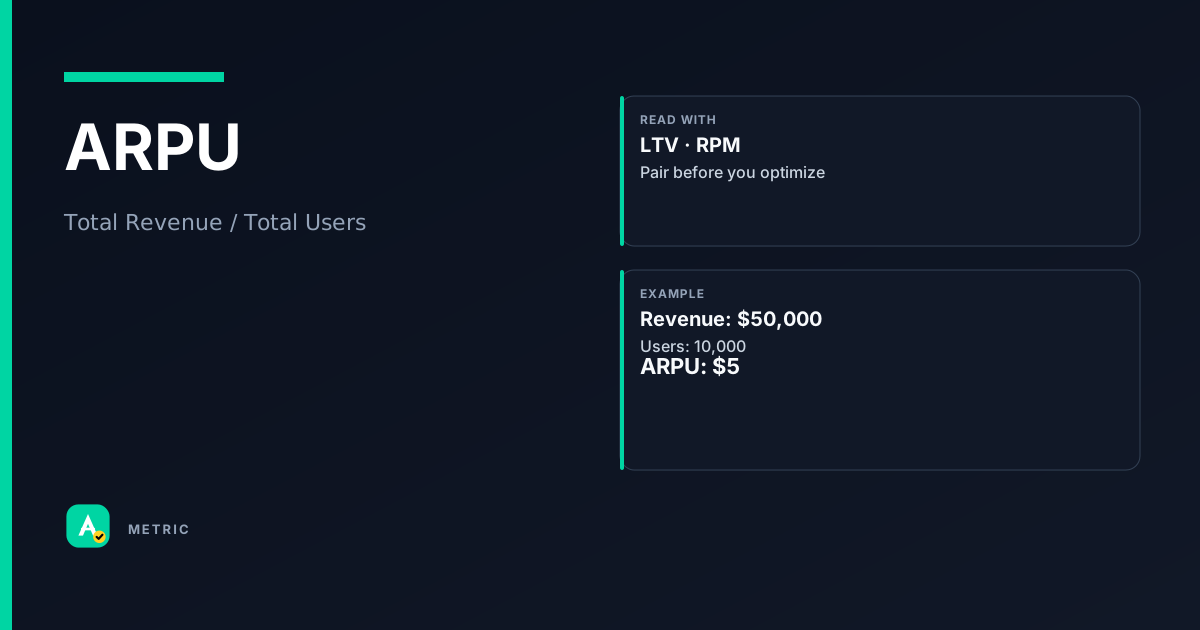
ARPU (Average Revenue Per User) measures the revenue generated per user or subscriber over a specific period. It is a top-line efficiency metric used by both publishers and platforms to understand monetization depth. Unlike RPM, which is page- or session-based, ARPU is user-based — a critical distinction for subscription and hybrid monetization models.
What it is
ARPU answers a simple question: For every active user, how much revenue did we collect? It is calculated by dividing total recognized revenue by the number of users (or subscribers) in the same period.
Where it lives
- Subscription businesses (SaaS, streaming): ARPU is a core KPI alongside LTV and churn.
- Publisher ad models: ARPU is often compared to RPM, but they are not interchangeable. RPM is inventory-centric (revenue per thousand page views); ARPU is audience-centric (revenue per unique user).
- Hybrid models (freemium, ad-supported + subscription): ARPU helps track whether the blend of ad revenue and subscription revenue is improving per user.
So what: ARPU tells you if your monetization strategy is gaining or losing ground per user. A rising ARPU with flat user count means you are extracting more value. A falling ARPU may signal ad load fatigue, subscription downgrades, or user mix shift toward low-monetization segments.
How it is calculated
ARPU = Total Revenue / Total Users (or Subscribers)
Revenue is recognized revenue for the period (subscription fees, ad revenue, in-app purchases). Users are active, paying, or subscribed — depending on the business model.
Important caveats
- User definition varies. A streaming service counts monthly active subscribers; an ad-supported news site counts monthly unique visitors. Always check the denominator before comparing ARPU across companies.
- Time period must match. Monthly ARPU uses monthly revenue and monthly active users. Annual ARPU uses annual figures. Mixing periods inflates or deflates the number.
- Blended vs. segment ARPU. A single ARPU hides differences between high-value and low-value user cohorts. Segment by acquisition channel, plan tier, or geography for actionable insight.
- Non-revenue users. If you include free-tier users in the denominator, ARPU drops — but that may be intentional for freemium analysis.
How to read it in a dashboard
A single ARPU number is nearly useless without context. Read it as a trend (week-over-week, month-over-month) and as a comparison against segments.
What to pair it with
- User count — ARPU can rise because revenue grew, or because user count dropped (the denominator shrank). Always check both.
- Churn rate — For subscription models, rising ARPU + rising churn often means you are pushing prices too hard and losing price-sensitive users.
- RPM — For publishers, compare ARPU and RPM to see if page-level efficiency is translating into user-level value. If RPM rises but ARPU is flat, you may be serving more pages to the same users without growing the audience.
Easy mistake: A team sees ARPU jump 20% and celebrates. They forgot to check that user count dropped 15% — the revenue per remaining user went up, but total revenue barely moved. Always read ARPU with its denominator.
What usually moves this metric
Revenue-side levers
- Pricing changes — Raising subscription price or ad rates directly lifts revenue per user, assuming demand holds.
- Upsells & cross-sells — Moving users from free to paid, or from basic to premium tier, increases ARPU.
- Ad load optimization — For ad-supported models, increasing ad frequency or introducing new ad formats (video, native) can lift ARPU — but watch for user fatigue.
User-mix levers
- Acquisition quality — Targeting higher-intent users (e.g., via paid search vs. display) can raise cohort ARPU.
- Reactivating lapsed users — Bringing back churned users at zero marginal acquisition cost boosts the denominator without proportional revenue gain, lowering ARPU in the short term. That is not necessarily bad.
Tradeoffs
ARPU vs. user growth. Aggressively raising prices to boost ARPU can accelerate churn and shrink the user base. Conversely, adding many low-monetization users (e.g., via a free tier) will depress blended ARPU even if total revenue grows. The right balance depends on whether your strategy prioritizes total revenue scale or per-user efficiency.
When you should NOT chase this metric: If your business is in a land-grab phase (e.g., a new market entry), optimizing for ARPU can lead you to ignore user acquisition. In that context, total revenue and user growth matter more than ARPU.
Formula
Platform-specific: Google Ad Manager reports 'ARPU' as part of audience analytics; the denominator is typically monthly active users. Check your platform's user definition before comparing.
Scenarios
The price hike that backfired
A SaaS company raised its monthly subscription from $10 to $12 to boost ARPU.
- What happened: ARPU rose from $10.50 to $11.80 in the first month. But churn doubled, and the user base shrank 25%.
- Net effect: Total revenue dropped despite higher ARPU.
- Takeaway: ARPU without churn and user count is a partial story. Test price changes on a cohort before rolling out globally.
Publisher ARPU vs. RPM confusion
A news publisher compared ARPU across two quarters and saw a 10% decline. The team panicked.
- What they found: RPM had actually increased 8% — they were monetizing page views better. But a new push notification campaign brought in many casual readers who visited once and left, diluting the user denominator.
- Fix: Segment ARPU by engagement tier (light vs. heavy users) and track RPM for page-level efficiency.
- Takeaway: ARPU and RPM measure different things. A declining ARPU with rising RPM can mean you are successfully growing a low-engagement audience — which may be fine if your goal is scale.
Freemium model: the free-tier drag
A mobile game company reported ARPU of $0.80. Investors were unimpressed.
- What they did: Segmented ARPU by paying users only (ARPPU = $4.50) and free users ($0.00). The blended ARPU was low because 82% of users were free.
- Action: Instead of trying to raise blended ARPU by monetizing free users aggressively (which risked churn), they focused on converting free users to paid via targeted offers.
- Takeaway: Blended ARPU hides the real story. Track ARPPU (Average Revenue Per Paying User) alongside ARPU for freemium products.
Common pitfalls
Treating ARPU as a single number
A single blended ARPU hides massive variation across user segments. A $5 ARPU could mean every user pays $5, or 10% pay $50 and 90% pay $0. What to do instead:
- Segment by acquisition channel, plan tier, geography, or engagement level.
- Report ARPU per cohort, not just a company-wide average.
Confusing ARPU with RPM
A publisher swapped ARPU and RPM in a board deck, claiming 'revenue per user' was $12 when it was actually $12 RPM (per thousand page views). The board approved a budget based on the wrong number. What to do instead:
- Remember: ARPU = revenue per unique user. RPM = revenue per thousand page views.
- Label dashboards clearly and include the denominator in the metric name (e.g., 'ARPU (per MAU)').
Ignoring the denominator shift
A subscription service saw ARPU rise 15% quarter-over-quarter and assumed pricing power. In reality, they had lost 20% of low-tier subscribers, leaving only high-tier users. What to do instead:
- Always graph ARPU alongside total user count and total revenue.
- If ARPU rises while users fall, investigate churn before celebrating.
Summary
ARPU is a powerful efficiency metric, but only when read in context.
- Always pair ARPU with user count and churn to avoid misreading denominator shifts.
- Segment ARPU by cohort — blended averages hide the real dynamics.
- Distinguish ARPU from RPM: one is user-level, the other is page/session-level.
Quick check
Confirm you understood this article.
single
ARPU is calculated as:
Select an answer to continue
References
- IAB measurement guidelines — conceptual reference for user-level vs. page-level metrics
- Subscription/SaaS finance definitions of ARPU — conceptual reference for period-based calculation
- Publisher analytics practice contrasting ARPU vs RPM — conceptual reference for hybrid monetization models
For learning only. Not advice on bids or spend.
You may also like
Metrics
Effective Cost Per Mille (eCPM)
eCPM (effective cost per mille) is the revenue a publisher earns per thousand ad impressions, r…
RevenueMetrics
Lifetime Value (LTV)
Lifetime Value (LTV) estimates the total net revenue a single customer (or cohort) will generat…
ValueMetrics
Revenue per Mille (RPM)
RPM (Revenue per Mille) measures how much a publisher earns per thousand page views or sessions.
RevenueMetrics
Bid Response (Bid Resp)
Bid Response is the message a bidder sends back to an exchange after receiving a Bid Request.
Auction