Jul 17, 2026·8 min read
Cost Per Lead (CPL)
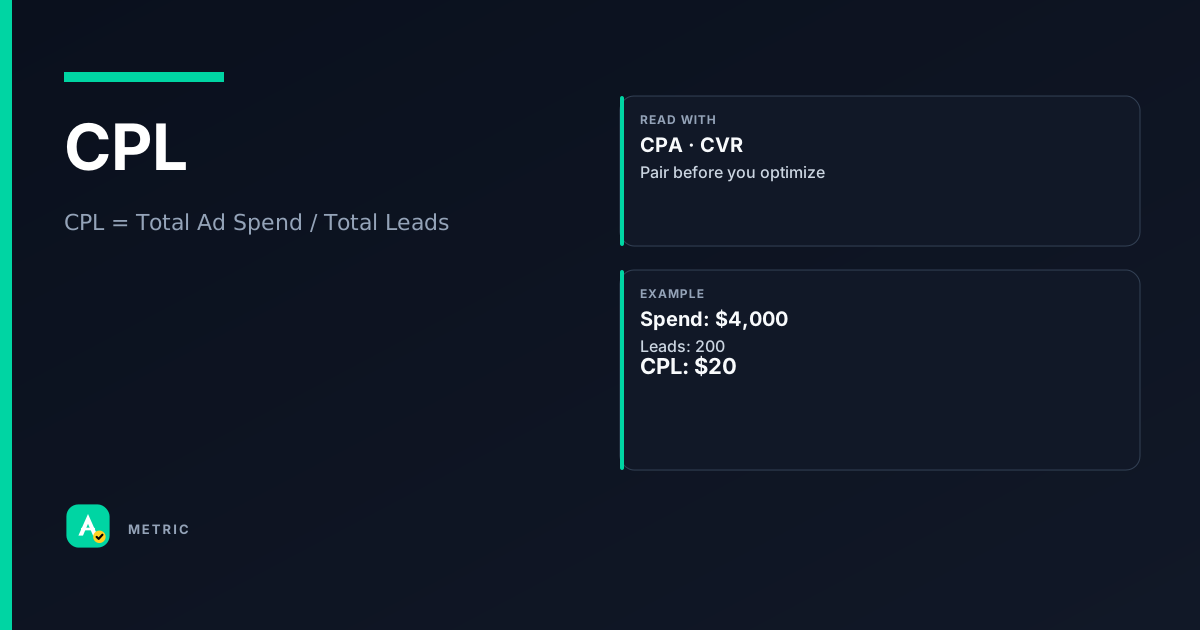
Cost Per Lead (CPL) measures how much you spend to acquire one lead — a person who has taken a specific action that your business defines as a lead. CPL is the unit-economics gate for any lead-generation campaign. It tells you whether your ad spend is generating enough raw volume, but it says nothing about whether those leads will convert into paying customers. That is why CPL must always be paired with lead-quality metrics like opportunity rate or qualified-lead rate.
What CPL is — and what it is not
Cost Per Lead (CPL) is the total ad spend divided by the number of leads attributed to those ads. A lead is not a click and not a sale — it is an action that signals purchase intent, such as filling out a contact form, calling a phone number, downloading a gated asset, or signing up for a trial.
CPL is a volume-efficiency metric. It answers: How cheaply can I get someone to raise their hand? It does not answer: How many of those hands become customers? That is where Cost Per Acquisition (CPA) comes in.
What CPL is NOT
- Not a conversion metric — a lead is a micro-conversion, not a revenue event.
- Not a quality metric — a $5 lead that never replies is worse than a $50 lead that closes.
- Not a bid-only problem — form UX, offer strength, and audience targeting often move CPL more than bid adjustments alone.
How CPL is calculated
CPL = Total Ad Spend / Total Leads
Example: If you spend $5,000 on a campaign and receive 100 leads, your CPL is $50.
Critical caveats
- Lead definition must match CRM reality. If your CRM counts only form completions but your ad platform counts phone calls and chat starts as leads, your CPL will differ between systems. Align conversion tracking with your actual lead pipeline.
- Attribution window matters. A 7-day click window will produce a different CPL than a 30-day click window. Be consistent when comparing campaigns.
- Leads are not conversions. Google Ads Help distinguishes between conversions (valuable actions you track) and leads (a subset of conversions). If you track a lead as a conversion in Google Ads, your reported CPL is really a CPA for that micro-action — not a true CPL against your CRM. Check your conversion action definition.
How to read CPL in a dashboard
A single CPL number is meaningless without context. You need to read it against:
- Campaign objective — a brand-awareness lead-gen campaign will have a higher CPL than a retargeting campaign. That is normal.
- Lead quality — pair CPL with qualified-lead rate (percentage of leads that sales accepts) or opportunity rate (percentage that become sales opportunities).
- Channel mix — LinkedIn CPL is typically higher than Facebook CPL because audience targeting is narrower. Compare within channel, not across.
What to look for
- Rising CPL + flat lead volume → audience fatigue or increased competition. Revisit creative and audience targeting.
- Falling CPL + falling lead quality → you are attracting tire-kickers. Tighten form fields or offer criteria.
- Stable CPL + rising opportunity rate → the sweet spot. Your lead quality is improving without sacrificing volume.
What usually moves CPL
Audience targeting
- Narrow audiences (job titles, in-market segments) tend to increase CPL because competition is higher, but lead quality is better.
- Broad audiences lower CPL but often bring unqualified leads. Test lookalike audiences based on converted leads, not just any lead.
Offer & creative
- Form length — every extra field reduces form completions by 5-10% (rough rule of thumb). Fewer fields = lower CPL, but may reduce lead quality.
- Offer strength — a free consultation converts better than a generic newsletter. Stronger offers lower CPL.
- Ad relevance — mismatch between ad copy and landing page increases bounce rate and raises CPL.
Bid strategy & budget
- Manual CPC gives you control but requires constant monitoring. Target CPA bidding can optimize for lead volume, but may drive up CPL if your target is too low.
- Budget constraints — if your daily budget is too low, the platform may limit delivery to cheaper, lower-quality placements, inflating CPL in the long run.
Tradeoffs
Cheaper CPL is not always better. The classic mistake: optimizing for CPL alone until sales complains that leads never pick up the phone. Always pair CPL optimization with a lead scoring or qualified-lead feedback loop from your CRM. If sales rejects 80% of leads, your true cost per qualified lead is 5× your reported CPL.
Formula
Platforms like Google Ads may report CPL as 'Cost per conversion' if the conversion action is defined as a lead. Always verify the conversion action type.
Scenarios
The cheap-lead trap
A home-services advertiser ran a Facebook lead ad campaign with a $12 CPL — half the industry average. Sales reported that 70% of leads never answered the phone or had wrong numbers.
What happened: The ad targeted broad audiences and used a one-click form with no validation. Leads were low-intent. What they did: Added phone number validation, a qualifying question (project type), and switched to a lookalike audience seeded from closed deals. CPL rose to $28, but the qualified-lead rate jumped from 30% to 75%. Takeaway: Cheap CPL that wastes sales time is not cheap — it is expensive noise.
The attribution mismatch
A B2B SaaS company saw a $45 CPL in Google Ads but a $120 CPL in their CRM. The discrepancy caused budget fights.
What happened: Google Ads counted any form fill as a lead (including gated content downloads). The CRM only counted demo requests as leads. What they did: Created a separate conversion action in Google Ads for 'demo request' and used that for CPL reporting. They kept the broader form-fill CPL for top-of-funnel analysis. Takeaway: Align your lead definition across ad platform and CRM. Report two CPLs if needed — one for volume, one for sales-ready leads.
The form-field tradeoff
An education client reduced their lead form from 8 fields to 4 fields. CPL dropped from $35 to $18. Lead volume tripled.
What happened: Fewer fields increased completions, but the leads were less qualified — many were students just browsing. What they did: Added a single dropdown question ('When do you plan to enroll?') to filter out non-serious leads. CPL settled at $24, but the enrollment rate from leads doubled. Takeaway: Test form fields methodically. The cheapest CPL is not always the most profitable CPL.
Common pitfalls
Optimizing CPL in isolation
If you optimize only for CPL, you will attract low-intent leads. What to do instead:
- Track qualified-lead rate or opportunity rate alongside CPL.
- Set a floor for lead quality — reject campaigns that generate leads below a minimum qualification threshold.
- Use lead scoring to give sales a way to flag poor leads back to marketing.
Comparing CPL across channels without context
LinkedIn CPL is often 3-5× higher than Meta CPL because the audience is more specific. What to do instead:
- Compare CPL within the same channel and campaign objective.
- Use cost per qualified lead as the cross-channel comparison metric.
- Remember: a high CPL on a channel that produces high-value leads may be more profitable than a low CPL on a channel that produces tire-kickers.
Ignoring attribution window differences
A 30-day click window will give you a lower CPL than a 7-day click window because more actions are attributed. What to do instead:
- Use the same attribution window for all campaigns you compare.
- Understand that longer windows inflate lead count and deflate CPL — they do not make your ads more efficient.
- Report both last-click and assisted-conversion CPL if you run multi-touch campaigns.
Summary
CPL is a useful volume-efficiency metric, but it is dangerous when read alone.
- Always pair CPL with a lead-quality metric (qualified-lead rate, opportunity rate, or lead score).
- Align your lead definition across ad platform and CRM to avoid attribution mismatches.
- Test form UX, offer, and audience before touching bids — those levers often move CPL more than bid adjustments.
Quick check
Confirm you understood this article.
single
What does CPL stand for?
Select an answer to continue
References
- Google Ads Help — about conversions: https://support.google.com/google-ads/answer/12851704 (conceptual reference for conversion tracking and lead definition)
- IAB Digital Advertising Measurement Guidelines — conceptual reference for attribution and counting rules
- Lead-gen performance marketing practice — grounded in CPA/conversion definitions (industry standard, no single URL)
For learning only. Not advice on bids or spend.
You may also like
Metrics
Cost Per Acquisition (CPA)
Cost Per Acquisition (CPA) measures the total advertising cost divided by the number of convers…
CostMetrics
Cost per click (CPC)
Cost per click (CPC) measures the average price an advertiser pays each time someone clicks the…
CostMetrics
Conversion Rate (CVR)
Conversion rate (CVR) measures how often a click (or visit) leads to a desired action — a purch…
PerformanceMetrics
First-Price Auction
In a first-price auction, the winning bidder pays exactly the amount they bid (subject to any a…
Auction