Jul 17, 2026·7 min read
Cost Per Acquisition (CPA)
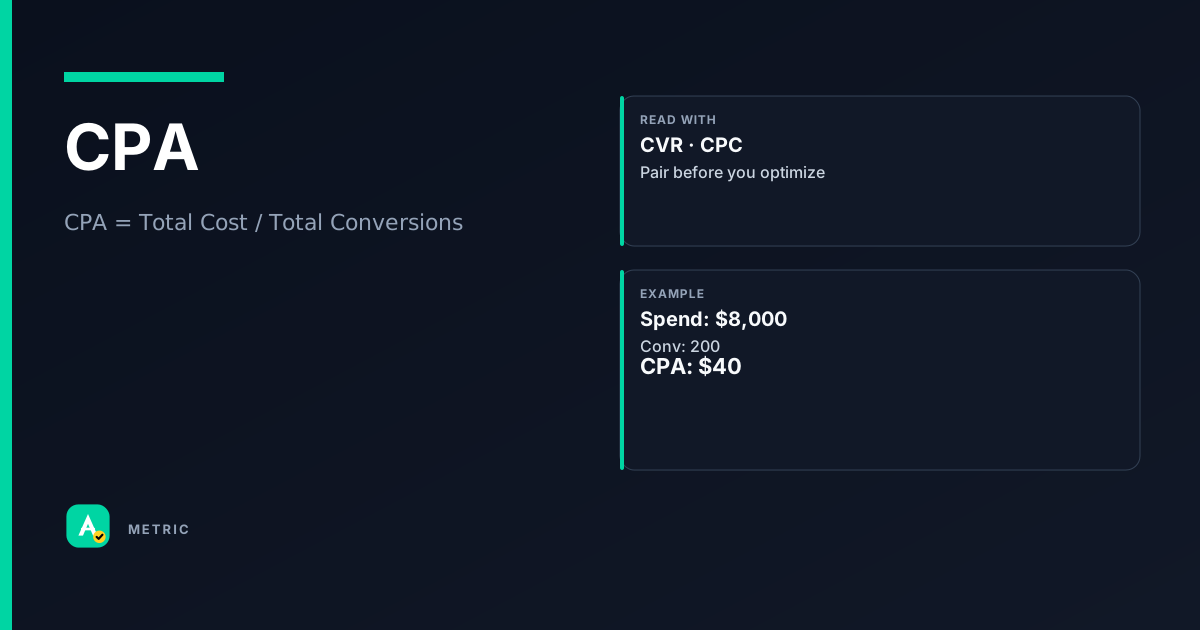
Cost Per Acquisition (CPA) measures the total advertising cost divided by the number of conversions attributed to those ads. Unlike CPC, which only tracks clicks, CPA ties spend directly to a defined business outcome — a purchase, sign-up, or lead. The metric is only as reliable as the conversion definition behind it.
What CPA is and why it matters
CPA answers a simple question: How much did it cost to get one customer action? The action — called a conversion — can be anything from a product purchase to a newsletter subscription. The advertiser defines it, and that definition determines what CPA actually measures.
A common mistake is treating CPA as a creative scoreboard. In reality, conversion definition drives CPA more than the ad itself. A home-services advertiser who counts a phone call lasting 30 seconds as a conversion will see a very different CPA than one who counts only booked appointments. The same ad, same audience, different CPA.
Why it matters
- CPA is the direct link between ad spend and business results.
- It enables comparison across channels that have different click or impression costs.
- Target CPA bidding (available in Google Ads and other platforms) uses historical data to automatically adjust bids toward a desired average CPA.
So what: CPA lets you evaluate whether your ad dollars are generating valuable actions — but only if you are strict about what counts as a conversion.
How CPA is calculated
CPA = Total Cost / Total Conversions
Where:
- Total Cost = sum of all ad spend (clicks, impressions, or other cost models) for the period.
- Total Conversions = number of conversion actions attributed to those ads within the selected attribution window.
Important caveats
- Attribution model matters. Last-click, first-click, and data-driven models assign conversions differently. The same spend can produce different CPA under different models.
- Conversion window. A click that converts 30 days later may or may not be counted, depending on the window setting. Short windows lower total conversions, raising CPA.
- Cross-device tracking gaps. If a user sees an ad on mobile but converts on desktop, the conversion may be missed unless cross-device tracking is enabled.
- View-through conversions. Some platforms count conversions from impressions without a click. Including them lowers CPA but may inflate the number of low-intent conversions.
So what: Always check the conversion definition, attribution model, and window before comparing CPA across campaigns or platforms.
How to read CPA in a dashboard
A single CPA number tells you little. You need context: Is this CPA within your target? How does it compare to customer lifetime value (LTV)?
What to look for
- Trend over time. A rising CPA may indicate audience fatigue, increased competition, or a seasonal shift in conversion rates.
- Segmentation. Break CPA down by campaign, ad group, device, or audience. A good blended CPA can hide a terrible segment.
- Volume context. A low CPA on 2 conversions is not meaningful. Always check conversion count.
Pair CPA with these metrics
- CVR (conversion rate): A high CPA with a high CVR may be acceptable if the conversion value is high.
- ROAS (return on ad spend): CPA tells cost; ROAS tells revenue. Together they show profitability.
- CAC (customer acquisition cost): For subscription businesses, CPA is often a subset of CAC (which includes non-ad costs).
So what: Read CPA in context of volume, trend, and paired metrics. A $50 CPA is good or bad depending on whether the customer is worth $200 or $20.
What usually moves CPA
CPA is a composite metric — anything that changes cost or conversion count moves it. Here are the main levers, grouped by area.
Conversion-side levers
- Conversion definition. Tightening the definition (e.g., from page visit to purchase) raises CPA but improves signal quality.
- Landing page experience. Faster load times, clearer calls-to-action, and mobile optimization increase conversion rate, lowering CPA.
- Audience targeting. More relevant audiences convert at higher rates. Broad targeting often increases CPA due to lower relevance.
Cost-side levers
- Bid strategy. Target CPA bidding can stabilize average CPA, but may overspend on easy conversions and underspend on hard ones.
- Ad rank / quality score. Higher quality scores lower CPC, which can reduce CPA if conversion rate stays constant.
- Competition. Seasonal spikes in bid prices raise cost per click, pushing CPA up unless conversion rate improves proportionally.
Tradeoffs
- Volume vs. CPA. Lowering the target CPA usually reduces conversion volume. The platform prioritizes cheap conversions, leaving more expensive (but still profitable) ones on the table.
- Speed vs. stability. Aggressive bid changes can cause CPA to swing wildly. Gradual adjustments (10-20% per week) give the algorithm time to learn.
- Short-term vs. long-term. Optimizing for a low 7-day CPA may miss conversions that happen after 30 days. Choose a conversion window that matches your real sales cycle.
So what: Don't optimize CPA in isolation. A low CPA is meaningless if volume disappears or if those conversions don't lead to revenue. Always balance CPA with conversion volume and value.
Formula
Google Ads Help defines CPA as total cost divided by total conversions. Conversion definition, attribution model, and window all affect the denominator.
Scenarios
The home-services lead mismatch
A home-services advertiser set CPA based on form submissions. What happened: CPA looked great ($12), but most leads were low-intent (price shoppers). Sales team rejected 80% of leads. What they did: Changed conversion definition to "phone call lasting 60+ seconds" and added a lead-quality score. CPA rose to $45, but sales accepted 70% of leads. Takeaway: A cheap CPA on the wrong conversion is worse than a higher CPA on a quality action.
Target CPA overshoot on a new campaign
An e-commerce brand launched a new campaign with target CPA set to $20. What happened: The algorithm spent aggressively to hit the target, delivering a $19 CPA but only 15 conversions. What they did: Raised the target to $30 and gave the campaign 2 weeks of data. CPA settled at $28 with 200 conversions — higher cost per conversion but far more total conversions. Takeaway: Target CPA bidding needs conversion volume to learn. A too-low target starves the algorithm.
Seasonal CPA spike misinterpreted
A SaaS company saw CPA jump from $40 to $70 in December. What happened: They assumed the campaign was failing and paused it. What they should have done: Checked conversion rate by segment. The spike was driven by higher CPC during holiday competition, but conversion rate for enterprise leads held steady. What they did (after re-launch): Set a higher target CPA for December and measured ROAS instead. Takeaway: CPA spikes from cost-side pressure are different from conversion-side problems. Check the cause before cutting spend.
Common pitfalls
Chasing a low CPA at the expense of volume
A low CPA feels good, but if it comes from a tiny conversion count, you may be leaving profitable customers on the table.
- Do this instead: Set a target CPA that balances cost and volume. Use a target CPA that is below your maximum allowable CPA (based on LTV), not the lowest possible number.
Comparing CPA across different conversion definitions
A campaign counting "page views" as conversions will have a much lower CPA than one counting "purchases." Comparing them directly is meaningless.
- Do this instead: Always compare CPA within the same conversion definition. If you need cross-campaign comparison, use a normalized metric like cost per unit of value (e.g., cost per $100 revenue).
Ignoring the attribution model
Switching from last-click to data-driven attribution can change CPA by 20-40% without any real change in performance.
- Do this instead: Pick one attribution model and stick with it for trend analysis. Document the model so everyone on the team reads CPA the same way.
Summary
CPA is the most direct cost metric for conversion-focused advertisers, but its value depends entirely on how you define a conversion and how you read it in context.
- Define conversions strictly — a cheap bad lead is not a win.
- Read CPA alongside volume, CVR, and ROAS, not in isolation.
- Use target CPA bidding only after you have enough conversion history for the algorithm to learn.
Quick check
Confirm you understood this article.
boolean
CPA is calculated as Total Cost divided by Total Conversions.
Select an answer to continue
References
- Google Ads Help — Glossary (CPA): https://support.google.com/google-ads/answer/12851704
- Google Ads Help — About target CPA bidding (conceptual reference)
- IAB / MRC — Digital Ad Measurement Standards (conceptual reference for conversion attribution)
For learning only. Not advice on bids or spend.
You may also like
Metrics
Customer Acquisition Cost (CAC)
Customer Acquisition Cost (CAC) is the total cost of convincing a prospect to become a paying c…
ValueMetrics
Cost per click (CPC)
Cost per click (CPC) measures the average price an advertiser pays each time someone clicks the…
CostMetrics
Conversion Rate (CVR)
Conversion rate (CVR) measures how often a click (or visit) leads to a desired action — a purch…
PerformanceMetrics
Return on Ad Spend (ROAS)
Return on Ad Spend (ROAS) measures the revenue generated for every dollar spent on advertising.
Performance