Jul 17, 2026·8 min read
First-Price Auction
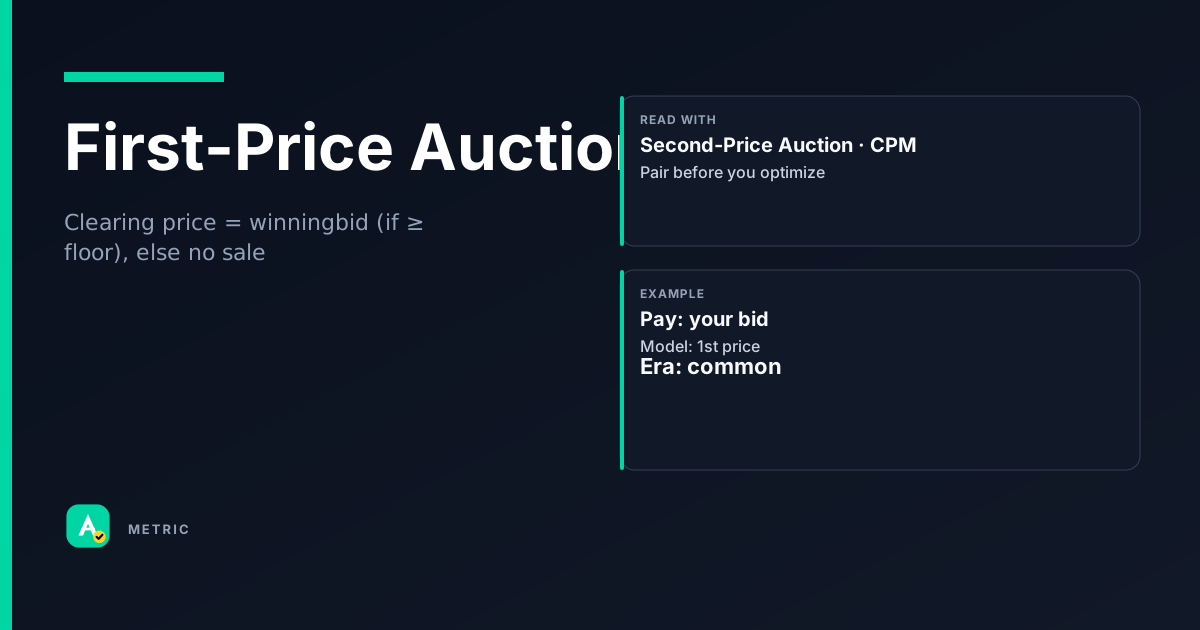
In a first-price auction, the winning bidder pays exactly the amount they bid (subject to any applicable floor prices and platform fees). This is the dominant auction model in programmatic advertising after the industry migration from second-price. It shifts risk and strategy: advertisers must decide their true willingness to pay without the safety net of paying only the second-highest bid.
What it is
A first-price auction is a sealed-bid mechanism where the highest bidder wins the impression and pays their own bid. The publisher (or exchange) collects the full bid amount, minus any platform fees, and the advertiser’s cost is exactly what they submitted.
In the OpenRTB protocol, first-price auctions are signaled with auction type at=1. This flag tells the bidder that the clearing price is their own bid, not the second-highest. The transition from second-price (at=2) to first-price happened rapidly around 2017–2019 as publishers and exchanges sought to eliminate the revenue leakage caused by bid shading on the buy side.
Key characteristics
- Winner pays own bid – no discount to second price.
- Bid shading emerged as a necessary optimization: advertisers submit bids lower than their true valuation to avoid overpaying, but risk losing the auction.
- Floor prices still apply – if the winning bid is below the floor, the impression may go unsold or be re-auctioned.
- Transparency is higher for publishers (they see the exact clearing price), but advertisers must manage their own bid strategy more carefully.
So what? First-price auctions simplify the publisher’s revenue math but force advertisers to invest in bid shading algorithms and frequent calibration. The platform’s role is to provide the auction type signal (at=1) and enforce floors consistently.
How it is calculated
Clearing price = winning bid (subject to floor and fees)
If the winning bid is below the floor price, the auction does not clear (no sale). If the winning bid is above the floor, the advertiser pays their bid, and the publisher receives the bid minus any platform fee (e.g., 10–20% ad tech tax).
Caveats
- Floors override: If the highest bid is $2.00 but the floor is $2.50, the impression is not sold (or a second-price floor rule may apply depending on exchange configuration).
- Platform fees: The bid amount is gross; the net revenue to the publisher is bid × (1 – fee rate).
- Bid shading: Advertisers may submit a shaded bid (e.g., $2.10 instead of $3.00) to avoid overpaying. The clearing price is still the shaded bid, not the true valuation.
- Multiple price floors: Some exchanges apply different floors for different deal types (open auction vs. private marketplace). The highest applicable floor is used.
How to read it in a dashboard
When you see a first-price auction metric (e.g., clearing price or winning bid), interpret it as the actual cost paid by the advertiser, not a theoretical second-price discount. A high clearing price may indicate strong competition, but it could also mean the advertiser is overpaying due to poor bid shading.
What to pair it with
- Win rate: If win rate is high and clearing price is high, the bid strategy may be too aggressive. If win rate is low and clearing price is low, the bid may be too conservative.
- Bid-to-clearing ratio: Compare the submitted bid to the clearing price. A ratio near 1.0 suggests no shading or very tight competition; a ratio well above 1.0 indicates the advertiser left money on the table.
- Floor price: If clearing price consistently equals the floor, the auction is likely floor-constrained, not competitive.
Common dashboard misread: A publisher sees a high eCPM and assumes strong demand. In a first-price auction, that eCPM is the exact bid – but if the floor is set too low, the publisher may be leaving revenue on the table because the advertiser shaded down to just above the floor.
What usually moves this metric
For advertisers (buy side)
- Bid shading algorithm: The most direct lever. A well-calibrated shader reduces the bid while maintaining a high win rate. Over-shading drops win rate; under-shading inflates cost.
- Frequency and recency of bid requests: More data on the same user allows better valuation and shading. Low data density leads to conservative (high) bids.
- Competitive density: More bidders in the auction push clearing prices up. Advertisers can respond by segmenting audiences or using deal IDs to bypass open auction.
For publishers (sell side)
- Floor price: Raising the floor increases the minimum clearing price but may reduce fill rate. Lowering the floor increases fill but may lower eCPM.
- Number of demand sources: More bidders increase competition, which raises clearing prices. But too many sources can increase latency.
- Auction type configuration: Some exchanges allow hybrid models (first-price with second-price floor rules). Check your SSP’s documentation.
Tradeoffs
- Fill vs. price: A high floor guarantees a minimum price but may leave inventory unsold. A low floor fills more impressions but at lower revenue. The optimal floor depends on demand elasticity.
- Bid shading aggressiveness: Aggressive shading saves money per win but reduces win rate. The advertiser must balance cost per acquisition (CPA) against reach.
- Latency vs. competition: Adding more bidders increases competition (good for price) but adds latency (bad for user experience and viewability).
Formula
Platform fees reduce net revenue: net = winning_bid × (1 – fee_rate). Check your exchange’s fee disclosure.
Scenarios
Advertiser overpaying due to no bid shading
A travel advertiser bids $5.00 CPM on every impression, winning 90% of auctions. Clearing price averages $4.80. What happened: No bid shading – they pay their full bid every time. Fix: Implement a simple bid shader that reduces bids by 15% and re-evaluates win rate. Takeaway: Without shading, first-price auctions punish honest bidders.
Publisher floor too low, leaving money on table
A news publisher sets a $0.50 floor on all display inventory. Average clearing price is $0.55. What happened: Advertisers shade their bids to just above the floor. Fix: Raise floor to $0.80 and monitor fill rate. If fill drops below 70%, lower floor incrementally. Takeaway: In first-price, the floor acts as an anchor; a low floor lets advertisers capture the surplus.
Bid shading too aggressive, losing auctions
A gaming advertiser shades bids by 40% to save budget. Win rate drops from 50% to 12%. What happened: The shader underestimated competition. Fix: Reduce shading to 20% and set a minimum bid floor equal to the historical clearing price. Takeaway: Bid shading must be dynamic, not static – test and calibrate regularly.
Common pitfalls
Assuming first-price is the same as second-price with a discount
Many advertisers treat first-price auctions as if they can bid their true valuation and pay less. What to do instead: Always apply bid shading. Your bid is your cost – there is no automatic discount. Use historical win-rate curves to estimate the optimal bid.
Ignoring the floor price when setting bids
Bidding below the floor guarantees a loss. Some advertisers set a single bid across all exchanges without checking floor prices. What to do instead: Segment bids by exchange and floor tier. Use floor price data from bid requests (available in OpenRTB as
bidfloor) to adjust bids upward when necessary.Measuring success only by eCPM (publisher side)
A high eCPM in first-price may simply mean the floor is high, not that demand is strong. What to do instead: Track fill rate alongside eCPM. If eCPM is high but fill is low, the floor is too high. Also monitor bid density (number of bidders per auction) to gauge true demand.
Summary
First-price auctions reward strategic bidding and punish naive honesty. Advertisers must invest in bid shading; publishers must set floors carefully.
- Advertisers: Always shade bids; calibrate using win-rate data; segment by floor and exchange.
- Publishers: Use floors as anchors, not ceilings; monitor fill rate and bid density.
- Platforms: Signal auction type correctly (
at=1) and enforce floors transparently.
Quick check
Confirm you understood this article.
boolean
In a first-price auction, the winning bidder pays the second-highest bid.
Select an answer to continue
Related metrics
References
- OpenRTB 2.x auction type definitions (IAB Tech Lab) – conceptual reference for `at=1` flag
- Industry explainers on first-price transition (e.g., AdExchanger, Digiday) – conceptual reference for market migration
- Google Ad Manager Help – first-price auction overview (conceptual reference)
For learning only. Not advice on bids or spend.
You may also like
Metrics
Cost Per Mille (CPM)
CPM (Cost Per Mille) is the price an advertiser pays for 1,000 ad impressions.
CostMetrics
Floor Price (Reserve Price)
Floor Price (also called reserve price) is the minimum bid an exchange or publisher will accept…
AuctionMetrics
Second-Price Auction
Second-Price Auction is a bidding mechanism where the winning bidder pays the price of the seco…
AuctionMetrics
Auction Latency
Auction Latency measures the time from when a bid request is sent to when the auction decision…
Tech