Jul 17, 2026·8 min read
Bid Response (Bid Resp)
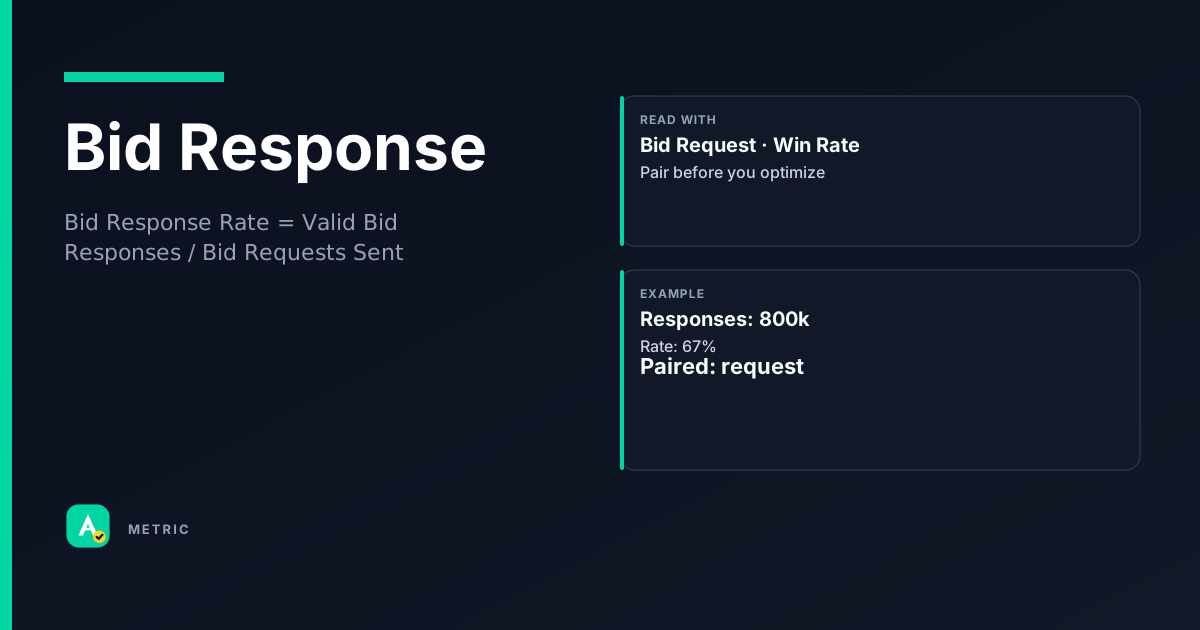
Bid Response is the message a bidder sends back to an exchange after receiving a Bid Request. It contains zero or more bids (via
seatbidarrays) and signals whether the bidder chose to participate. The bid response rate — valid responses divided by requests — is a core platform health metric. A low rate often points to timeout, data mismatch, or throttling issues, not necessarily low demand.
What it is
A Bid Response is the OpenRTB object a bidder returns to an exchange. It wraps one or more seatbid objects, each containing actual bids. The response can also be empty (a no-bid), but how exchanges log empty responses varies — some count them as responses, others ignore them.
Key properties of a Bid Response:
seatbidarray — holds bids grouped by buyer seat. Each seatbid has abidarray with price, creative ID, and targeting details.cur— currency of the bid prices (typically USD).nbr— no-bid reason code (optional; not all exchanges populate it).
So what?
The Bid Response is the moment a demand partner reveals intent. A high response rate means the bidder is engaged and has data to act on. A low rate means something upstream is broken — slow parsing, missing user ID, or a floor that chokes all bids.
How it is calculated
The bid response rate is a ratio, but the denominator depends on your reporting system.
Bid Response Rate = Valid Bid Responses / Bid Requests Sent
Where:
- Valid Bid Response = a response that arrives within the timeout window and parses successfully (valid JSON, correct seatbid structure).
- Bid Requests Sent = requests the exchange dispatched to the bidder (not requests received from publishers).
Important caveats
- No-bid counting — Some platforms count a response with an empty
seatbidarray as a valid response. Others treat it as a non-response. Always check your vendor’s definition. - Timeout window — A response that arrives after the exchange’s timeout is silently dropped and never counted as a valid response. The bidder may think it responded; the exchange disagrees.
- Seatbid array size — A single response can contain multiple seatbids. The rate counts the response, not the number of bids inside it.
- Error responses — HTTP 500 or malformed JSON are not valid responses, even if the bidder intended to bid.
How to read it in a dashboard
A bid response rate of 95%+ is generally healthy for a well-tuned bidder. Below 80% warrants investigation — but don’t panic at a single low number.
What to pair it with:
- Bid Request volume — A low response rate on a tiny request pool is noise. On millions of requests, it’s a signal.
- Average response time — If response time creeps above 80% of the timeout, the rate will drop. Slow infrastructure is the #1 cause of low response rates.
- Win Rate — A high response rate with a low win rate means you’re bidding often but losing. A low response rate with a high win rate means you’re picky but effective.
Easy mistake
Someone in Slack says “Our response rate dropped to 60% — we must be losing demand!” Check timeout first. A 50ms increase in P99 latency can crater response rate without any change in demand quality.
What usually moves this metric
Three levers move bid response rate: infrastructure, data quality, and auction configuration.
Infrastructure
- Server latency — The biggest lever. Shaving 10ms off P99 response time can lift rate by 5-10 points.
- Timeout alignment — If the exchange timeout is 100ms and your P95 is 95ms, you’re living dangerously. Raise timeout or lower latency.
- Connection pooling — Reusing HTTP connections reduces handshake overhead.
Data quality
- User ID match rate — If the bidder can’t resolve the user (no cookie, no device ID), it often skips responding. Improving ID sync raises response rate.
- Inventory filtering — Overly aggressive pre-bid filtering (e.g., blocking all but 5% of domains) reduces response rate by design. That’s fine — just don’t confuse it with a technical problem.
Auction configuration
- Floor price — Very high floors can cause the bidder to skip responding entirely if it knows it can’t compete. This is a strategic choice, not a bug.
- Deal priority — If the bidder only responds to deals, the open-auction response rate will be low by design.
Tradeoffs
Raising response rate at all costs is a trap. If you relax timeout limits, you may increase response rate but miss the auction deadline — those late responses are worthless. If you lower pre-bid filters, you may respond to garbage inventory and waste compute. Optimize response rate only after you’ve confirmed that the responses are competitive and arrive on time.
Formula
Definition of 'valid' varies by platform — some count empty seatbid arrays as valid; others do not. Always verify with your exchange or SSP documentation.
Scenarios
The timeout creep
A DSP notices bid response rate dropped from 92% to 74% over two weeks. No code changes were made.
What happened: A new data-enrichment service added 30ms to every request path. P99 latency went from 85ms to 115ms, but the exchange timeout was still 100ms.
Fix: Profile the request pipeline, move enrichment to async, or increase timeout if the exchange allows.
Takeaway: Response rate is a latency metric in disguise.
The floor that killed responses
A publisher raised floor prices across all ad units by 40%. The exchange’s bid response rate from one DSP dropped from 88% to 55%.
What happened: The DSP’s bidding algorithm pre-filtered requests where the floor exceeded its predicted CPM. It stopped responding to most requests.
Fix: The DSP adjusted its floor threshold logic to still send a no-bid response (instead of skipping). The exchange started counting those as valid responses.
Takeaway: Check whether your platform counts no-bid responses. If not, a floor change can look like a technical failure.
The ID sync gap
A new SSP integration showed a 40% bid response rate while the incumbent SSP ran at 92%.
What happened: The new SSP had no cookie sync with the bidder. For 60% of requests, the bidder couldn’t recognize the user and chose not to respond.
Fix: Implement cookie sync or device ID matching between the bidder and the new SSP.
Takeaway: Low response rate on a new integration is often an identity problem, not a performance problem.
Common pitfalls
Confusing bid response rate with win rate
A high response rate does not mean you’re winning. Responding is cheap; winning requires a competitive price and creative.
What to do instead: Track both metrics side by side. If response rate is high but win rate is low, your bids are too conservative or your creative doesn’t pass publisher review.
Chasing 100% response rate
A 100% response rate is suspicious — it usually means the bidder is responding to everything, including garbage inventory, or the platform counts empty responses as valid.
What to do instead: Target 90-98% for a healthy, selective bidder. Below 80% is a red flag; above 99% is a different red flag.
Ignoring timeout in cross-region traffic
A bidder in US-East responding to a European exchange may have 120ms RTT. If the timeout is 100ms, response rate will be near zero.
What to do instead: Deploy edge servers or use a regional cloud provider. Check timeout settings per exchange — some allow negotiation.
Summary
Bid Response rate is a platform health signal, not a demand quality metric. Treat it as a diagnostic for latency, data integration, and auction configuration.
- Always pair with average response time and win rate.
- Verify how your platform counts no-bid responses before comparing across systems.
- Optimize for consistent, on-time responses — not for a perfect 100% rate.
Quick check
Confirm you understood this article.
single
What does a Bid Response contain?
Select an answer to continue
Related metrics
References
- IAB Tech Lab OpenRTB specification — Bid Response object definition (https://iabtechlab.com/standards/openrtb/)
- Exchange/SSP bid response diagnostics practice — common industry knowledge
- Google Ad Manager Help — bid response timeout and error reporting (conceptual reference)
For learning only. Not advice on bids or spend.
You may also like
Metrics
Bid Request (OpenRTB)
A Bid Request is the message an ad exchange sends to bidders (DSPs) to describe available inven…
AuctionMetrics
Floor Price (Reserve Price)
Floor Price (also called reserve price) is the minimum bid an exchange or publisher will accept…
AuctionMetrics
Win Rate
Win Rate is the percentage of auctions in which a bidder wins the impression.
AuctionMetrics
Effective Cost Per Mille (eCPM)
eCPM (effective cost per mille) is the revenue a publisher earns per thousand ad impressions, r…
Revenue