#relationships·Jul 17, 2026·6 min read
LTV vs ROAS: Which metric tells you if your campaigns are building long-term value or just short-term revenue?
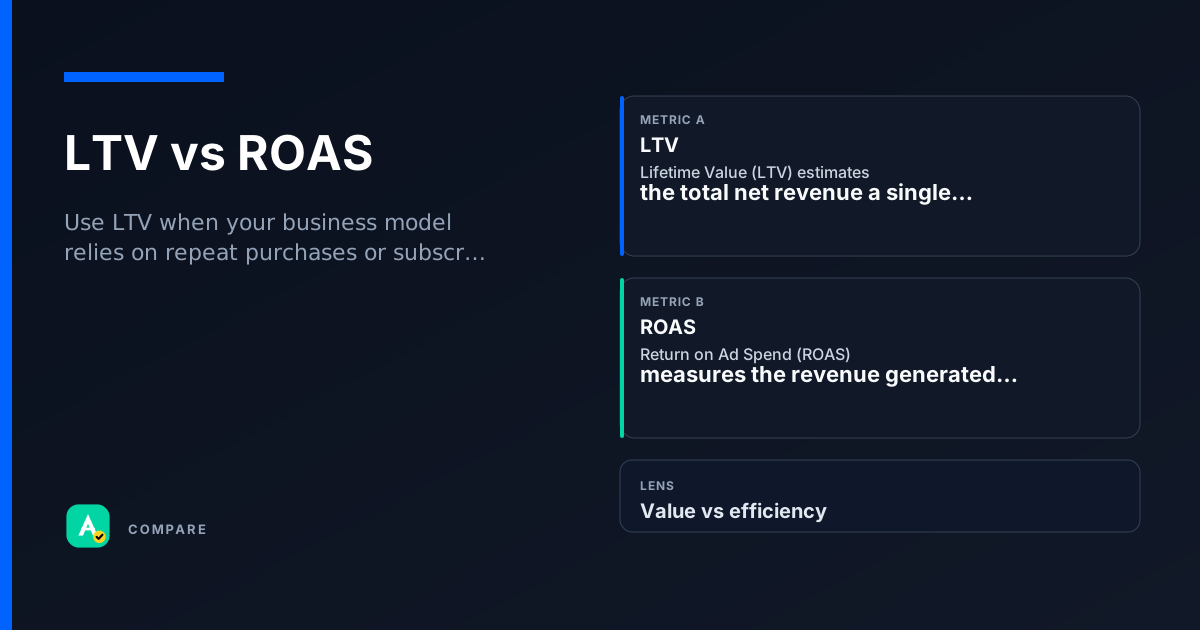
LTV (Lifetime Value) and ROAS (Return on Ad Spend) answer two different questions: Are my customers worth more than it costs to acquire them over time? vs Is this campaign generating immediate revenue relative to its cost? LTV looks at the total profit a customer generates across their entire relationship with your brand, while ROAS focuses on the direct return from a specific ad spend window.
Core difference: Time horizon and scope
LTV estimates the total net profit a single customer will bring over their entire relationship with your business. It includes repeat purchases, upsells, and retention costs.
ROAS measures the gross revenue generated per dollar spent on a specific campaign or ad set, typically within a short attribution window (e.g., 7-day click, 28-day view).
Key contrasts
- Time frame: LTV = lifetime; ROAS = campaign window
- Scope: LTV = customer-level; ROAS = campaign-level
- Costs included: LTV includes retention, support, COGS; ROAS only includes ad spend
- Formula: LTV = (Average Order Value × Purchase Frequency × Gross Margin) / Churn Rate; ROAS = Revenue from Campaign / Ad Spend
Which to use when
Use LTV when:
- You have a subscription, repeat-purchase, or high-retention business model.
- You need to justify high upfront acquisition costs (e.g., SaaS, DTC with strong retention).
- You are optimizing for long-term profitability, not just first-purchase revenue.
Use ROAS when:
- You run short-term campaigns (flash sales, seasonal pushes) and need immediate performance feedback.
- Your attribution window is short and you can measure revenue directly from the ad platform.
- You are A/B testing creative or audience segments and need a quick signal.
Use both together when:
- You want to set a target ROAS that is informed by LTV (e.g., break-even ROAS = 1 / (LTV / CAC)).
- You are scaling acquisition and need to ensure short-term returns don't mask long-term value.
How they diverge
Time horizon
LTV projects value over months or years. ROAS measures a fixed attribution window (e.g., 7 days).
- LTV: future-looking, requires assumptions about retention and churn.
- ROAS: past-looking, based on actual revenue within the window.
Cost scope
LTV includes all costs to serve the customer (COGS, support, retention). ROAS only includes ad spend.
- LTV: net profit per customer.
- ROAS: gross revenue per ad dollar.
Decision use
LTV guides customer acquisition cost (CAC) limits. ROAS guides campaign optimization.
- LTV: “How much can I afford to spend to acquire this type of customer?”
- ROAS: “Is this campaign generating enough immediate revenue to continue spending?”
Where they overlap
Both are efficiency ratios
Both LTV and ROAS express a return relative to a cost. They help marketers decide where to allocate budget.
Both depend on attribution
Accurate tracking of revenue to marketing touchpoints is essential for both metrics. Without proper attribution, both can be misleading.
Both can be segmented
You can calculate LTV and ROAS by channel, campaign, audience segment, or product line to compare performance across dimensions.
Real scenarios
SaaS startup: LTV-driven acquisition
A B2B SaaS company spends $5,000 on LinkedIn ads. ROAS after 7 days is 0.8x — looks bad. But LTV analysis shows the average customer stays 18 months and generates $12,000 in gross profit.
- What happened: Short-term ROAS understated true value.
- What they checked: LTV/CAC ratio (12,000 / 5,000 = 2.4x) — healthy.
Takeaway: For subscription models, LTV is the north star. ROAS alone would have killed a profitable channel.
DTC flash sale: ROAS-driven optimization
A DTC brand runs a 48-hour flash sale on Instagram. They track ROAS by ad set. One creative has 4.5x ROAS, another has 1.2x.
- What happened: They shifted budget to the 4.5x creative and generated $50k in 2 days.
- What they checked: ROAS only — LTV wasn't relevant because the campaign was a one-time event.
Takeaway: For short-term revenue pushes, ROAS is the right metric. LTV would add unnecessary complexity.
How they work together
Use LTV when your business model relies on repeat purchases or subscriptions. LTV tells you the true value of a customer beyond the first transaction, helping you set sustainable acquisition costs.
Use ROAS when you need a quick, campaign-level performance signal. ROAS is ideal for short-term optimizations like A/B testing ad creatives, audiences, or bidding strategies.
Use both together to set informed bid targets. For example, if your LTV is $200 and your target payback period is 90 days, you can calculate a break-even ROAS that ensures you don't overspend on acquisition.
Side-by-side snapshot
| Lens | LTV | ROAS |
|---|---|---|
| Definition | Total net profit a customer generates over their entire relationship with your business | Gross revenue generated per dollar spent on a specific campaign |
| Time horizon | Lifetime (months/years) | Attribution window (days/weeks) |
| Costs included | Ad spend + COGS + retention + support | Ad spend only |
| Formula | (AOV × Purchase Frequency × Gross Margin) / Churn Rate | Revenue from Campaign / Ad Spend |
| Best for | Subscription, repeat-purchase, high-retention models | Short-term campaigns, flash sales, A/B testing |
Common pitfalls
Confusing ROAS with profitability
A 4x ROAS sounds great, but if your gross margin is 20%, that 4x revenue only yields 0.8x profit. ROAS is gross revenue, not net profit.
- What to do instead: Calculate net ROAS by subtracting COGS and fulfillment costs, or use LTV to capture true profitability.
Using LTV without accurate churn data
LTV is only as good as your churn assumption. If you underestimate churn, LTV looks artificially high and you may overspend on acquisition.
- What to do instead: Use cohort analysis to measure actual retention and update LTV models quarterly.
Quick check
Test whether you can tell these metrics apart.
single
Which metric includes the cost of goods sold and customer support in its calculation?
Select an answer to continue
For learning only. Not advice on bids or spend.
You may also like
Metrics
Lifetime Value (LTV)
Lifetime Value (LTV) estimates the total net revenue a single customer (or cohort) will generat…
ValueMetrics
Return on Ad Spend (ROAS)
Return on Ad Spend (ROAS) measures the revenue generated for every dollar spent on advertising.
PerformanceRelationships
eCPM vs Take Rate
RelationshipsRelationships
Fill Rate vs RPM
Relationships