#relationships·Jul 17, 2026·6 min read
Impression vs Reach: What’s the Difference for Ad Learners?
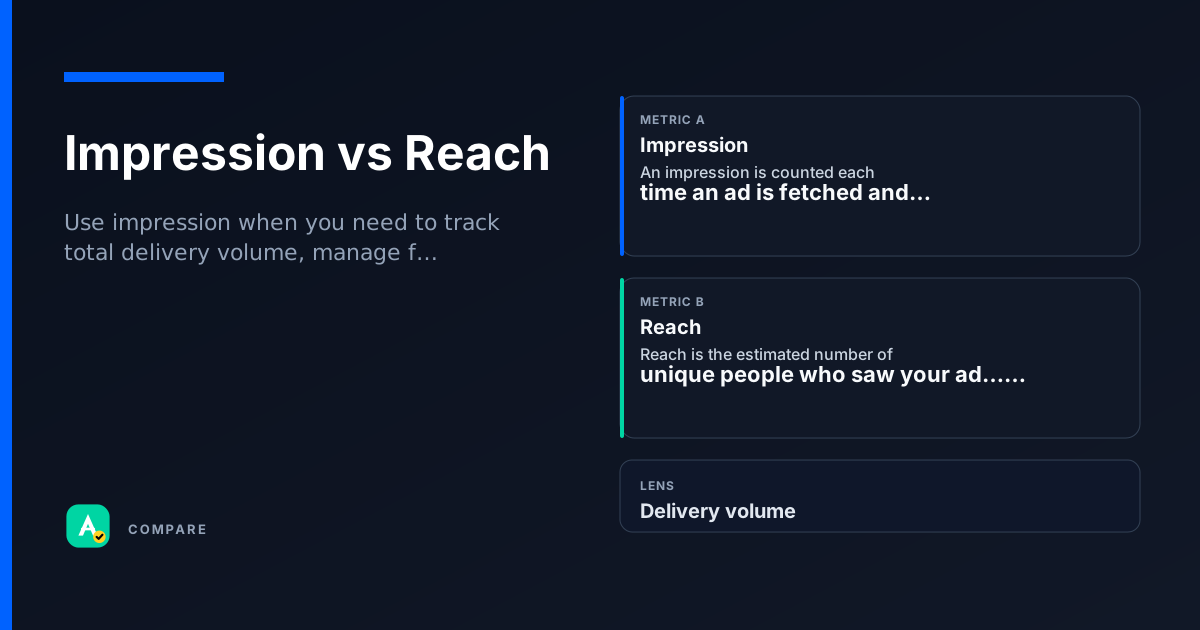
Impression counts every time an ad is served, even to the same person. Reach counts the number of unique people who saw the ad. Understanding both helps you measure frequency and avoid wasted spend.
Core Difference: Counts vs Unique People
Impression = total number of times an ad loads (including repeats). Reach = number of distinct individuals who see the ad at least once.
- Impression is a volume metric — good for measuring delivery.
- Reach is an audience metric — good for measuring spread.
Why it matters
If you see high impressions but low reach, your ad is hitting the same people repeatedly (high frequency). That can lead to ad fatigue and wasted budget.
Which to Use When
Choose Impression when:
- You want to measure total delivery volume.
- You’re optimizing for frequency (e.g., retargeting campaigns).
- You’re tracking ad server load or billing (CPM).
Choose Reach when:
- You want to know how many unique people saw your ad.
- You’re running a brand awareness or new audience campaign.
- You need to avoid over-exposing the same users.
Use both together to calculate frequency (impressions / reach). A healthy frequency depends on your goal: retargeting may need 3–5, awareness may need 1–2.
How they diverge
Counting Method
Impression counts every ad load, including repeats to the same user. Reach counts unique users (deduplicated).
- Impression: 1 user sees 5 ads = 5 impressions.
- Reach: 1 user = 1 reach.
Use Case
Impression is best for measuring delivery volume and frequency. Reach is best for measuring audience size and campaign spread.
- Impression: CPM billing, frequency capping.
- Reach: Brand awareness, new customer acquisition.
Relationship to Frequency
Impression is the numerator in frequency calculation. Reach is the denominator.
- Frequency = Impressions / Reach.
- High frequency with low reach = ad fatigue risk.
Where they overlap
Both Are Awareness Metrics
Neither measures clicks, conversions, or engagement. They only show how many times (impression) or to how many people (reach) the ad was delivered.
Both Depend on Viewability
Both metrics are typically counted only when an ad meets minimum viewability standards (e.g., 50% of pixels visible for 1 second for display, per IAB/Google Ads Help).
Both Are Used in Campaign Planning
Advertisers set goals for both impressions (e.g., 1M impressions) and reach (e.g., 500K unique users) depending on campaign objectives.
Real scenarios
Retargeting Campaign with High Frequency
Setup: An e-commerce brand runs a retargeting campaign for cart abandoners.
- What happened: Impressions = 50,000, Reach = 5,000 → Frequency = 10.
- What they checked: They saw high impressions but low reach, meaning the same 5,000 users saw the ad 10 times each.
Takeaway: High frequency can lead to ad fatigue. They added a frequency cap of 3 per user to improve experience.
Brand Awareness Campaign with Low Frequency
Setup: A new app runs a brand awareness campaign to reach as many people as possible.
- What happened: Impressions = 100,000, Reach = 90,000 → Frequency ≈ 1.1.
- What they checked: They saw high reach relative to impressions, meaning most users saw the ad only once.
Takeaway: Low frequency is fine for awareness. They focused on expanding reach further by broadening targeting.
How they work together
Use impression when you need to track total delivery volume, manage frequency, or are billed on a CPM (cost per thousand impressions) basis.
Use reach when you want to know how many unique people saw your ad, especially for brand awareness campaigns targeting new audiences.
Use both together to calculate frequency (impressions / reach). This helps you balance visibility without annoying your audience.
Side-by-side snapshot
| Lens | Impression | Reach |
|---|---|---|
| Definition | Total number of ad loads | Number of unique people who saw the ad |
| Deduplication | No — counts repeats | Yes — counts each person once |
| Best For | Measuring delivery volume, frequency, CPM billing | Measuring audience size, brand awareness, campaign spread |
| Relationship to Frequency | Numerator (Impressions / Reach = Frequency) | Denominator (Impressions / Reach = Frequency) |
| Risk If Used Alone | May hide over-exposure (ad fatigue) | May hide under-delivery (low total views) |
Common pitfalls
Confusing Impression with Unique View
Why the confusion is wrong: Some beginners think an impression equals one person. But one person can generate many impressions.
- What to do instead: Always check reach to know unique audience size. Use frequency = impressions / reach to understand repetition.
Ignoring Frequency When Using Only One Metric
Why the confusion is wrong: Looking only at impressions can hide over-exposure; looking only at reach can hide under-delivery.
- What to do instead: Always calculate frequency. A healthy frequency depends on your goal — retargeting may need 3–5, awareness may need 1–2.
Quick check
Test whether you can tell these metrics apart.
single
Which metric counts the same person multiple times?
Select an answer to continue
For learning only. Not advice on bids or spend.
You may also like
Metrics
Impression
An impression is counted each time an ad is fetched and displayed to a user, per the platform’s…
DeliveryMetrics
Reach (Unique Reach)
Reach is the estimated number of unique people who saw your ad at least once during a reporting…
DeliveryRelationships
AOV vs CPA
RelationshipsRelationships
ARPU vs RPM
Relationships