#relationships·Jul 17, 2026·6 min read
ARPU vs RPM: What’s the Difference for Ad-Supported Learning Platforms?
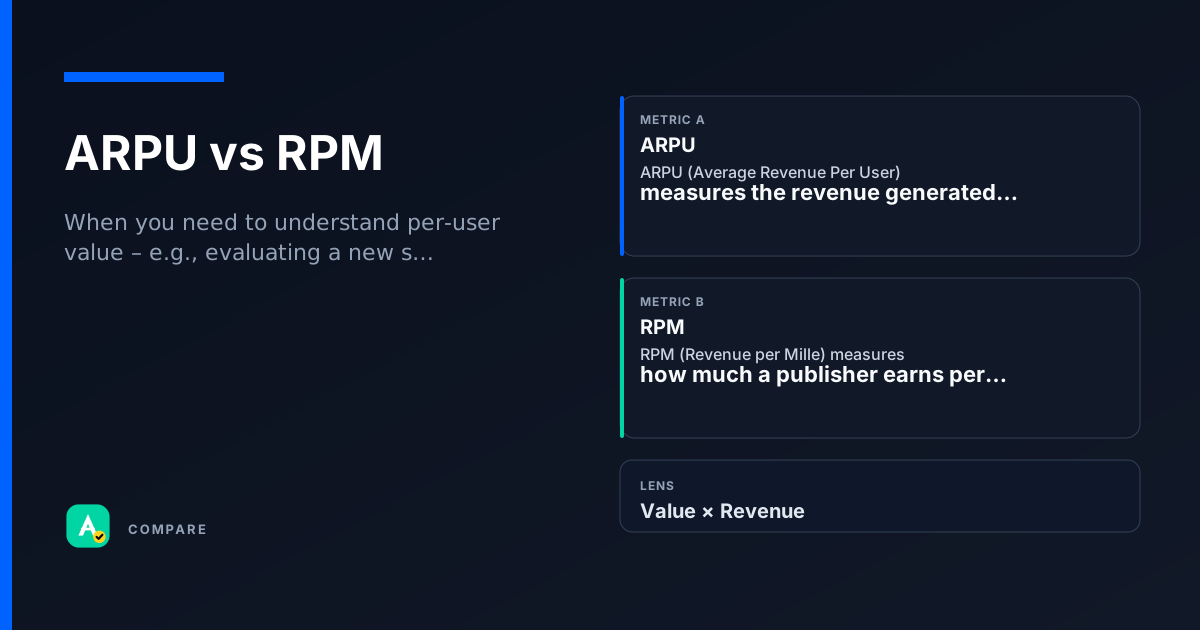
ARPU (Average Revenue Per User) and RPM (Revenue Per Mille) both measure revenue efficiency, but they answer different questions. ARPU looks at revenue per individual user, while RPM looks at revenue per thousand ad impressions.
Core Difference: User vs. Impression
ARPU = Total Revenue / Total Users
RPM = (Total Revenue / Total Impressions) × 1000
- ARPU focuses on the person: how much value each user generates, regardless of how many ads they see.
- RPM focuses on the inventory: how much each thousand ad slots earn, regardless of how many users see them.
Why it matters
- ARPU helps you evaluate user monetization strategies (e.g., subscriptions, ad load).
- RPM helps you evaluate ad placement and pricing efficiency.
Example
- 10 users see 100 ads → $1 total revenue.
- ARPU = $0.10/user.
- RPM = ($1 / 100) × 1000 = $10.
Which to use when
Pick ARPU when:
- You want to understand user value (e.g., freemium vs. paid tiers).
- You’re optimizing user acquisition (LTV vs. CAC).
- Your business model mixes ads + subscriptions.
Pick RPM when:
- You want to benchmark ad inventory performance (e.g., against industry CPMs).
- You’re optimizing ad placement or ad format.
- You’re comparing ad networks or programmatic vs. direct deals.
Use both together when:
- You need a full picture: “Are we making more per user because users see more ads, or because each ad earns more?”
How they diverge
Denominator
ARPU uses total users (active users in a period).
RPM uses total ad impressions (count of ad slots served).
What it optimizes
ARPU optimizes for user-level revenue – encourages higher ad load or premium features.
RPM optimizes for impression-level revenue – encourages higher CPMs, better targeting, or premium placements.
Typical use case
ARPU is common in subscription/freemium models (e.g., SaaS, games).
RPM is standard in ad-supported media (e.g., publishers, ad networks).
Where they overlap
Both are revenue efficiency ratios
Both divide total revenue by a volume metric (users or impressions) to normalize for scale.
Both can be misleading in isolation
High ARPU could come from a tiny, high-value user base. High RPM could come from very few impressions. Always pair with volume metrics.
Both are used for benchmarking
Industry averages exist for both (e.g., IAB reports RPM benchmarks; SaaS benchmarks for ARPU).
Real scenarios
Case 1: ARPU drops, RPM stays flat
Setup: A learning app sees ARPU fall 15% month-over-month, but RPM is unchanged.
- What happened: Users are viewing fewer ads (lower ad load per session).
- What they checked: Session length dropped after a UI redesign.
Takeaway: ARPU caught the user behavior change; RPM alone would have missed it.
Case 2: RPM rises, ARPU stays flat
Setup: An ad-supported video platform improves ad targeting, raising RPM by 20%.
- What happened: Each ad slot earns more, but total impressions per user stayed the same.
- What they checked: User engagement metrics unchanged.
Takeaway: RPM reflected ad quality improvement; ARPU didn’t move because users didn’t change behavior.
How they work together
When you need to understand per-user value – e.g., evaluating a new subscription tier, or comparing user segments.
When you need to evaluate ad inventory performance – e.g., testing a new ad format, or negotiating with ad networks.
When you want to diagnose revenue changes: “Did ARPU drop because users saw fewer ads (RPM flat) or because ads earned less (RPM down)?”
Side-by-side snapshot
| Lens | ARPU | RPM |
|---|---|---|
| Denominator | Total users | Total ad impressions |
| Formula | Revenue / Users | (Revenue / Impressions) × 1000 |
| Primary focus | User monetization | Ad inventory monetization |
| Common in | Subscription / freemium models | Ad-supported media / publishers |
| Sensitive to | User count and engagement | Impression volume and CPM |
Common pitfalls
Confusing ARPU with average revenue per paying user (ARPPU)
ARPU includes all users (including non-paying). ARPPU only counts paying users. Mixing them inflates expectations.
- What to do instead: Always specify the denominator (total users vs. paying users).
Using RPM to compare across different ad formats
RPM can vary wildly by format (video vs. display vs. native). Comparing RPM without normalizing for format is misleading.
- What to do instead: Segment RPM by format, or use eCPM for apples-to-apples.
Quick check
Test whether you can tell these metrics apart.
single
Which metric uses total users as the denominator?
Select an answer to continue
For learning only. Not advice on bids or spend.
You may also like
Metrics
Average Revenue Per User (ARPU)
ARPU (Average Revenue Per User) measures the revenue generated per user or subscriber over a sp…
ValueMetrics
Revenue per Mille (RPM)
RPM (Revenue per Mille) measures how much a publisher earns per thousand page views or sessions.
RevenueRelationships
CPI vs ROAS
RelationshipsRelationships
Bid Response vs Floor Price
Relationships