#relationships·Jul 17, 2026·6 min read
CTR vs IVT Rate: When Clicks Lie and When Invalid Traffic Hides
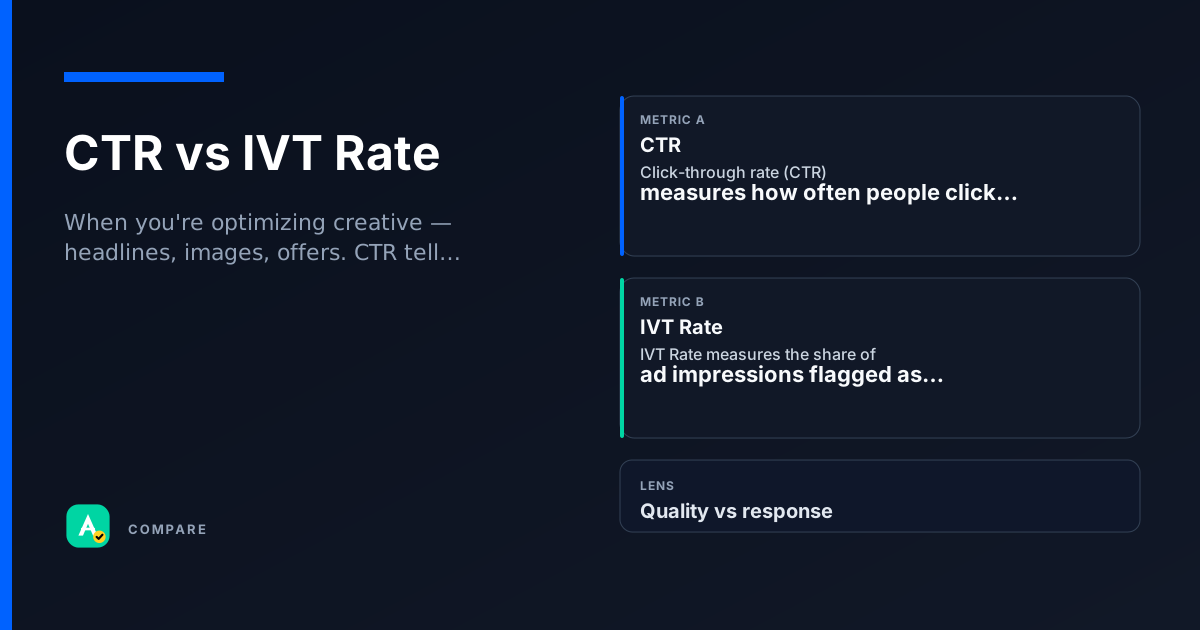
CTR (Click-Through Rate) measures how often people click your ad. IVT Rate (Invalid Traffic Rate) measures how much of your traffic is non-human or fraudulent. The decision question: Are you optimizing for genuine engagement or filtering out fake activity?
Core Difference: Intent vs Authenticity
CTR = Clicks / Impressions × 100%. It answers: Did users find this ad compelling enough to click?
IVT Rate = Invalid Impressions / Total Impressions × 100%. It answers: How much of my traffic is bots, crawlers, or fraudulent?
- CTR is about user action – a positive signal of interest.
- IVT Rate is about traffic quality – a negative signal of waste.
- High CTR can coexist with high IVT Rate if bots click your ads.
Key formula
- CTR = Clicks / Impressions
- IVT Rate = Invalid Impressions / Total Impressions
Which to Use When
Pick CTR when:
- You want to measure ad creative effectiveness.
- You're running a direct-response campaign (e.g., app install, sign-up).
- You're A/B testing headlines, images, or calls-to-action.
Pick IVT Rate when:
- You need to audit traffic quality before trusting other metrics.
- You're buying programmatic inventory and want to avoid waste.
- You suspect bot activity or non-human traffic.
Use both together when:
- You want to know if high CTR is real or inflated by bots.
- You're optimizing for genuine engagement while filtering fraud.
- You're reporting campaign performance to stakeholders who care about both reach and quality.
How they diverge
What They Measure
- CTR: User engagement — clicks per impression.
- IVT Rate: Traffic validity — share of non-human or fraudulent impressions.
Direction of Good
- CTR: Higher is better (more clicks).
- IVT Rate: Lower is better (less invalid traffic).
Impact on Campaigns
- CTR: Directly affects Quality Score in Google Ads and cost-per-click.
- IVT Rate: Directly affects viewability, brand safety, and ad spend waste.
Where they overlap
Both Are Ratios
Both are calculated as a fraction of impressions: CTR = Clicks / Impressions; IVT Rate = Invalid Impressions / Total Impressions.
Both Require Scale
Both metrics are unreliable with very low impression counts (e.g., <1,000). Small sample sizes produce noisy percentages.
Both Can Be Gamed
CTR can be inflated by click farms; IVT Rate can be hidden by sophisticated botnets. Neither is foolproof alone.
Real scenarios
The Bot Click Surge
Setup: A display campaign sees CTR jump from 0.5% to 3% in one day.
- What happened: A botnet targeted the campaign, generating thousands of fake clicks.
- What they checked: IVT Rate spiked to 40%. The high CTR was entirely invalid.
Takeaway: Never celebrate a CTR spike without checking IVT Rate first.
The Clean Campaign That Flopped
Setup: A brand safety-focused campaign had IVT Rate below 1% but CTR was only 0.1%.
- What happened: The audience targeting was too narrow, reaching few real users.
- What they checked: IVT Rate was clean, but CTR showed the creative didn't resonate.
Takeaway: Low IVT Rate doesn't guarantee good engagement — you still need CTR to measure creative success.
How they work together
When you're optimizing creative — headlines, images, offers. CTR tells you what resonates with real users.
When you're auditing traffic sources — especially programmatic or low-cost placements. IVT Rate reveals waste.
When you need trustworthy engagement data. Filter out high-IVT placements first, then optimize CTR on clean traffic.
Side-by-side snapshot
| Lens | CTR | IVT Rate |
|---|---|---|
| Definition | Clicks / Impressions | Invalid Impressions / Total Impressions |
| What It Tells You | How compelling your ad is | How clean your traffic is |
| Good Direction | Higher is better | Lower is better |
| Common Use Case | Creative A/B testing | Traffic source auditing |
| Gaming Risk | Click farms, bots | Sophisticated fraud hiding as human |
Common pitfalls
Treating High CTR as Always Good
Why it's wrong: High CTR can come from bots, accidental clicks (fat-finger), or misleading creative.
- What to do instead: Always cross-reference with IVT Rate and conversion rate. A 10% CTR with 50% IVT Rate is worthless.
Ignoring IVT Rate on Low-Volume Campaigns
Why it's wrong: A 5% IVT Rate on 100 impressions is just 5 invalid impressions — noise, not a pattern.
- What to do instead: Only act on IVT Rate when impression volume exceeds a statistical threshold (e.g., 10,000+). Use confidence intervals if available.
Quick check
Test whether you can tell these metrics apart.
boolean
A high CTR always means your campaign is successful.
Select an answer to continue
For learning only. Not advice on bids or spend.
You may also like
Metrics
Click-through rate (CTR)
Click-through rate (CTR) measures how often people click your ad after seeing it.
EngagementMetrics
Invalid Traffic Rate (IVT Rate)
IVT Rate measures the share of ad impressions flagged as invalid traffic — non-human or fraudul…
QualityRelationships
CPA vs LTV
RelationshipsRelationships
Ad Density vs RPM
Relationships