#relationships·Jul 17, 2026·6 min read
CPA vs LTV: Which Metric Should You Optimize For?
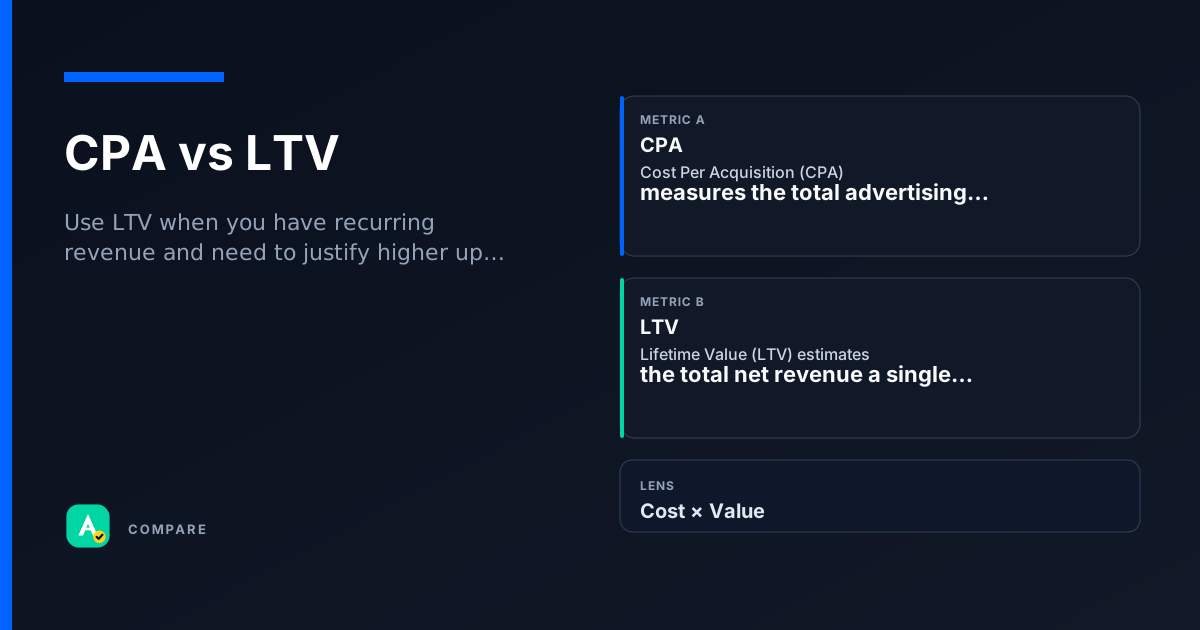
CPA (Cost Per Acquisition) tells you how much you spend to get a new user. LTV (Lifetime Value) estimates the total revenue that user will generate. Together they reveal whether your ad spend is actually profitable.
Core Difference: Cost vs. Worth
CPA is a short-term efficiency metric. It answers: How much did this click or install cost me?
LTV is a long-term value metric. It answers: How much will this user be worth over their entire relationship with my product?
Why this matters
- Low CPA ≠ success if users churn quickly.
- High LTV can justify a higher CPA.
- The magic ratio is LTV > 3× CPA (common industry heuristic, not a hard rule).
Which to Use When
Pick CPA when:
- You're running a short-term campaign (e.g., a 2-week promo).
- You need to control daily ad spend.
- Your product has no repeat purchases (e.g., one-time download).
Pick LTV when:
- You have a subscription or repeat-purchase model.
- You're deciding which user segments to re-engage.
- You want to set a maximum bid for programmatic buying.
Use both when:
- You're evaluating channel profitability (e.g., Facebook vs. Google).
- You're building a ROAS forecast for the next quarter.
How they diverge
Time Horizon
CPA looks backward at a single moment (the conversion).
- CPA: Immediate cost of acquisition.
- LTV: Forecasted revenue over months or years.
Data Requirements
CPA needs only conversion tracking. LTV needs historical user data and retention curves.
- CPA: Easy to set up in any ad platform.
- LTV: Requires a BI pipeline or analytics tool (e.g., Mixpanel, Amplitude).
Stability
CPA can fluctuate daily with bid changes. LTV is more stable but takes weeks to converge.
- CPA: Volatile, good for real-time optimization.
- LTV: Smooth, good for strategic planning.
Where they overlap
Both Are Averages
Both metrics hide variance. A low CPA could come from one cheap channel and one expensive one. A high LTV could be driven by a few whales.
Both Need Attribution
Without a consistent attribution model, both CPA and LTV will be misleading. Last-click attribution often overvalues the final touchpoint.
Real scenarios
The Free-to-Play Mobile Game
A game studio ran UA campaigns targeting a CPA of $2 per install.
- What happened: CPA target was met, but 90% of users churned within 7 days. LTV was only $0.50.
- What they checked: They calculated LTV for users who made an in-app purchase. That cohort had LTV of $15.
Takeaway: Optimizing for CPA alone led to low-quality installs. They shifted to targeting users likely to purchase, accepting a higher CPA ($5) but achieving LTV of $18.
The Subscription Box Service
A DTC brand used LTV to set bids on Facebook.
- What happened: They estimated LTV at $120 over 6 months. They set a target CPA of $40 (LTV/3).
- What they checked: After 3 months, actual LTV was only $80 because of higher-than-expected churn.
Takeaway: LTV estimates must be updated with real cohort data. They adjusted their CPA target to $27 to maintain profitability.
How they work together
Use LTV when you have recurring revenue and need to justify higher upfront spend. Example: a SaaS company with a 12-month average subscription.
Use CPA when you're optimizing a campaign with a fixed budget and a short sales cycle. Example: a flash sale for a physical product.
Use both to calculate LTV / CPA ratio. A ratio above 3 is generally healthy. Below 1 means you're losing money per user.
Side-by-side snapshot
| Lens | CPA | LTV |
|---|---|---|
| Definition | Total revenue a user generates over their lifetime | Cost to acquire one converting user |
| Time orientation | Forward-looking (forecast) | Backward-looking (historical) |
| Data complexity | High (needs retention & revenue data) | Low (needs conversion tracking only) |
| Best for | Subscription & repeat-purchase models | One-time purchase & lead gen |
| Optimization use | Set max bids, evaluate channels | Daily budget control, A/B testing |
Common pitfalls
Confusing CPA with Cost Per Click (CPC)
CPA is the cost per acquisition (a defined conversion), not per click.
- What to do instead: Always verify your conversion event in the ad platform. A click is not an acquisition.
Using LTV Without a Time Window
LTV is meaningless without a defined period (e.g., LTV-12 months).
- What to do instead: Always specify the time horizon. Compare LTV-6mo across channels, not raw LTV.
Quick check
Test whether you can tell these metrics apart.
boolean
A low CPA always means a campaign is profitable.
Select an answer to continue
For learning only. Not advice on bids or spend.
You may also like
Metrics
Cost Per Acquisition (CPA)
Cost Per Acquisition (CPA) measures the total advertising cost divided by the number of convers…
CostMetrics
Lifetime Value (LTV)
Lifetime Value (LTV) estimates the total net revenue a single customer (or cohort) will generat…
ValueRelationships
Attribution vs CVR
RelationshipsRelationships
CPA vs CVR
Relationships