#relationships·Jul 17, 2026·6 min read
CPM vs Impression: Which Metric Drives Your Ad Buying Decision?
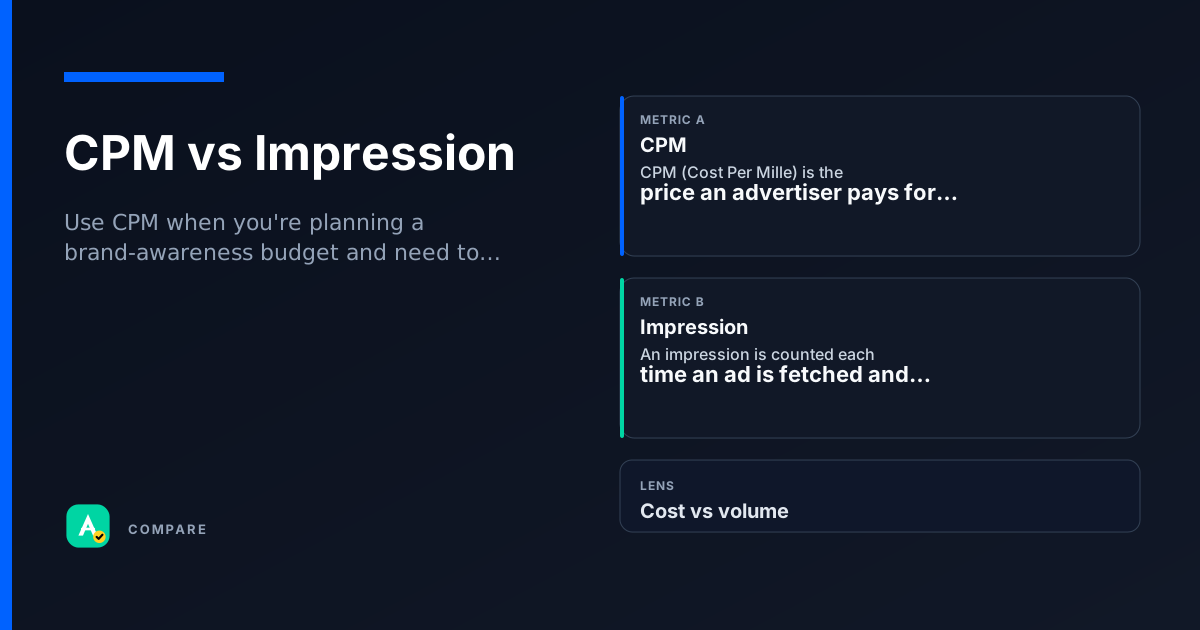
CPM (Cost Per Mille) and Impression are two sides of the same coin. One tells you the cost of reaching 1,000 people; the other counts how many times your ad was actually seen.
Core Difference: Cost vs. Count
CPM is a pricing model — the cost you pay per 1,000 ad impressions served. Impression is a raw count — each time an ad is fetched and displayed (or at least begins to render).
- CPM = (Total Cost / Total Impressions) × 1,000
- Impression = a single unit of delivery
Think of impressions as the quantity of exposure and CPM as the price tag on that quantity.
Which to use when
Pick CPM when:
- You're budgeting for a brand campaign and need to control cost per exposure.
- You're comparing inventory costs across publishers or networks.
- You want to benchmark efficiency (e.g., $5 CPM vs. $12 CPM).
Pick Impressions when:
- You're measuring reach or frequency caps.
- You're reporting total delivery volume to a client.
- You're diagnosing delivery issues (underdelivery = too few impressions).
Use both together:
- To calculate effective CPM (eCPM) when you have a blended cost.
- To ensure you're not overpaying for low-quality inventory (high CPM + low viewability).
How they diverge
What they measure
CPM measures cost efficiency (dollars per thousand). Impression measures raw delivery count (ad units served).
- CPM: financial metric
- Impression: volume metric
How they're calculated
CPM = (Total Cost / Total Impressions) × 1,000. Impression is a simple count from the ad server.
- CPM requires cost data; impressions require only a counting mechanism.
Role in campaign optimization
CPM helps you decide where to spend. Impression helps you decide if you're delivering enough.
- Optimize CPM to lower cost per exposure.
- Optimize impressions to hit delivery goals.
Where they overlap
Both are top-funnel metrics
Neither CPM nor impression measures engagement, click-through, or conversion. They're both about exposure.
Both rely on ad server counting
Both are counted by the same ad server logic (e.g., Google Ad Manager, Amazon Publisher Services). If the server counts an impression, that impression feeds into CPM.
Real scenarios
Brand launch with CPM goal
A CPG brand wants to launch a new cereal. They set a $10 CPM target.
- What happened: The campaign delivered 5M impressions at $12 CPM.
- What they checked: Impressions were on track, but CPM was 20% over target.
Takeaway: Impressions alone would have looked fine; CPM revealed overspend.
Underdelivery on impressions
An e-commerce brand buys a $15 CPM package but only receives 200K impressions out of 500K promised.
- What happened: The publisher couldn't deliver the volume.
- What they checked: CPM was correct, but impression count was too low.
Takeaway: CPM doesn't guarantee volume; always monitor impression delivery.
How they work together
Use CPM when you're planning a brand-awareness budget and need to compare cost efficiency across publishers. It's the standard for buying guaranteed inventory (e.g., IAB's Programmatic Guaranteed).
Use Impressions when you're tracking delivery against a goal (e.g., 10M impressions for a campaign). It's also essential for frequency capping and reach calculations.
Use both when you need to calculate effective CPM (eCPM) for a campaign with mixed pricing, or when diagnosing whether a high CPM is justified by high-quality inventory.
Side-by-side snapshot
| Lens | CPM | Impression |
|---|---|---|
| Definition | Cost per 1,000 impressions | Single ad display event |
| Formula | (Total Cost / Total Impressions) × 1000 | Count of ad server events |
| Primary use | Budgeting and cost efficiency | Delivery tracking and frequency capping |
| Optimization lever | Lower CPM = cheaper exposure | Higher impressions = more reach |
| Dependency | Needs impression count to calculate | Independent of cost data |
Common pitfalls
Confusing CPM with cost per result
Some advertisers think a low CPM automatically means a cheap campaign. But if those impressions never convert, you've wasted money.
- What to do instead: Pair CPM with downstream metrics like CTR or CPA to evaluate true efficiency.
Treating all impressions as equal
A high impression count can hide low viewability or bot traffic. CPM alone won't catch that.
- What to do instead: Layer on viewability (e.g., IAB's viewable impression standard) and invalid traffic filtering.
Quick check
Test whether you can tell these metrics apart.
single
Which metric is a pricing model?
Select an answer to continue
For learning only. Not advice on bids or spend.
You may also like
Metrics
Cost Per Mille (CPM)
CPM (Cost Per Mille) is the price an advertiser pays for 1,000 ad impressions.
CostMetrics
Impression
An impression is counted each time an ad is fetched and displayed to a user, per the platform’s…
DeliveryRelationships
CVR vs ROI
RelationshipsRelationships
CPL vs CVR
Relationships