#relationships·Jul 17, 2026·6 min read
CVR vs ROI: Which Metric Tells You If Your Ads Actually Make Money?
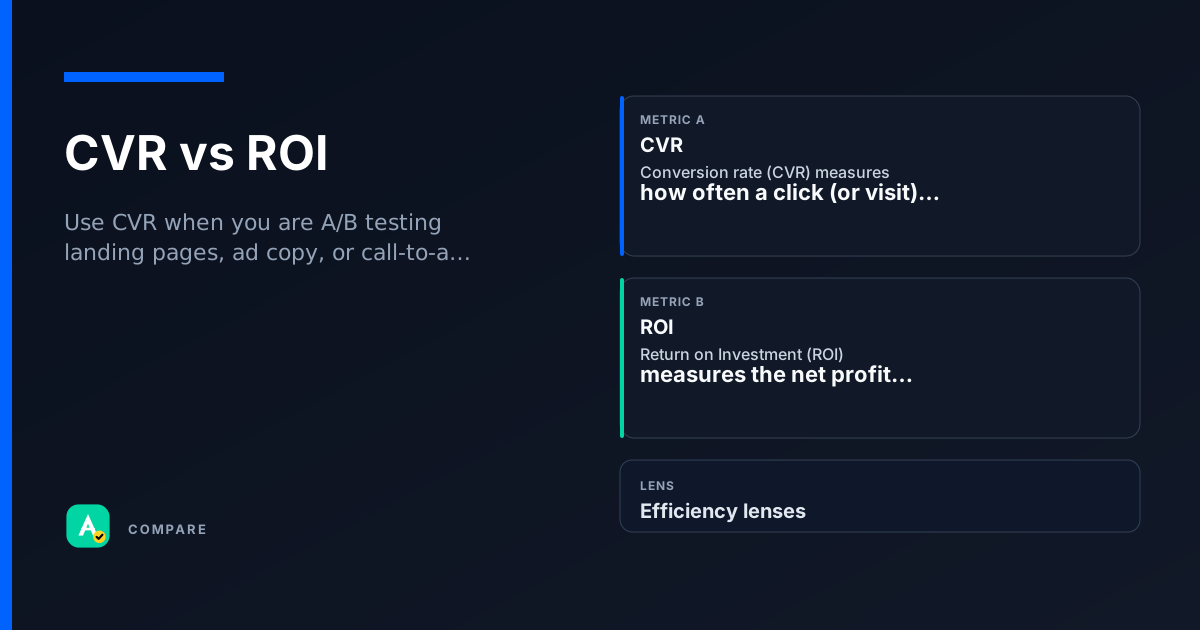
CVR (Conversion Rate) tells you how often clicks turn into desired actions. ROI (Return on Investment) tells you whether those actions generated more revenue than you spent. CVR is about efficiency; ROI is about profitability.
Core difference: Efficiency vs Profitability
CVR measures the percentage of users who complete a goal after clicking an ad.
- Formula: (Conversions / Clicks) × 100
- Tells you: "How good is my ad at convincing people to act?"
ROI measures the net financial return relative to the cost of the campaign.
- Formula: (Revenue - Cost) / Cost × 100
- Tells you: "Did I make more money than I spent?"
A high CVR does not guarantee a positive ROI. For example, a 20% CVR on a $50 product with $10 cost per click can still lose money if the margin is thin. Conversely, a low CVR (e.g., 1%) can yield excellent ROI if the product margin is high and cost per click is low.
Which to use when
Pick CVR when:
- You are optimizing landing pages or ad creative for user action.
- You are in a testing phase and need quick feedback on user response.
- Your goal is lead generation or sign-ups, not immediate revenue.
Pick ROI when:
- You need to justify ad spend to stakeholders.
- You are comparing channels with different cost structures.
- The ultimate business goal is profit, not just conversions.
Use both together when:
- You want to diagnose why a campaign is underperforming. Low ROI with high CVR? Check pricing or margins. Low CVR with decent ROI? Check if the few conversions are high-value.
How they diverge
What they measure
- CVR: Conversion rate — the ratio of conversions to clicks.
- ROI: Return on investment — the ratio of net profit to cost.
Unit of analysis
- CVR: Percentage (0–100%).
- ROI: Percentage (can be negative, zero, or positive; often >100% for profitable campaigns).
What they ignore
- CVR: Ignores revenue, cost per click, and profit margins.
- ROI: Ignores the conversion path details — a high ROI can hide a poor user experience if only a few high-value users convert.
Where they overlap
Both are post-click metrics
Neither metric makes sense without clicks. Both require tracking from click to conversion (or revenue).
Both need context
A standalone CVR or ROI number is meaningless without a benchmark — past performance, industry average, or campaign goal.
Real scenarios
High CVR, low ROI — the margin trap
Setup: An e-commerce campaign sells $20 T-shirts with a $5 cost per click. CVR is 10% (good).
- What happened: 100 clicks → 10 conversions → $200 revenue. Cost = $500. ROI = (200-500)/500 = -60%.
- What they checked: CVR looked great, but the low product margin and high CPC killed ROI.
Takeaway: High CVR does not guarantee profit. Always pair CVR with cost and margin data.
Low CVR, high ROI — the high-ticket win
Setup: A SaaS company sells a $2,000 annual plan. Cost per click is $10. CVR is 1%.
- What happened: 100 clicks → 1 conversion → $2,000 revenue. Cost = $1,000. ROI = (2000-1000)/1000 = 100%.
- What they checked: CVR was low, but the high average order value made the campaign very profitable.
Takeaway: Low CVR can be acceptable if the conversion value is high enough to offset acquisition costs.
How they work together
Use CVR when you are A/B testing landing pages, ad copy, or call-to-action buttons. It gives fast, actionable feedback on user engagement.
Use ROI when you need to decide budget allocation across channels or report to executives. It directly ties ad spend to business profit.
Use both when diagnosing campaign health. For example, if ROI drops but CVR stays high, the issue is likely cost or margin, not creative.
Side-by-side snapshot
| Lens | CVR | ROI |
|---|---|---|
| Definition | Conversions / Clicks × 100 | (Revenue - Cost) / Cost × 100 |
| Tells you | How effective is the ad at driving action? | How profitable is the campaign? |
| Needs revenue data? | No | Yes |
| Needs cost data? | No | Yes |
| Best for | Tactical optimization (landing pages, creative) | Strategic decisions (budget, channel mix) |
Common pitfalls
Optimizing CVR without considering cost
Why it's wrong: Chasing a higher CVR often means spending more on targeting or incentives, which can lower ROI.
- What to do instead: Set a target CVR that is realistic for your margin. Use ROI as the final gatekeeper.
Using ROI alone for creative decisions
Why it's wrong: ROI can be high even with a terrible user experience if a few big spenders convert. You miss the chance to improve the funnel for the majority.
- What to do instead: Monitor CVR alongside ROI to spot friction points in the conversion path.
Quick check
Test whether you can tell these metrics apart.
boolean
A high CVR always means a high ROI.
Select an answer to continue
For learning only. Not advice on bids or spend.
You may also like
Metrics
Conversion Rate (CVR)
Conversion rate (CVR) measures how often a click (or visit) leads to a desired action — a purch…
PerformanceMetrics
Return on Investment (ROI)
Return on Investment (ROI) measures the net profit generated by an advertising campaign relativ…
PerformanceRelationships
CPA vs CVR
RelationshipsRelationships
RPM vs Session RPM
Relationships