#relationships·Jul 17, 2026·6 min read
CPM vs eCPM: What’s the Difference?
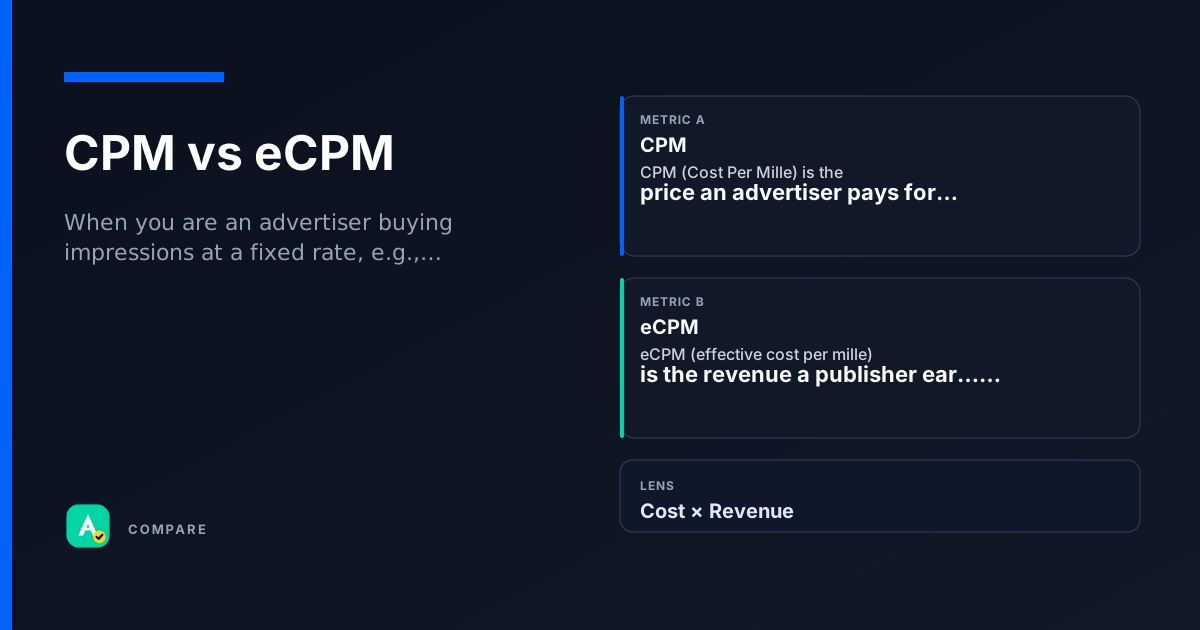
CPM (Cost Per Mille) is the price an advertiser pays for 1,000 ad impressions. eCPM (effective Cost Per Mille) is a publisher-side metric that converts any ad revenue (CPC, CPA, etc.) into a CPM-equivalent number so different campaigns can be compared fairly.
Core Difference: Buyer vs Seller Lens
CPM is a buy-side metric: an advertiser agrees to pay a fixed amount per 1,000 impressions.
eCPM is a sell-side metric: a publisher calculates (Total Revenue / Total Impressions) × 1,000 to see how much each 1,000 impressions actually earned, regardless of the pricing model used.
- CPM = cost for the buyer
- eCPM = revenue for the seller
Example
- An advertiser runs a CPM campaign at $5 CPM → publisher earns $5 per 1,000 impressions.
- A different campaign uses CPC: 10 clicks × $0.50 = $5 revenue from 2,000 impressions → eCPM = ($5 / 2,000) × 1,000 = $2.50.
Which to Use When
Pick CPM when:
- You are an advertiser buying guaranteed impressions.
- You want a fixed, predictable cost for brand awareness campaigns.
- You are planning a budget based on impression volume.
Pick eCPM when:
- You are a publisher evaluating overall ad revenue performance.
- You run a mix of CPC, CPA, and CPM campaigns and need a common benchmark.
- You want to compare the revenue efficiency of different ad units, placements, or networks.
Use both together when you need to reconcile what you pay (CPM) with what you earn (eCPM) — e.g., in an ad mediation stack.
How they diverge
Perspective
- CPM: Buyer’s cost per 1,000 impressions.
- eCPM: Seller’s revenue per 1,000 impressions.
Pricing Model
- CPM: A specific pricing model (fixed cost per 1,000 impressions).
- eCPM: A derived metric that works across any pricing model (CPC, CPA, CPM, etc.).
Calculation
- CPM: Set by the advertiser before the campaign runs.
- eCPM: Calculated after the fact: (Total Revenue / Total Impressions) × 1,000.
Where they overlap
Per-1,000 Basis
Both metrics normalize value to 1,000 impressions, making them directly comparable across different campaigns or ad units.
Programmatic Use
Both are standard in programmatic platforms like Google Ad Manager, Meta Ads, and OpenRTB (IAB Tech Lab).
Not Engagement Metrics
Neither measures clicks, conversions, or viewability — they are purely impression-based monetary metrics.
Real scenarios
Publisher Comparing Two Campaigns
A publisher runs two campaigns on the same ad slot:
-
Campaign A: CPM at $10 → 10,000 impressions → revenue = $100.
-
Campaign B: CPC at $0.50 → 100 clicks from 10,000 impressions → revenue = $50.
-
What happened: Campaign A earned $100; Campaign B earned $50.
-
What they checked: eCPM for Campaign B = ($50 / 10,000) × 1,000 = $5.00.
Takeaway: Even though Campaign B had a $0.50 CPC, its eCPM was only $5.00 — half of Campaign A’s CPM. The publisher can now decide which campaign type to prioritize.
-
Advertiser Budgeting with CPM
An advertiser wants 500,000 impressions at a $12 CPM.
- What happened: Cost = (500,000 / 1,000) × $12 = $6,000.
- What they checked: The publisher’s eCPM on that placement was $8.00 (from mixed campaigns).
Takeaway: The advertiser’s $12 CPM is above the publisher’s average eCPM, so the publisher will likely accept the deal. If the advertiser’s CPM were below the publisher’s eCPM, the publisher might reject or allocate less inventory.
How they work together
When you are an advertiser buying impressions at a fixed rate, e.g., for a brand awareness campaign. CPM gives you predictable costs.
When you are a publisher or ad ops manager who needs to compare revenue across different pricing models (CPC, CPA, flat fee). eCPM standardizes everything.
When you are running an ad mediation setup (e.g., Google Ad Manager with multiple networks). Compare each network’s eCPM to your own CPM floor prices to optimize yield.
Side-by-side snapshot
| Lens | CPM | eCPM |
|---|---|---|
| Definition | Cost per 1,000 impressions (buyer pays) | Effective revenue per 1,000 impressions (seller earns) |
| Who Uses It | Advertisers, media buyers | Publishers, ad ops, yield managers |
| Calculation | Fixed before campaign: CPM = cost per 1,000 impressions | Calculated after: eCPM = (Total Revenue / Total Impressions) × 1,000 |
| Pricing Models Covered | Only CPM campaigns | Any model (CPM, CPC, CPA, flat fee) |
| Typical Range (Illustrative) | $1 – $20+ (varies by niche, ad format, audience) | $0.50 – $15+ (varies by placement, device, country) |
Common pitfalls
Confusing CPM with eCPM
Why the confusion is wrong: Newcomers often think CPM and eCPM are interchangeable because both use “per 1,000 impressions.” But CPM is a cost (buyer), eCPM is a revenue (seller). Using the wrong one can lead to mispriced campaigns or incorrect revenue reports.
- What to do instead: Always ask: “Am I paying (CPM) or earning (eCPM)?” Label your reports clearly.
Ignoring Viewability When Comparing eCPM
Why the confusion is wrong: A high eCPM might come from a low-viewability placement that still gets clicks. Comparing eCPM across placements without factoring in viewability can mislead optimization decisions.
- What to do instead: Always pair eCPM with viewability rate (e.g., Google Active View). Filter out placements below your viewability threshold before comparing eCPM.
Quick check
Test whether you can tell these metrics apart.
single
Which metric is calculated after a campaign runs?
Select an answer to continue
For learning only. Not advice on bids or spend.
You may also like
Metrics
Cost Per Mille (CPM)
CPM (Cost Per Mille) is the price an advertiser pays for 1,000 ad impressions.
CostMetrics
Effective Cost Per Mille (eCPM)
eCPM (effective cost per mille) is the revenue a publisher earns per thousand ad impressions, r…
RevenueRelationships
eCPM vs Take Rate
RelationshipsRelationships
Bid Request vs Win Rate
Relationships