#relationships·Jul 17, 2026·6 min read
Bid Request vs Win Rate: Which Metric Tells You If Your Bid Was Competitive?
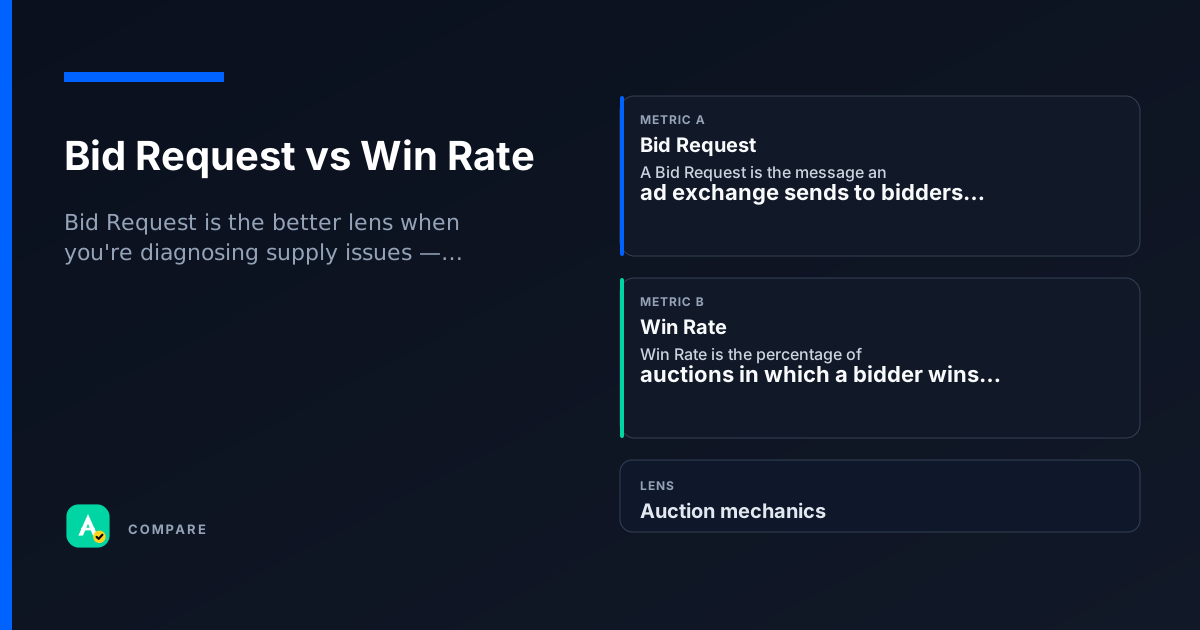
Bid Request counts how many times your bid was invited. Win Rate tells you the percentage of those bids that actually won. Together they separate opportunity from outcome.
Core difference: Opportunity vs. success rate
Bid Request is a volume metric — it measures how many ad slots your DSP was asked to bid on. A high number means you're in the auction, but says nothing about whether you won.
Win Rate is an efficiency metric — it's the ratio of won impressions to total bid requests (or bids submitted). It shows how often your bid was the best in the eyes of the exchange.
Key formula
- Win Rate = Won impressions / Bid requests (or Bids submitted)
Why it matters
- High bid requests + low win rate = you're invited but rarely competitive
- Low bid requests + high win rate = you're selective but may be missing scale
Which to use when
Choose Bid Request when:
- You're evaluating reach or inventory access
- You want to know if your bidder is being invited to enough auctions
- You're diagnosing a supply path issue (e.g., low requests from a certain exchange)
Choose Win Rate when:
- You're measuring bid competitiveness or campaign efficiency
- You want to know if your bid price, creative, or targeting is effective
- You're optimizing for cost per win or pacing
Use both together when:
- You need the full picture: Are we invited? And when we are, do we win?
- Example: High bid requests but falling win rate → your bids are losing ground; low bid requests but high win rate → you're too selective or missing supply
How they diverge
What they measure
- Bid Request: Count of invitations to bid (opportunity)
- Win Rate: Percentage of invitations that resulted in a win (outcome)
Scale vs. ratio
- Bid Request: Absolute number (e.g., 10M requests)
- Win Rate: Ratio (e.g., 12%) — always relative to a denominator
Diagnostic use
- Bid Request: Tells you about supply access (are you even in the game?)
- Win Rate: Tells you about bid quality (are you winning when you play?)
Where they overlap
Both are auction metrics
Both originate from the same real-time bidding (RTB) event stream and are reported by DSPs and ad exchanges.
Both depend on bid request definition
If your DSP counts only eligible bid requests (after targeting/floor filtering), both metrics shift. Always check the denominator.
Both are used in campaign optimization
Advertisers and publishers alike track both to adjust bidding strategy, creative rotation, and audience targeting.
Real scenarios
The high-volume, low-win campaign
Setup: A DSP reports 50M bid requests but only 2M wins (4% win rate).
- What happened: The campaign was targeting broad audiences with a low bid price.
- What they checked: Bid requests were healthy (supply access was fine), but win rate was low because the bid price was below market floor for many impressions.
Takeaway: High bid requests don't guarantee wins. Use win rate to diagnose if your bid is competitive.
The low-bid-request, high-win-rate anomaly
Setup: A niche campaign gets only 100K bid requests but wins 80% of them.
- What happened: The campaign used very specific targeting (e.g., in-market auto buyers in a small geography).
- What they checked: Bid requests were low because few users matched the criteria, but when a match occurred, the bid was highly relevant and won often.
Takeaway: A high win rate can mask a reach problem. Always check bid requests to ensure you're not missing scale.
How they work together
Bid Request is the better lens when you're diagnosing supply issues — e.g., why a campaign isn't spending. Low bid requests mean you're not getting enough opportunities.
Win Rate is the better lens when you're optimizing bid competitiveness — e.g., testing a new bid price or creative. It tells you if your changes are working.
Use both when you need a full pipeline health check. For example, if spend is low, check bid requests (are we invited?) and win rate (are we losing when invited?).
Side-by-side snapshot
| Lens | Bid Request | Win Rate |
|---|---|---|
| Type | Volume (count) | Ratio (percentage) |
| What it tells you | How many auctions you were invited to | How often you won those auctions |
| Typical use case | Diagnosing supply/access issues | Diagnosing bid competitiveness |
| Denominator | None (absolute count) | Bid requests (or bids submitted) |
| Can be high while the other is low? | Yes — many invites, few wins | Yes — few invites, most won |
Common pitfalls
Mistaking high bid requests for success
Why it's wrong: Bid requests only measure opportunity, not outcome. A campaign with 100M bid requests but 1% win rate is wasting bidder resources and may be unprofitable.
- What to do instead: Always pair bid requests with win rate (and cost per win) to evaluate true campaign health.
Optimizing win rate without considering bid requests
Why it's wrong: Raising bid price to boost win rate can work, but if bid requests are already low, you may be overpaying for scarce inventory.
- What to do instead: Check bid request volume first. If it's low, address supply access before tweaking bid price.
For learning only. Not advice on bids or spend.
You may also like
Metrics
Bid Request (OpenRTB)
A Bid Request is the message an ad exchange sends to bidders (DSPs) to describe available inven…
AuctionMetrics
Win Rate
Win Rate is the percentage of auctions in which a bidder wins the impression.
AuctionRelationships
CPM vs Take Rate
RelationshipsRelationships
Ad Density vs Viewability
Relationships