#relationships·Jul 17, 2026·6 min read
ROAS vs CPA: Which Metric Should You Use for Campaign Optimization?
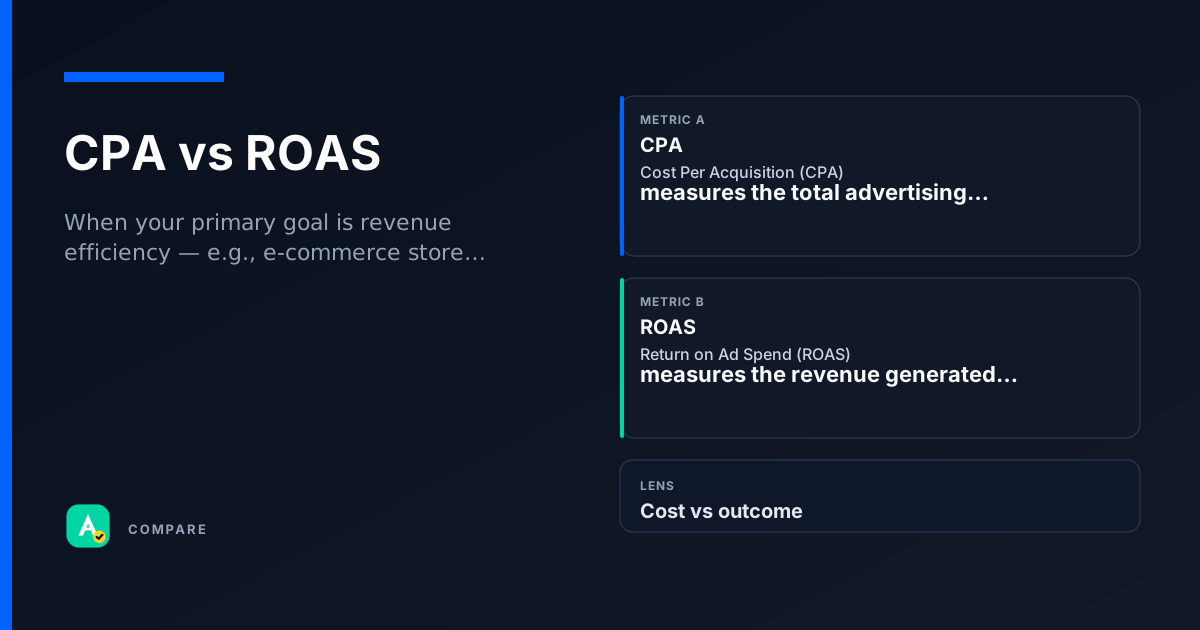
ROAS (Return on Ad Spend) and CPA (Cost Per Acquisition) are two sides of the same coin. ROAS measures revenue generated per dollar spent, while CPA measures the cost to acquire a single customer. Choosing the right one depends on your campaign goal: profitability or efficiency.
Core Difference: Revenue vs. Cost
ROAS focuses on the top line — how much revenue each ad dollar brings back.
- Formula: Revenue / Ad Spend
- Example: $500 revenue from $100 spend → ROAS = 5x
- Tells you: "Is my campaign profitable?"
CPA focuses on the bottom line — how much it costs to get one conversion.
- Formula: Total Ad Spend / Number of Conversions
- Example: $100 spend for 10 conversions → CPA = $10
- Tells you: "Is my customer acquisition cost sustainable?"
Key distinction
- ROAS is a ratio (higher is better).
- CPA is a monetary value (lower is better).
Which to use when
Pick ROAS when:
- You care about revenue efficiency (e.g., e-commerce, lead gen with known LTV).
- You want to compare profitability across channels.
- Your goal is to maximize revenue within a fixed budget.
Pick CPA when:
- You care about cost control per acquisition (e.g., subscription services, app installs).
- You have a fixed target cost per customer.
- Your goal is to scale volume while staying under a cost ceiling.
Use both together when:
- You need a complete picture: ROAS shows if you're profitable, CPA shows if you're efficient.
- Example: High ROAS but high CPA may indicate low volume; low CPA but low ROAS may indicate cheap but unprofitable conversions.
How they diverge
What they measure
ROAS measures revenue per dollar spent (output/input).
- CPA measures cost per conversion (input/output).
- ROAS is a ratio; CPA is a monetary value.
Optimization direction
ROAS → higher is better.
- CPA → lower is better.
- A campaign with ROAS 4x is better than 2x; a CPA of $5 is better than $10.
Data requirements
ROAS needs revenue data tied to conversions (e.g., purchase value).
- CPA only needs conversion count and ad spend.
- ROAS is harder to track if revenue attribution is incomplete.
Where they overlap
Both are post-click metrics
Both ROAS and CPA measure outcomes after a user clicks an ad and completes a desired action.
Both are used for campaign optimization
Ad platforms like Google Ads and Meta allow you to set bid strategies based on either ROAS (target ROAS) or CPA (target CPA).
Both require sufficient data
Small sample sizes can make both metrics unreliable. They need a minimum number of conversions to be statistically meaningful.
Real scenarios
E-commerce store optimizing for profitability
Setup: An online store runs Google Shopping ads. They track both ROAS and CPA.
- What happened: Campaign A had ROAS 4x and CPA $25; Campaign B had ROAS 2x and CPA $15.
- What they checked: ROAS showed Campaign A was more profitable; CPA showed Campaign B was cheaper per order.
Takeaway: They shifted budget to Campaign A because higher ROAS meant better overall profit, even though CPA was higher.
SaaS company scaling user acquisition
Setup: A SaaS company runs Meta ads for free trial sign-ups. They have a fixed CPA target of $10.
- What happened: Campaign A had CPA $8 and ROAS 1.5x; Campaign B had CPA $12 and ROAS 3x.
- What they checked: CPA showed Campaign A was within budget; ROAS showed Campaign B had higher revenue per user.
Takeaway: They used CPA to scale volume, but monitored ROAS to ensure long-term profitability. They paused Campaign B because CPA exceeded their target.
How they work together
When your primary goal is revenue efficiency — e.g., e-commerce stores, lead gen with known customer lifetime value. ROAS helps you compare profitability across campaigns.
When your primary goal is cost control — e.g., subscription services, app installs, or any business with a fixed acceptable cost per customer. CPA helps you scale while staying under budget.
When you need a balanced view — ROAS ensures you're profitable, CPA ensures you're efficient. For example, a campaign with ROAS 3x and CPA $20 might be better than ROAS 5x with CPA $50.
Side-by-side snapshot
| Lens | CPA | ROAS |
|---|---|---|
| What it measures | Revenue per dollar spent | Cost per conversion |
| Formula | Revenue / Ad Spend | Ad Spend / Conversions |
| Optimization direction | Higher is better | Lower is better |
| Data needed | Revenue + spend | Conversions + spend |
| Best for | Profitability analysis | Cost control |
Common pitfalls
Confusing ROAS with profit margin
Why the confusion is wrong: ROAS is revenue / spend, not profit / spend. A ROAS of 2x might still be unprofitable if your product margin is low.
- What to do instead: Calculate net ROAS (revenue minus COGS) / spend, or pair ROAS with CPA to understand true profitability.
Using CPA alone for revenue-focused campaigns
Why the confusion is wrong: Low CPA doesn't guarantee profitability. Cheap conversions might have low lifetime value.
- What to do instead: Always pair CPA with revenue metrics (ROAS, LTV) to ensure you're not just acquiring cheap but unprofitable customers.
Quick check
Test whether you can tell these metrics apart.
single
Which metric measures revenue per dollar spent?
Select an answer to continue
For learning only. Not advice on bids or spend.
You may also like
Metrics
Cost Per Acquisition (CPA)
Cost Per Acquisition (CPA) measures the total advertising cost divided by the number of convers…
CostMetrics
Return on Ad Spend (ROAS)
Return on Ad Spend (ROAS) measures the revenue generated for every dollar spent on advertising.
PerformanceRelationships
CAC vs ROAS
RelationshipsRelationships
CTR vs CVR
Relationships