#relationships·Jul 17, 2026·6 min read
CAC vs ROAS: Which Metric Tells You If Your Ad Spend Is Working?
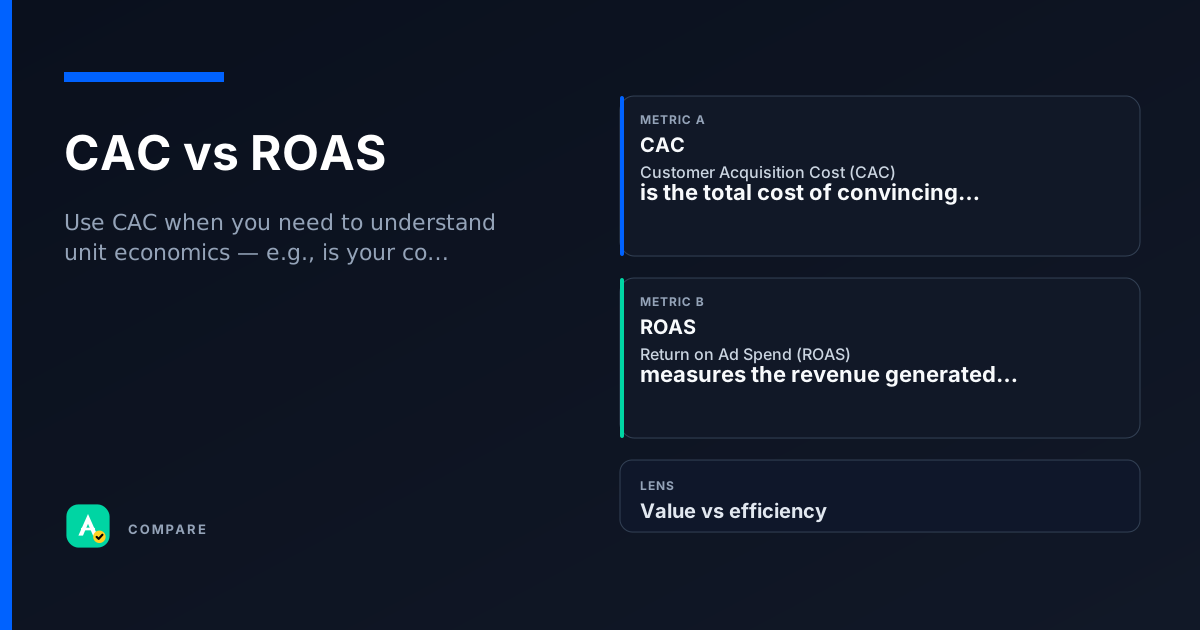
CAC (Customer Acquisition Cost) tells you how much you spend to win a single customer. ROAS (Return on Ad Spend) tells you how much revenue each dollar of ad spend generates. One measures cost efficiency; the other measures revenue efficiency.
Core difference: cost vs. return
CAC = total acquisition cost / number of new customers. It answers: How much does it cost to acquire one customer?
ROAS = revenue from ad campaign / cost of ad campaign. It answers: For every $1 spent on ads, how much revenue comes back?
Key contrasts
- CAC focuses on cost per customer; ROAS focuses on revenue per dollar spent.
- CAC includes all acquisition costs (ads, salaries, tools); ROAS typically only includes ad spend.
- CAC is a unit-cost metric; ROAS is a ratio (often expressed as 3:1, 4:1, etc.).
Which to use when
Pick CAC when:
- You want to understand unit economics (e.g., is the cost to acquire a customer sustainable?).
- You're evaluating sales team efficiency or channel profitability beyond just ad spend.
- You need to set LTV-to-CAC targets (common in SaaS).
Pick ROAS when:
- You're optimizing ad campaigns in real-time (e.g., Google Ads, Meta).
- You want a quick revenue efficiency snapshot for a specific campaign.
- You're comparing ad platforms (e.g., which channel gives the highest return per dollar).
Use both when:
- You need a full picture: low CAC + high ROAS = healthy growth. High CAC + low ROAS = trouble.
- You're building a dashboard for executives — CAC shows cost health, ROAS shows ad efficiency.
How they diverge
What they measure
- CAC: Cost to acquire one customer (includes all acquisition costs).
- ROAS: Revenue generated per dollar of ad spend (ad spend only).
Formula
- CAC: Total acquisition cost / Number of new customers.
- ROAS: Revenue from ads / Cost of ads.
Typical use case
- CAC: Used for long-term business health, LTV analysis, sales efficiency.
- ROAS: Used for campaign-level optimization, ad platform comparison, short-term ROI.
Where they overlap
Both are efficiency ratios
Both metrics measure how efficiently you're spending money to get results — one per customer, one per ad dollar.
Both depend on attribution
The value of both CAC and ROAS changes dramatically depending on your attribution model (first-click, last-click, linear, etc.).
Both are used for budget decisions
Marketers use both to decide which channels or campaigns to scale up or cut back.
Real scenarios
SaaS startup: CAC reveals hidden costs
Setup: A B2B SaaS company runs LinkedIn ads. ROAS is 4:1 — looks good.
- What happened: CAC was $500, but LTV was only $600. The company was barely breaking even.
- What they checked: ROAS alone hid the fact that ad costs were only part of the acquisition cost (sales team salaries, CRM tools).
Takeaway: ROAS can look healthy while CAC reveals poor unit economics. Always pair CAC with LTV.
E-commerce brand: ROAS drives campaign decisions
Setup: A DTC brand runs Facebook and Google Shopping campaigns.
- What happened: Facebook ROAS was 2.5:1, Google Shopping ROAS was 4:1. They shifted budget to Google.
- What they checked: ROAS per channel — quick, actionable.
Takeaway: ROAS is great for channel-level optimization. CAC would be too slow and aggregate for this decision.
How they work together
Use CAC when you need to understand unit economics — e.g., is your cost to acquire a customer lower than the customer's lifetime value (LTV)? Essential for SaaS, subscription, and high-ticket sales.
Use ROAS when you're optimizing ad campaigns day-to-day — e.g., which ad set gives the best return per dollar? Standard in Google Ads, Meta Ads, and e-commerce.
Use both when you want a complete picture: low CAC + high ROAS = efficient growth. High CAC + low ROAS = you're spending too much to acquire customers who don't buy enough.
Side-by-side snapshot
| Lens | CAC | ROAS |
|---|---|---|
| What it measures | Cost per customer acquired | Revenue per dollar of ad spend |
| Formula | Total acquisition cost / New customers | Revenue from ads / Cost of ads |
| Scope of costs | Includes all acquisition costs (ads, salaries, tools) | Only ad spend |
| Typical use | Unit economics, LTV analysis, sales efficiency | Campaign optimization, channel comparison, short-term ROI |
| Time horizon | Long-term (monthly/quarterly) | Short-term (campaign-level, daily/weekly) |
| Common in | SaaS, subscription, B2B | E-commerce, DTC, performance marketing |
Common pitfalls
Confusing ROAS with profit
Why the confusion is wrong: ROAS only measures revenue, not profit. A 4:1 ROAS might still lose money if margins are thin.
- What to do instead: Use ROMI (Return on Marketing Investment) which factors in cost of goods sold (COGS) and other expenses.
Using CAC without LTV
Why the confusion is wrong: A low CAC is meaningless if customers churn quickly or spend very little.
- What to do instead: Always compare CAC to LTV. A healthy ratio is LTV > 3x CAC (common SaaS benchmark).
For learning only. Not advice on bids or spend.
You may also like
Metrics
Customer Acquisition Cost (CAC)
Customer Acquisition Cost (CAC) is the total cost of convincing a prospect to become a paying c…
ValueMetrics
Return on Ad Spend (ROAS)
Return on Ad Spend (ROAS) measures the revenue generated for every dollar spent on advertising.
PerformanceRelationships
LTV vs ROI
RelationshipsRelationships
CPM vs Take Rate
Relationships