#relationships·Jul 17, 2026·6 min read
ARPU vs LTV: Which Revenue Metric Tells You More About Your Users?
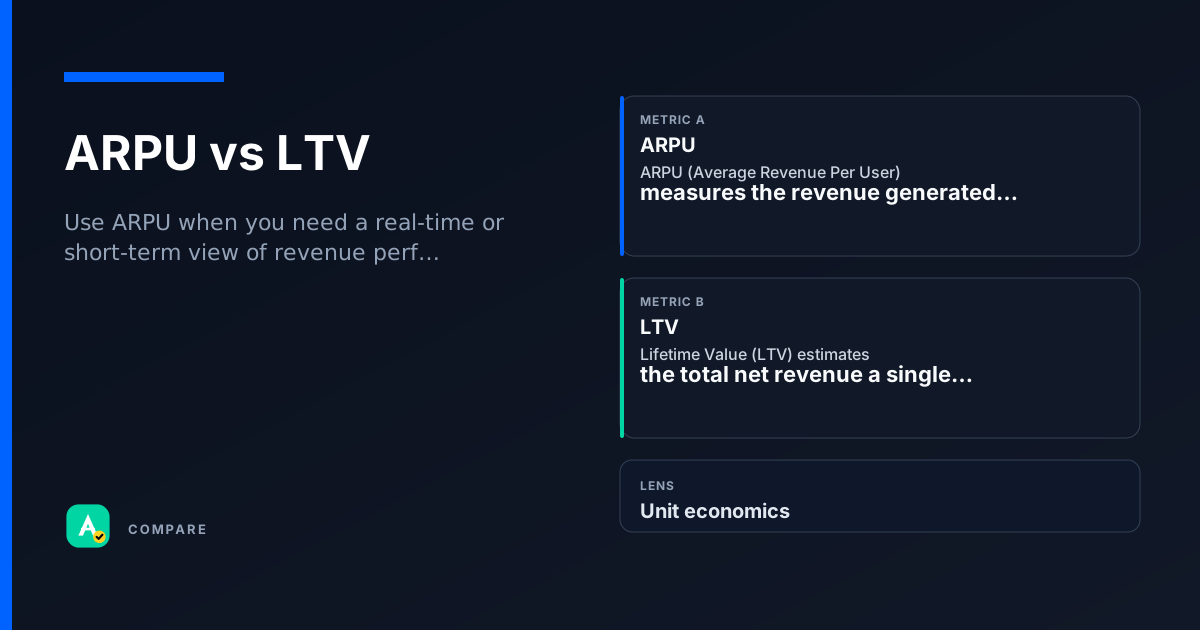
ARPU (Average Revenue Per User) measures short-term revenue efficiency across all users. LTV (Lifetime Value) projects the total revenue a single user will generate over their entire relationship with your product. Both answer: How much is a user worth? — but at very different time horizons.
Core Difference: Snapshot vs Forecast
ARPU is a backward-looking average: total revenue divided by total users in a period. It tells you right now how much each user contributes on average.
LTV is a forward-looking estimate: predicted revenue per user over their expected lifetime. It tells you over time how valuable a user cohort will be.
Key contrast
- ARPU = Revenue / Total Users (simple, fast, period-specific)
- LTV = (Average Revenue per Period × Average Lifetime) – Acquisition Cost
Why it matters
- ARPU helps optimize short-term monetization (e.g., ad load, pricing tiers)
- LTV guides long-term investment decisions (e.g., ad spend, retention programs)
Which to Use When
Pick ARPU when:
- You need a quick pulse on revenue per user this week/month
- You're optimizing ad placements or pricing experiments
- Your user base is mature and stable (LTV is less volatile)
Pick LTV when:
- You're deciding how much to spend on acquisition (CAC vs LTV)
- You're evaluating retention initiatives or subscription models
- You need to forecast revenue for investor or budget planning
Use both when:
- You want to validate that short-term ARPU gains aren't hurting long-term LTV (e.g., aggressive ads may boost ARPU but reduce retention)
- You're building a cohort analysis to see how LTV evolves as users age
How they diverge
Time Horizon
- ARPU looks at a fixed period (day, week, month).
- LTV looks at the entire projected user lifespan.
Calculation Complexity
- ARPU = Total Revenue / Total Users (simple division).
- LTV = (ARPU per period × Average Lifetime) – CAC (requires retention modeling).
Use Case Focus
- ARPU is best for monetization efficiency (e.g., ad revenue per user).
- LTV is best for acquisition and retention strategy (e.g., is it worth spending $50 to acquire a user?).
Where they overlap
Both Are Per-User Revenue Metrics
Both normalize revenue by user count, making them comparable across different user bases.
Both Depend on Accurate Revenue Attribution
If you can't track which revenue comes from which user, both metrics become unreliable.
Both Can Be Segmented by Cohort
You can calculate ARPU and LTV for specific user groups (by channel, plan, behavior) to uncover differences.
Real scenarios
The Ad-Heavy App That Boosted ARPU but Killed LTV
A mobile game doubled ad frequency to raise ARPU from $0.50 to $0.80.
- What happened: ARPU looked great for two months.
- What they checked: LTV of new cohorts dropped from $12 to $6 because users churned faster due to intrusive ads.
Takeaway: ARPU gains can mask LTV damage. Always monitor both when changing monetization.
The Subscription Service That Used LTV to Justify Higher CAC
A SaaS company had ARPU of $30/month and a 12-month average lifetime.
- What happened: LTV = $360. They could afford a $100 CAC (CAC/LTV = 0.28).
- What they checked: ARPU alone would suggest $30/user — too low to justify $100 acquisition cost.
Takeaway: LTV unlocks higher acquisition spend that ARPU alone would reject.
How they work together
Use ARPU when you need a real-time or short-term view of revenue performance — e.g., weekly ad revenue per user, or A/B testing a new pricing tier.
Use LTV when you're making long-term bets — e.g., setting CAC limits, evaluating subscription retention, or forecasting revenue for a new market.
Use both when you want to balance short-term gains vs long-term health — e.g., if ARPU rises but LTV drops, you may be sacrificing retention for quick revenue.
Side-by-side snapshot
| Lens | ARPU | LTV |
|---|---|---|
| Definition | Average revenue per user in a given period | Total predicted revenue from a user over their lifetime |
| Time Horizon | Short-term (day/week/month) | Long-term (months/years) |
| Calculation | Revenue / Total Users | (ARPU per period × Avg Lifetime) – CAC |
| Primary Use | Monetization efficiency, pricing experiments | Acquisition budget, retention strategy, forecasting |
| Dependency | Accurate revenue attribution | Retention data + revenue attribution + churn model |
| Risk if Used Alone | May hide churn problems | May be based on outdated assumptions |
Common pitfalls
Treating ARPU as a Proxy for LTV
Why it's wrong: ARPU ignores retention. A high-ARPU user who churns in month 1 is worth less than a low-ARPU user who stays 24 months.
- What to do instead: Calculate LTV separately using retention curves, or at least segment ARPU by user age.
Using LTV Without Updating Assumptions
Why it's wrong: LTV models rely on retention and revenue assumptions that change over time. Stale LTV can lead to over-investment in acquisition.
- What to do instead: Recalculate LTV quarterly and compare predicted vs actual values for past cohorts.
Quick Check
Test whether you can tell these metrics apart.
single
Which metric is most useful for deciding how much to spend on acquiring new users?
Select an answer to continue
For learning only. Not advice on bids or spend.
You may also like
Metrics
Average Revenue Per User (ARPU)
ARPU (Average Revenue Per User) measures the revenue generated per user or subscriber over a sp…
ValueMetrics
Lifetime Value (LTV)
Lifetime Value (LTV) estimates the total net revenue a single customer (or cohort) will generat…
ValueRelationships
AOV vs ROAS
RelationshipsRelationships
CVR vs Quality Score
Relationships