#relationships·Jul 17, 2026·6 min read
CVR vs Quality Score: Which Metric Drives Campaign Performance?
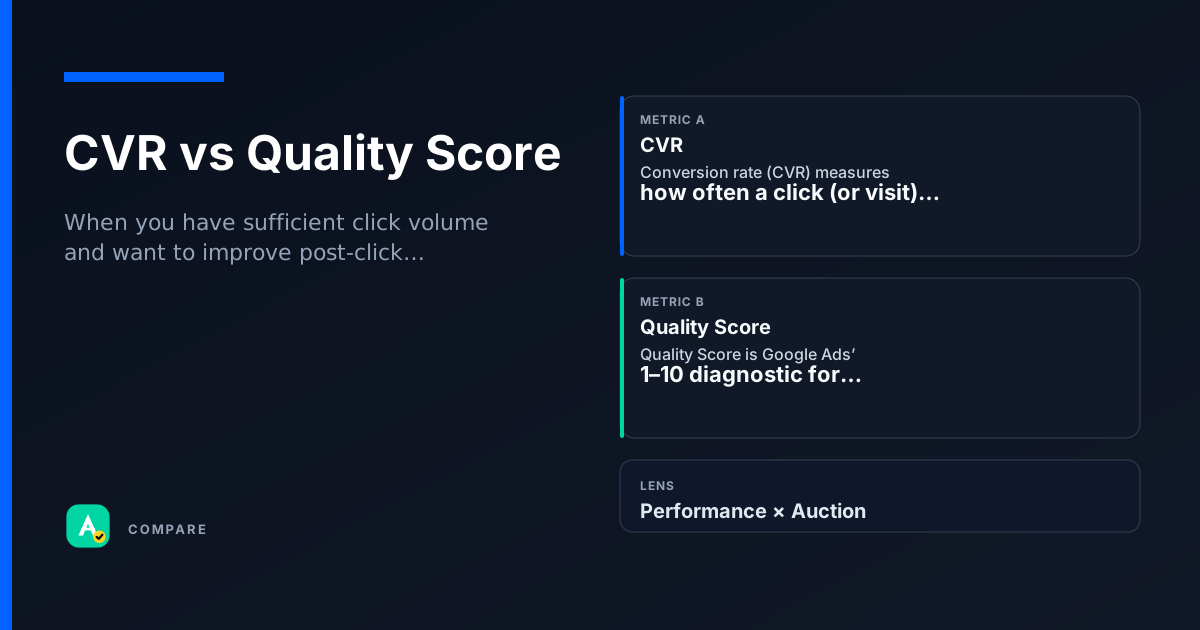
CVR (Conversion Rate) tells you how often a click leads to a desired action. Quality Score is a search engine's rating of your ad relevance and landing page experience. Both impact cost and performance, but they measure different stages of the funnel.
Core Difference: Post-Click Outcome vs Pre-Click Relevance
CVR = Conversions / Clicks. It measures the efficiency of your landing page and offer after a user clicks.
Quality Score (Google Ads, Microsoft Ads) is a 1-10 rating based on expected CTR, ad relevance, and landing page experience. It affects your cost-per-click (CPC) and ad rank before the click happens.
- CVR is a post-click metric — you can only calculate it after users arrive.
- Quality Score is a pre-click signal — it influences whether your ad shows and at what cost.
Key formula
- CVR = Conversions / Clicks × 100%
- Quality Score = composite of expected CTR, ad relevance, landing page experience (no single formula, but each component is scored 1-10)
Which to Use When
Choose CVR when:
- You're optimizing landing pages, checkout flow, or lead forms.
- You need to compare performance across different traffic sources.
- Your goal is to maximize conversions from existing clicks.
Choose Quality Score when:
- You're managing Google Ads or Microsoft Ads and want to lower CPC.
- You're diagnosing why your ads aren't showing or are too expensive.
- You're launching new keywords and need a pre-click quality signal.
Use both together when:
- You want to reduce cost per conversion. High Quality Score lowers CPC; high CVR converts more of those clicks.
- You're running a full-funnel optimization: fix Quality Score for ad rank, then fix CVR for landing page experience.
How they diverge
Measurement Point
- CVR is measured after the click (post-click).
- Quality Score is assigned before the click (pre-click) based on historical signals.
What They Influence
- CVR directly affects cost per conversion (CPC / CVR = CPA).
- Quality Score directly affects ad rank and actual CPC (higher QS = lower CPC).
Optimization Levers
- CVR is improved by landing page UX, offer clarity, form simplicity, page speed.
- Quality Score is improved by ad copy relevance, keyword match, landing page relevance, and expected CTR.
Where they overlap
Both Impact Cost Efficiency
Improving either CVR or Quality Score reduces your cost per conversion — CVR by converting more clicks, Quality Score by lowering the cost per click.
Both Depend on Relevance
A mismatch between keyword, ad, and landing page hurts both Quality Score (relevance score drops) and CVR (users bounce).
Real scenarios
High CVR, Low Quality Score — The Hidden Cost
Setup: An e-commerce campaign converts at 8% (above average) but has a Quality Score of 4/10.
- What happened: The advertiser was paying $2.50 CPC despite good CVR because Google penalized low ad relevance.
- What they checked: Quality Score components revealed poor expected CTR and ad relevance due to generic ad copy.
Takeaway: High CVR alone doesn't guarantee low costs. Fix Quality Score first to reduce CPC, then CVR improvements compound savings.
High Quality Score, Low CVR — Wasted Clicks
Setup: A B2B campaign had Quality Score 9/10 but CVR of only 1%.
- What happened: The ad was highly relevant (good QS), but the landing page was a generic homepage instead of a dedicated offer page.
- What they checked: CVR by landing page revealed the mismatch.
Takeaway: Cheap clicks are wasted if the landing page doesn't convert. High QS lowers CPC, but low CVR still drives high CPA.
How they work together
When you have sufficient click volume and want to improve post-click conversion performance — e.g., A/B testing landing pages, checkout flows, or lead forms.
When you're launching new campaigns or keywords and need to lower CPCs — or when your ads have low impression share due to poor ad rank.
When you're running a full-funnel optimization: first fix Quality Score (ad relevance, landing page relevance) to lower CPC, then optimize CVR (landing page experience) to convert more of those cheaper clicks.
Side-by-side snapshot
| Lens | CVR | Quality Score |
|---|---|---|
| What it measures | Conversion rate — % of clicks that convert | Ad relevance & landing page quality (1-10) |
| When it's calculated | After the click (post-click) | Before the auction (pre-click, updated periodically) |
| Primary impact | Cost per conversion (CPA) | Ad rank and actual CPC |
| Optimization lever | Landing page, offer, form, checkout | Ad copy, keyword match, landing page relevance |
| Available in | Any analytics platform (GA4, Adobe, etc.) | Google Ads, Microsoft Ads (not in analytics platforms) |
Common pitfalls
Treating Quality Score as a Post-Click Metric
Why the confusion is wrong: Quality Score is a pre-click prediction, not a measure of what happens after the click. A high QS doesn't guarantee high CVR.
- What to do instead: Use Quality Score to diagnose ad rank and CPC issues. Use CVR to diagnose landing page and offer issues.
Optimizing CVR Without Considering Quality Score
Why the confusion is wrong: You can have a great landing page (high CVR) but still pay too much per click because your ad relevance is poor (low QS).
- What to do instead: Always check Quality Score components when CPC is high, even if CVR looks good.
Quick check
Test whether you can tell these metrics apart.
single
Which metric is calculated after the user clicks the ad?
Select an answer to continue
For learning only. Not advice on bids or spend.
You may also like
Metrics
Conversion Rate (CVR)
Conversion rate (CVR) measures how often a click (or visit) leads to a desired action — a purch…
PerformanceMetrics
Quality Score (QS)
Quality Score is Google Ads’ 1–10 diagnostic for keyword-level expected CTR, ad relevance, and…
AuctionRelationships
CAC vs ROAS
RelationshipsRelationships
eCPM vs Session RPM
Relationships