#relationships·Jul 17, 2026·6 min read
ARPU vs eCPM: Which Revenue Metric Tells You More About Your Users?
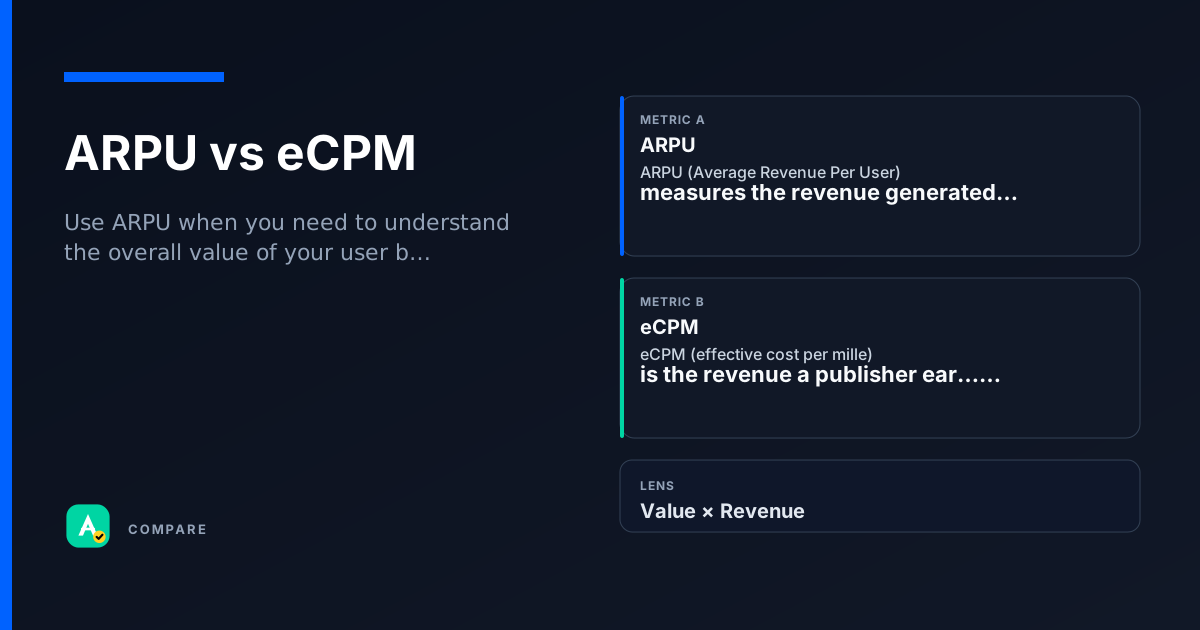
ARPU (Average Revenue Per User) and eCPM (effective Cost Per Mille) both measure revenue, but from opposite angles. ARPU asks “How much does each user contribute?” while eCPM asks “How much does each thousand ad impressions earn?”
Core Difference: User Value vs Ad Unit Value
ARPU = Total Revenue / Total Users
eCPM = (Total Ad Revenue / Total Ad Impressions) × 1000
- ARPU blends all revenue sources (ads, subscriptions, in-app purchases) and spreads them across your user base. It tells you the average value of a user.
- eCPM isolates ad revenue and normalizes it per thousand impressions. It tells you the monetization efficiency of your ad inventory.
Why this matters
- ARPU drops if you add low‑value users, even if ad rates stay the same.
- eCPM can rise while ARPU falls if you show more ads to fewer users.
- They move independently — optimizing one can hurt the other.
Which to Use When
Pick ARPU when:
- You need to understand user lifetime value (LTV) for acquisition decisions.
- Your business model mixes ads with subscriptions or purchases.
- You’re comparing user segments (e.g., iOS vs Android users).
Pick eCPM when:
- You’re optimizing ad placement, format, or network.
- You want to benchmark against industry CPM rates.
- You’re a publisher or app developer focused purely on ad revenue.
Use both together when:
- You need to diagnose revenue changes: “eCPM is flat but ARPU dropped → we lost high‑value users.”
- You’re building a revenue forecast that accounts for both user volume and ad density.
How they diverge
Denominator
ARPU uses total users (active or all).
eCPM uses total ad impressions.
- ARPU denominator shrinks if you churn users → ARPU can rise artificially.
- eCPM denominator grows if you add more ad slots → eCPM can drop even if revenue is stable.
Revenue Scope
ARPU includes all revenue (ads, IAP, subscriptions, sponsorships).
eCPM includes only ad revenue.
- ARPU gives a holistic view of user value.
- eCPM isolates ad monetization efficiency.
Optimization Target
ARPU is optimized by increasing user engagement, retention, and monetization breadth.
eCPM is optimized by improving ad fill rate, viewability, and CPM bids.
- Raising ad frequency boosts eCPM but may lower ARPU if users churn.
- Adding a subscription tier raises ARPU but doesn’t affect eCPM.
Where they overlap
Both Are Averages
Both metrics smooth out individual variation. A few high‑spending users can inflate ARPU; a few high‑CPM placements can inflate eCPM.
Both Are Used in Revenue Reporting
Ad platforms (Google Ad Manager, Meta) report eCPM; analytics tools (Mixpanel, Amplitude) report ARPU. Both appear in investor dashboards.
Both Can Be Segmented
You can slice ARPU by country, device, or acquisition channel. You can slice eCPM by ad format, placement, or network.
Real scenarios
The Ad‑Heavy App That Lost Users
A gaming app doubled ad frequency to boost eCPM. eCPM rose 20%, but ARPU fell 15%.
- What happened: Users churned due to intrusive ads.
- What they checked: ARPU by cohort showed retention dropped after the change.
Takeaway: Optimizing eCPM alone can destroy user value. Always watch ARPU.
The Subscription Launch That Confused the Team
A news app added a $5/month subscription tier. ARPU jumped 40%, but eCPM stayed flat.
- What happened: Subscribers saw no ads, so ad impressions dropped, but total revenue rose.
- What they checked: eCPM didn’t change because ad rates were stable.
Takeaway: ARPU captured the new revenue stream; eCPM was irrelevant for that decision.
How they work together
Use ARPU when you need to understand the overall value of your user base — especially if you have multiple revenue streams or are evaluating user acquisition costs.
Use eCPM when you are optimizing ad inventory — testing ad formats, networks, or placements to maximize ad revenue per impression.
Use both when diagnosing a revenue change: “eCPM is up but ARPU is down → we’re showing more ads to fewer users.” They give you the full picture.
Side-by-side snapshot
| Lens | ARPU | eCPM |
|---|---|---|
| What it measures | Average revenue per user | Revenue per thousand ad impressions |
| Denominator | Total users | Total ad impressions |
| Revenue sources included | All (ads, IAP, subscriptions, etc.) | Ad revenue only |
| Best for | User lifetime value, acquisition decisions | Ad inventory optimization, network comparison |
| Can rise while the other falls? | Yes (e.g., add high‑spending users, cut ad frequency) | Yes (e.g., show more ads, lose users) |
Common pitfalls
Treating ARPU and eCPM as Interchangeable
They measure different things. ARPU is about users; eCPM is about impressions.
- What to do instead: Use ARPU for user‑value questions, eCPM for ad‑inventory questions.
Comparing ARPU Across Different User Definitions
Some tools count only active users, others count all registered users. This changes ARPU dramatically.
- What to do instead: Always define your user base (DAU, MAU, total installs) and keep it consistent.
Ignoring the Denominator Effect on eCPM
If you add low‑value impressions (e.g., banner ads on a low‑traffic page), eCPM drops even if your premium placements are fine.
- What to do instead: Segment eCPM by placement or format to see the real story.
Quick check
Test whether you can tell these metrics apart.
single
Which metric includes revenue from subscriptions and in‑app purchases?
Select an answer to continue
For learning only. Not advice on bids or spend.
You may also like
Metrics
Average Revenue Per User (ARPU)
ARPU (Average Revenue Per User) measures the revenue generated per user or subscriber over a sp…
ValueMetrics
Effective Cost Per Mille (eCPM)
eCPM (effective cost per mille) is the revenue a publisher earns per thousand ad impressions, r…
RevenueRelationships
CAC vs LTV
RelationshipsRelationships
CAC vs ROAS
Relationships