#relationships·Jul 17, 2026·6 min read
CAC vs LTV: Which Metric Tells You If Your Ed-Tech Ads Are Profitable?
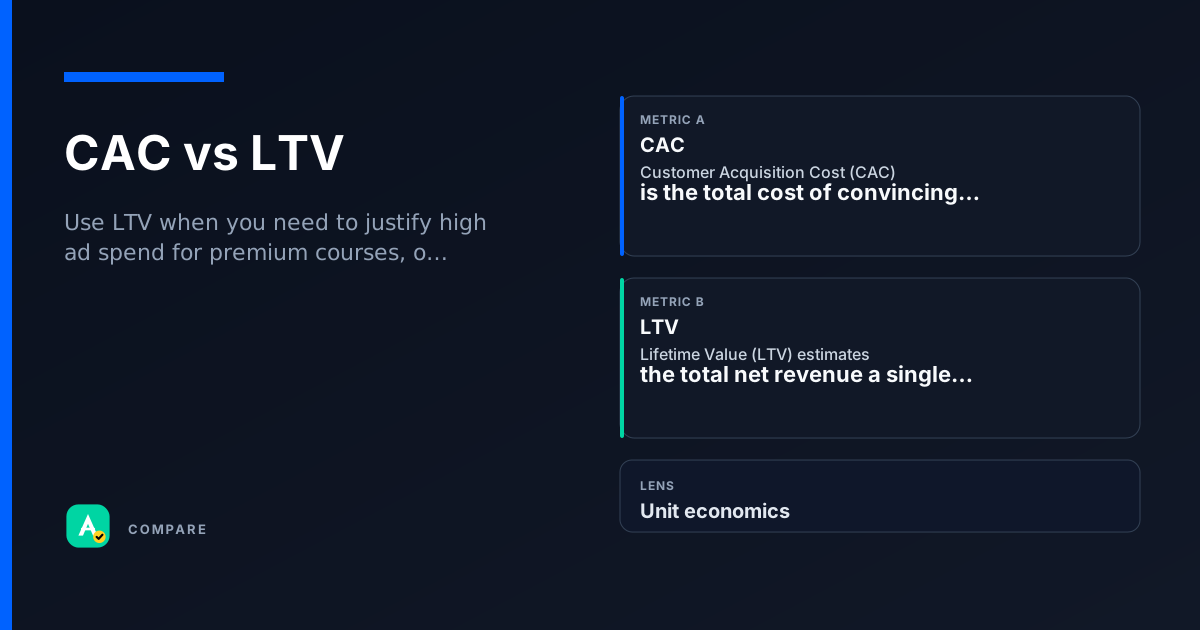
CAC (Customer Acquisition Cost) tells you how much you spend to get one learner. LTV (Lifetime Value) tells you how much that learner is worth over time. Together they reveal whether your ad spend is an investment or a loss.
Core Difference: Cost vs. Worth
CAC is a short-term cost metric. It answers: How much did we pay to acquire this learner?
LTV is a long-term revenue metric. It answers: How much total value will this learner generate?
Why it matters
- CAC focuses on efficiency of your ad funnel (CPC, conversion rate).
- LTV focuses on retention, upsells, and learner satisfaction.
- The LTV:CAC ratio (e.g., 3:1) is the standard health check for ed-tech businesses.
Quick formula
- CAC = Total ad & sales cost / Number of new learners
- LTV = Average revenue per learner × Average retention period
Which to Use When
Choose CAC when:
- You are optimizing ad creative or landing pages.
- You need to compare channel efficiency (e.g., Meta vs. Google).
- You are running short-term campaigns (e.g., enrollment push).
Choose LTV when:
- You are evaluating product-market fit or retention strategies.
- You need to justify higher upfront ad spend.
- You are planning subscription or cohort-based pricing.
Use both together when:
- You want to calculate LTV:CAC ratio (target >3:1 per IAB benchmarks).
- You are deciding budget allocation across channels.
How they diverge
Time Horizon
CAC is a snapshot of the acquisition moment. LTV projects value over months or years.
- CAC changes with ad cost fluctuations.
- LTV changes with churn rate and upsell success.
What They Measure
CAC measures cost efficiency. LTV measures revenue potential.
- CAC = money out (expense).
- LTV = money in (revenue).
Actionability
CAC is actionable in real-time (bid adjustments, A/B tests). LTV is a lagging indicator (needs 3–12 months of data).
- CAC → immediate optimization.
- LTV → strategic planning.
Where they overlap
Both Are Per-Learner Metrics
Both CAC and LTV normalize data to a single learner, making them comparable across channels and campaigns.
Both Depend on Attribution
Accurate CAC and LTV both require consistent attribution rules (e.g., last-click vs. multi-touch). Changing attribution changes both metrics.
Both Are Used in ROI Calculations
The LTV:CAC ratio is the standard profitability benchmark. A ratio below 1:1 means you lose money per learner.
Real scenarios
Case: Low CAC, Low LTV — The Volume Trap
An ed-tech company ran Facebook ads with a very low CAC ($10). They scaled spend aggressively.
- What happened: Learners churned after the first month. LTV was only $8.
- What they checked: They had only looked at CAC, not LTV.
Takeaway: Low CAC is meaningless if LTV is lower. Always check the ratio.
Case: High CAC, High LTV — The Premium Play
A coding bootcamp spent $500 CAC per learner via Google Ads.
- What happened: Learners stayed for 12 months, paying $200/month. LTV = $2,400.
- What they checked: LTV:CAC ratio = 4.8:1 — very healthy.
Takeaway: High CAC is fine if LTV is proportionally higher. Don't cut spend based on CAC alone.
How they work together
Use LTV when you need to justify high ad spend for premium courses, or when you have a subscription model with recurring revenue.
Use CAC when you are running short-term enrollment campaigns, testing new ad platforms, or optimizing landing page conversion rates.
Use both together to calculate the LTV:CAC ratio. This tells you if your ad spend is sustainable. Aim for a ratio of 3:1 or higher (per industry benchmarks).
Side-by-side snapshot
| Lens | CAC | LTV |
|---|---|---|
| Time focus | Long-term (months/years) | Short-term (campaign level) |
| What it measures | Revenue potential per learner | Cost to acquire one learner |
| Actionability | Strategic (retention, pricing) | Tactical (bids, creatives) |
| Data needed | Retention data, revenue per period | Ad spend + new learner count |
| Common benchmark | LTV:CAC ratio > 3:1 | Varies by channel (e.g., $10–$500) |
Common pitfalls
Confusing CAC with CPA (Cost Per Acquisition)
Why the confusion is wrong: CPA usually refers to a single conversion event (e.g., form fill). CAC includes all costs (ads, sales team, tools) to turn a lead into a paying learner.
- What to do instead: Use CAC for profitability analysis, CPA for funnel optimization.
Ignoring Time in LTV Calculation
Why the confusion is wrong: Some teams calculate LTV as first-month revenue only, ignoring retention.
- What to do instead: Use cohort analysis to track average learner lifetime (e.g., 6 months, 12 months). LTV = ARPU × average months retained.
Quick check
Test whether you can tell these metrics apart.
single
Which metric focuses on the cost to acquire a new learner?
Select an answer to continue
For learning only. Not advice on bids or spend.
You may also like
Metrics
Customer Acquisition Cost (CAC)
Customer Acquisition Cost (CAC) is the total cost of convincing a prospect to become a paying c…
ValueMetrics
Lifetime Value (LTV)
Lifetime Value (LTV) estimates the total net revenue a single customer (or cohort) will generat…
ValueRelationships
First-Price Auction vs Win Rate
RelationshipsRelationships
CPM vs eCPM
Relationships