#relationships·Jul 17, 2026·6 min read
LTV vs ROI: Which Metric Tells You If Your Ad Spend Actually Paid Off?
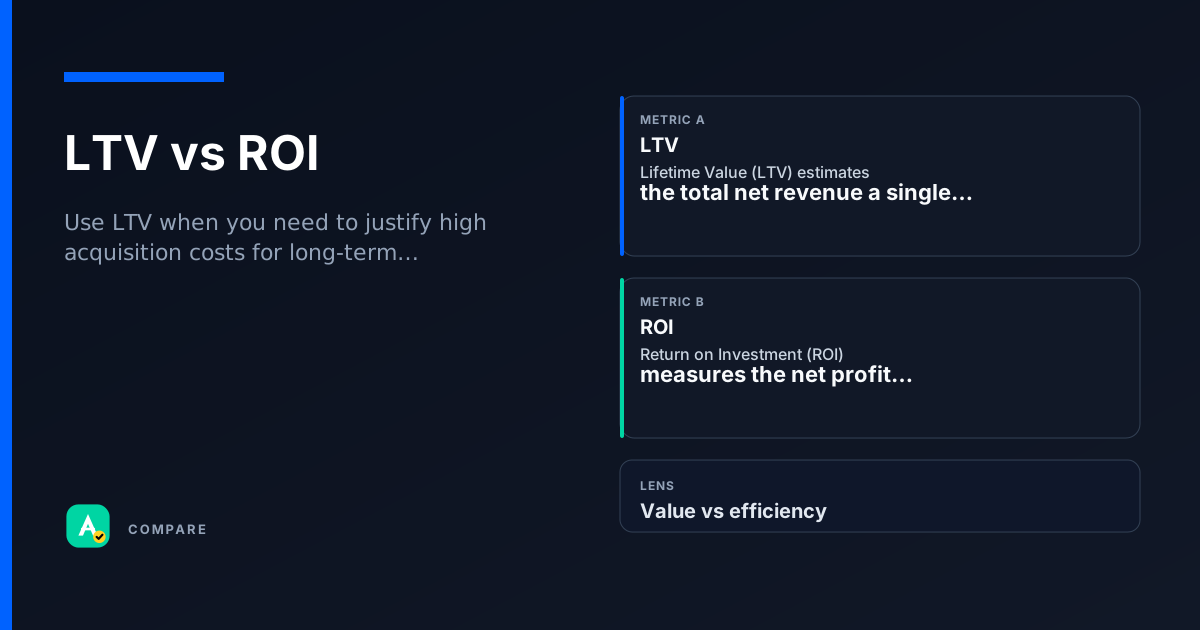
Should you optimize for LTV (lifetime value) or ROI (return on investment)? The core decision question is: Are you trying to prove a campaign was profitable, or are you trying to build a sustainable customer base? LTV looks forward, ROI looks backward.
LTV vs ROI: The Core Difference
LTV (Lifetime Value) estimates the total net profit a single customer will generate over their entire relationship with your business. ROI (Return on Investment) measures the immediate profit or loss from a specific campaign or ad spend.
- LTV = (Average Order Value × Purchase Frequency × Average Customer Lifespan) – Customer Acquisition Cost
- ROI = (Revenue from Campaign – Cost of Campaign) / Cost of Campaign
Key distinction: LTV is a predictive metric about future customer worth. ROI is a historical metric about past campaign efficiency. You cannot calculate LTV without ROI data, but ROI alone tells you nothing about customer retention.
Which to Use When
Choose LTV when:
- You run subscription or repeat-purchase businesses (SaaS, DTC, apps)
- You need to justify high upfront acquisition costs (e.g., $50 CPA for a $200 LTV customer)
- You're optimizing for retention and long-term growth
Choose ROI when:
- You run short sales cycles or one-time purchases (e.g., event tickets, flash sales)
- You need to prove campaign profitability to a CFO or client this quarter
- You're A/B testing ad creatives or landing pages
Use both together when:
- You want to know: "Is this campaign profitable now, and will these customers be profitable later?"
- Example: A campaign with 200% ROI but low LTV may be burning through one-time buyers; a campaign with 50% ROI but high LTV may be worth scaling.
How they diverge
Time Horizon
LTV projects value over months or years. ROI measures a specific campaign period (days or weeks).
- LTV: "What will this customer be worth in 12 months?"
- ROI: "Did this campaign make money last week?"
Data Required
LTV needs historical purchase data, churn rates, and average order values. ROI needs campaign cost and attributed revenue.
- LTV: Requires a data pipeline (CRM, analytics, retention tracking)
- ROI: Can be calculated from ad platform reports alone
Optimization Goal
LTV optimizes for customer quality and retention. ROI optimizes for immediate profit per dollar spent.
- LTV: Lower CPA acceptable if LTV is high
- ROI: Must be >100% to be profitable
Where they overlap
Both Are Profitability Metrics
Both LTV and ROI answer the question: "Did we make more money than we spent?" They just answer it at different levels — per customer vs per campaign.
Both Require Accurate Attribution
If you can't track which revenue came from which ad, both metrics become meaningless. Clean UTM parameters, conversion tracking, and deduplication are prerequisites for both.
Real scenarios
The Subscription Box That Optimized Only ROI
A subscription box startup optimized Facebook campaigns for ROI > 200%.
- What happened: They attracted bargain hunters who bought once with a coupon and never returned. ROI looked great, but churn was 80%.
- What they checked: When they calculated LTV, they found the average customer was worth only $30 — less than the $40 CPA.
Takeaway: ROI alone can mask a failing business model. Always pair with LTV for subscription/repeat-purchase models.
The DTC Brand That Scaled on LTV Alone
A DTC apparel brand saw a campaign with 80% ROI (below their 150% target) but high LTV.
- What happened: Customers acquired through that campaign had a 12-month LTV of $250 vs the usual $150.
- What they checked: They calculated LTV:ROI ratio and found the campaign was actually the most profitable over 6 months.
Takeaway: Low ROI campaigns can be winners if LTV is high. Don't kill campaigns based on ROI alone.
How they work together
Use LTV when you need to justify high acquisition costs for long-term customers. Example: A SaaS company paying $100 CPA for a customer with $600 LTV over 2 years. LTV tells you the spend is worth it even if ROI is negative in month 1.
Use ROI when you need to prove a campaign was profitable within a reporting period. Example: A Black Friday flash sale where you need to show the CFO that every $1 spent returned $3. ROI is the standard for campaign-level P&L.
Use both together to avoid short-term vs long-term blind spots. A campaign with high ROI but low LTV may be burning through one-time buyers. A campaign with low ROI but high LTV may be worth scaling despite initial losses.
Side-by-side snapshot
| Lens | LTV | ROI |
|---|---|---|
| Definition | Predicted net profit from a customer over their lifetime | Profit or loss from a specific campaign relative to its cost |
| Time Horizon | Long-term (months to years) | Short-term (campaign duration) |
| Calculation | (AOV × Frequency × Lifespan) – CAC | (Revenue – Cost) / Cost |
| Best For | Subscription, repeat-purchase, high-ticket items | One-time sales, flash campaigns, A/B tests |
| Data Dependency | Requires CRM, retention data, churn analysis | Requires campaign cost + attributed revenue |
Common pitfalls
Confusing LTV with ROI
The confusion: Treating a high LTV as proof a campaign was profitable.
- Why it's wrong: LTV is a prediction, not a P&L. A campaign could have high LTV customers but still lose money if the CPA exceeds the LTV.
- What to do instead: Always calculate ROI first to confirm the campaign was cash-flow positive, then use LTV to decide if it's worth repeating.
Optimizing LTV Without Tracking ROI
The confusion: Focusing only on LTV and ignoring campaign-level profitability.
- Why it's wrong: You might scale a campaign that acquires high-LTV customers but at a CPA that makes the campaign unprofitable in the short term, draining cash reserves.
- What to do instead: Set a minimum ROI threshold (e.g., 100%) and then optimize LTV within that constraint.
For learning only. Not advice on bids or spend.
You may also like
Metrics
Lifetime Value (LTV)
Lifetime Value (LTV) estimates the total net revenue a single customer (or cohort) will generat…
ValueMetrics
Return on Investment (ROI)
Return on Investment (ROI) measures the net profit generated by an advertising campaign relativ…
PerformanceRelationships
Floor Price vs Win Rate
RelationshipsRelationships
Match Rate vs Win Rate
Relationships