#relationships·Jul 17, 2026·6 min read
Floor Price vs Win Rate: Balancing Revenue and Demand
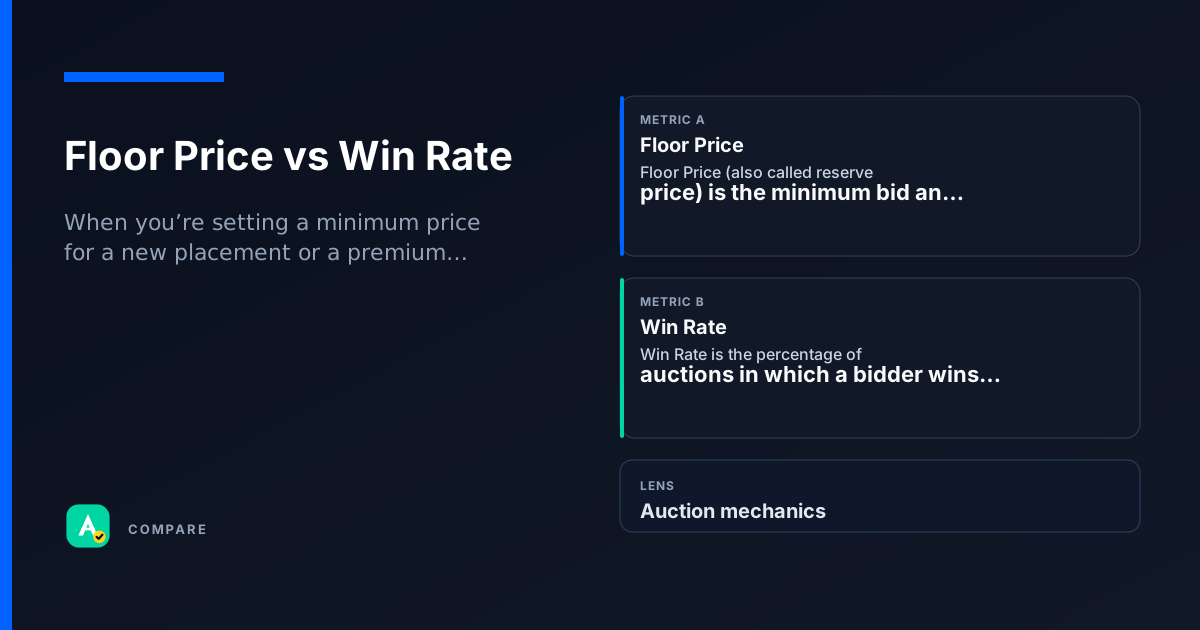
Floor Price is the minimum CPM you’ll accept for an impression. Win Rate is the share of bid requests where your floor was met and you won the auction. Together they reveal whether your pricing is too high (low win rate) or too low (leaving money on the table).
Core Difference: Control vs Outcome
Floor Price is a setting you control — the minimum CPM you require before selling an impression. Win Rate is a result — the percentage of bid requests that actually clear your floor and win the auction.
- Floor Price → input (what you ask for)
- Win Rate → output (how often the market agrees)
How they interact
- Raise your floor → fewer buyers qualify → win rate drops
- Lower your floor → more buyers qualify → win rate rises, but at lower CPMs
The sweet spot balances a floor high enough to protect yield but low enough to keep win rate healthy.
Which to Use When
Choose Floor Price when:
- You’re setting up a new placement and need a starting minimum.
- You want to protect brand safety or premium inventory from low bids.
- You’re A/B testing price floors across similar ad units.
Choose Win Rate when:
- You’re diagnosing why fill rate is low — is it a floor issue or a demand issue?
- You’re optimizing for volume (e.g., remnant inventory).
- You’re comparing two floors: the one with the higher win rate at a similar CPM is better.
Use both together when:
- You’re running a price floor experiment: track win rate at each floor level.
- You’re setting dynamic floors (e.g., via header bidding) — win rate tells you if the floor is too aggressive.
How they diverge
Input vs Output
Floor Price is a control variable you set before the auction. Win Rate is a performance metric that measures the outcome of that setting.
- Floor Price: you decide it.
- Win Rate: the market decides it.
Direction of Impact
Floor Price moves independently (you raise or lower it). Win Rate moves inversely to floor price.
- Higher floor → lower win rate.
- Lower floor → higher win rate (but possibly lower revenue).
Optimization Goal
Floor Price is optimized to maximize revenue per impression. Win Rate is optimized to maximize fill rate or auction participation.
- Floor Price: “How much do I want?”
- Win Rate: “How often do I sell?”
Where they overlap
Both Are Placement-Level Metrics
Both floor price and win rate are typically calculated per ad unit, not per user or session.
Both Depend on Auction Dynamics
Both are meaningless without a competitive auction — if only one bidder exists, win rate is binary and floor price is just a take-it-or-leave-it price.
Both Are Used in Yield Optimization
Publishers and ad ops teams track both to find the price point that maximizes revenue without killing demand.
Real scenarios
Publisher Sets a High Floor for Premium Inventory
Setup: A news site sets a $5.00 CPM floor on its homepage header.
- What happened: Win rate dropped from 80% to 30%.
- What they checked: They compared floor price vs win rate by placement. The high floor was pricing out most demand.
Takeaway: A high floor protects yield but can kill fill. Use win rate to validate whether the floor is realistic.
Ad Ops Lowers Floor to Boost Fill
Setup: A gaming site had 60% fill on a mid-roll video slot. They lowered the floor from $2.00 to $1.00.
- What happened: Win rate jumped to 90%, but average CPM dropped from $2.50 to $1.40.
- What they checked: They calculated revenue before and after: (fill × CPM). Revenue actually increased because volume made up for lower price.
Takeaway: Sometimes a lower floor with higher win rate yields more total revenue. Always test both metrics together.
How they work together
When you’re setting a minimum price for a new placement or a premium inventory segment. Floor Price is your first lever.
When you’re troubleshooting low fill — a low win rate tells you your floor may be too high or demand is weak.
When you’re running a price floor experiment. Track win rate at each floor level to find the point where revenue is maximized without collapsing demand.
Side-by-side snapshot
| Lens | Floor Price | Win Rate |
|---|---|---|
| Type | Setting (input) | Outcome (output) |
| Who Sets It | Publisher / Ad Ops | Market (buyers + auction) |
| Impact of Raising | Higher potential revenue per impression | Win rate decreases |
| Typical Range | Any CPM value (e.g., $0.50–$10.00) | 0%–100% |
| Used For | Yield protection, brand safety | Fill rate diagnosis, demand health |
Common pitfalls
Confusing Floor Price with Clearing Price
Why the confusion is wrong: Floor price is the minimum you accept; the clearing price is what the winner actually pays (often higher).
- What to do instead: Track both floor price and average CPM to see the gap. A large gap means you could raise the floor without hurting win rate much.
Optimizing Win Rate Alone
Why the confusion is wrong: A 100% win rate sounds great, but it means your floor is so low that you’re leaving money on the table.
- What to do instead: Set a target win rate (e.g., 60-80%) and adjust floor to hit it. Balance is key.
Quick check
Test whether you can tell these metrics apart.
single
Which metric is a setting you control before the auction?
Select an answer to continue
For learning only. Not advice on bids or spend.
You may also like
Metrics
Floor Price (Reserve Price)
Floor Price (also called reserve price) is the minimum bid an exchange or publisher will accept…
AuctionMetrics
Win Rate
Win Rate is the percentage of auctions in which a bidder wins the impression.
AuctionRelationships
Fill Rate vs Auction Latency
RelationshipsRelationships
Impression vs Reach
Relationships