#relationships·Jul 17, 2026·6 min read
Auction Latency vs Win Rate: Speed or Success in Programmatic Bidding
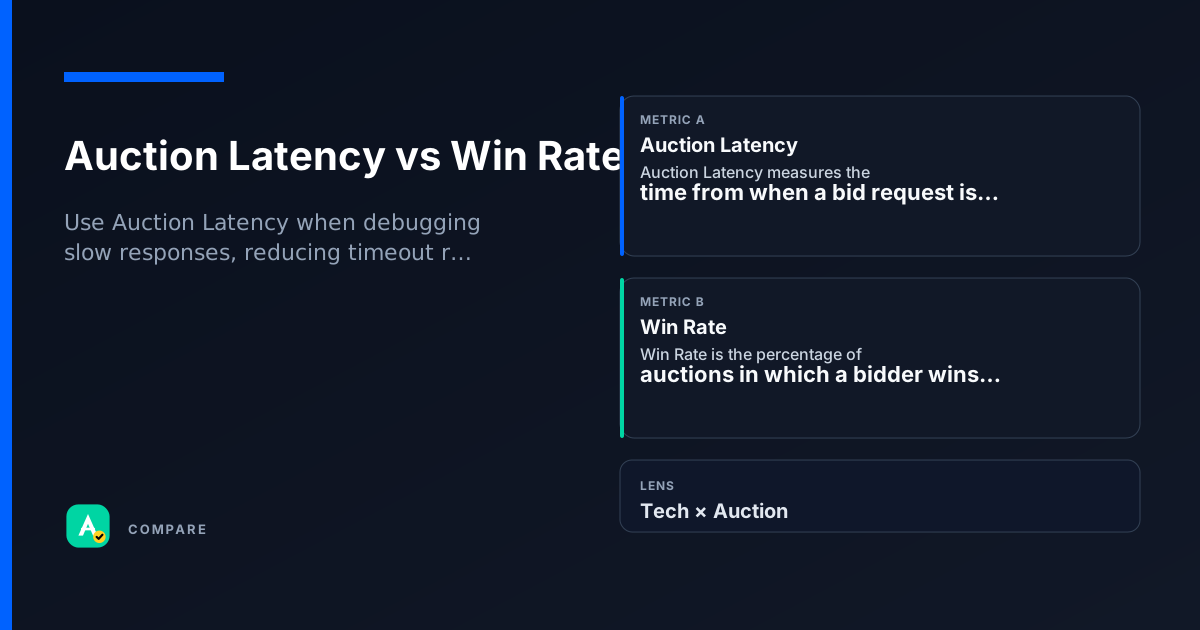
Should you optimize for faster auctions or higher win rates? Auction Latency measures how long an ad request takes to complete, while Win Rate tracks the percentage of bids that actually win. Together they reveal whether your bid strategy is fast enough to compete and effective enough to win.
Core Difference: Speed vs Success
Auction Latency is the time (in milliseconds) from bid request to response. It answers: How fast can my system respond?
Win Rate is the ratio of won impressions to total bids submitted (Win Rate = Won Bids / Total Bids × 100). It answers: How often does my bid win?
- Latency is a process metric — it reflects technical efficiency.
- Win Rate is an outcome metric — it reflects bid competitiveness.
A low latency does not guarantee a high win rate, and a high win rate may come at the cost of slower responses.
Which to Use When
Choose Auction Latency when:
- You suspect timeouts or slow server responses.
- You are optimizing infrastructure (e.g., cloud regions, CDN, bidder code).
- You want to reduce dropped bids due to timeout (common in mobile or video).
Choose Win Rate when:
- You are evaluating bid price strategy or creative performance.
- You want to compare your bid competitiveness against other buyers.
- You are A/B testing audience segments or targeting parameters.
Use both together when:
- You need to diagnose why a campaign is underdelivering — is it too slow (latency) or not competitive enough (win rate)?
How they diverge
What They Measure
- Auction Latency: Duration of the bid request-response cycle (ms).
- Win Rate: Percentage of bids that result in an impression.
Impact of Optimization
- Lowering latency can increase bid volume but may reduce bid quality.
- Raising win rate often requires higher bids or better creatives, which can increase latency.
Reporting Frequency
- Latency is typically monitored per request or aggregated as average/p95.
- Win Rate is a cumulative ratio over a time window (hourly, daily).
Where they overlap
Both Are Auction Diagnostics
Both metrics help you understand how your bidder performs in the RTB marketplace. Neither alone tells the full story.
Both Influence Revenue
High latency can cause timeouts and lost bids; low win rate means fewer impressions won. Both directly impact campaign delivery and monetization.
Real scenarios
Slow Bidder, High Win Rate
Setup: A DSP notices high win rate (25%) but low fill rate.
- What happened: The bidder was slow (latency > 400ms), causing many requests to timeout before the bid was submitted.
- What they checked: Auction Latency p95 was 450ms; Win Rate was 25% on completed bids.
Takeaway: High win rate on submitted bids masked a latency problem. Fixing latency increased total wins by 40%.
Fast Bidder, Low Win Rate
Setup: An exchange reports low win rate (2%) despite fast responses.
- What happened: The bid price was too low for the inventory quality.
- What they checked: Latency was 50ms (excellent), but Win Rate was 2%.
Takeaway: Speed alone doesn't win auctions. The bid price needed adjustment. Raising CPM by 15% improved win rate to 8%.
How they work together
Use Auction Latency when debugging slow responses, reducing timeout rates, or optimizing server infrastructure. It's the first check if you see high bid rejection due to timeout.
Use Win Rate when evaluating bid price competitiveness, creative effectiveness, or audience targeting. It's the key metric for bid strategy optimization.
Use both when a campaign is underdelivering: check latency first to rule out timeouts, then check win rate to see if bids are competitive. This sequence avoids wasted optimization effort.
Side-by-side snapshot
| Lens | Auction Latency | Win Rate |
|---|---|---|
| Definition | Time from bid request to response (ms) | Won bids / Total bids × 100 (%) |
| Primary Use | Infrastructure & timeout optimization | Bid price & creative strategy |
| Typical Range | 50–300 ms (varies by exchange) | 1–30% (varies by market) |
| Trade-off | Lower latency may reduce bid quality | Higher win rate may increase latency |
Common pitfalls
Confusing Low Latency with High Performance
A fast bidder that loses most auctions is still underperforming. Low latency is necessary but not sufficient.
- What to do instead: Always pair latency with win rate to assess both speed and competitiveness.
Optimizing Win Rate Without Considering Latency
Raising bids to boost win rate can increase latency if your bidder becomes slower under higher load.
- What to do instead: Monitor latency during win rate optimization. If latency rises, scale infrastructure or optimize bid logic.
Quick check
Test whether you can tell these metrics apart.
boolean
A high Win Rate always means your bidder is fast.
Select an answer to continue
For learning only. Not advice on bids or spend.
You may also like
Metrics
Auction Latency
Auction Latency measures the time from when a bid request is sent to when the auction decision…
TechMetrics
Win Rate
Win Rate is the percentage of auctions in which a bidder wins the impression.
AuctionRelationships
Impression vs Reach
RelationshipsRelationships
CPC vs Quality Score
Relationships