Jul 17, 2026·7 min read
Win Rate
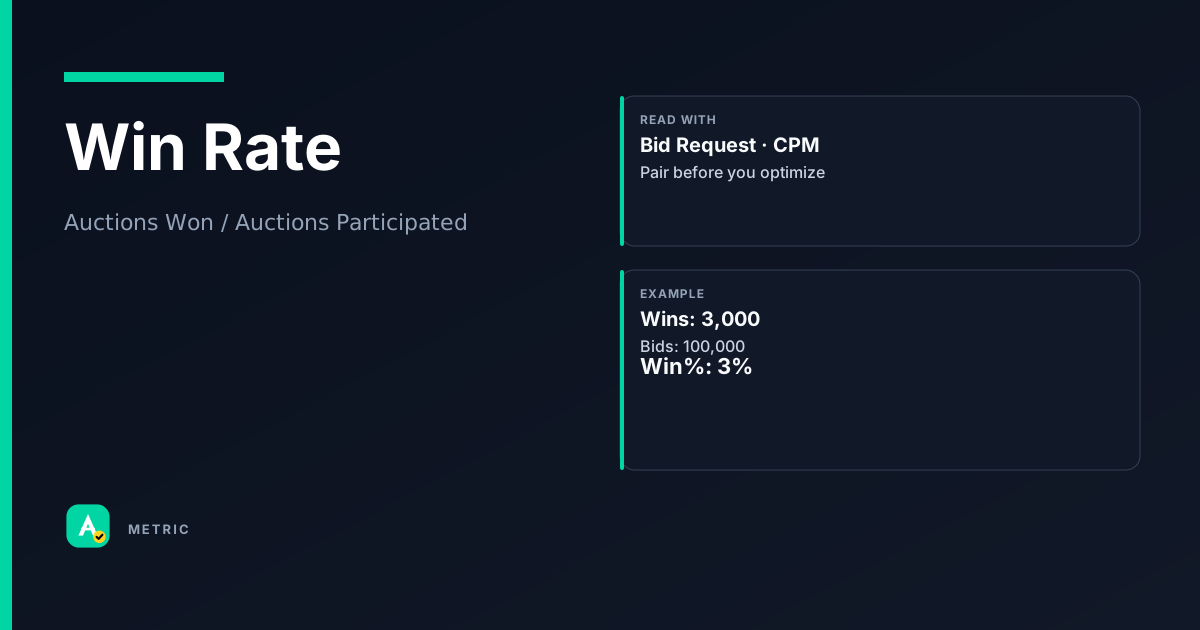
Win Rate is the percentage of auctions in which a bidder wins the impression. It is a direct measure of competitiveness in the real-time bidding (RTB) marketplace. A low win rate paired with high bid volume often signals mispriced bids or aggressive floor prices. Always interpret win rate alongside CPM and floor price.
What Win Rate is
Win Rate answers a simple question: of all the auctions you participated in, how many did you win? It is the most basic pulse check for bid competitiveness in programmatic advertising.
Platforms define the denominator differently. Some count every bid request the DSP received; others count only bids actually sent to the exchange. The difference matters — a DSP that throttles bids aggressively may report a high win rate on sent bids while missing many eligible auctions.
Why it matters
- A win rate that is too low means your bids are losing consistently. You are spending on bid processing without winning impressions.
- A win rate that is too high (above 80-90% on open exchange) may mean you are overpaying or missing valuable low-price inventory.
- The sweet spot depends on your vertical, audience, and auction type (first-price vs. second-price).
So what? Win rate is a directional signal, not a standalone KPI. Always pair it with loss reason data from OpenRTB loss notices to understand why you lost.
How it is calculated
Win Rate = Auctions Won / Auctions Participated
Most platforms express this as a percentage. The denominator is the key variable.
Denominator caveats
- Bids sent — only auctions where the DSP actually submitted a bid. This is the most common definition in DSP analytics.
- Bid requests received — includes auctions the DSP chose not to bid on. This definition yields a lower rate and reflects targeting efficiency.
- Bid responses with a valid price — some platforms exclude bids that were filtered by the exchange before the auction.
Example
- A DSP receives 10,000 bid requests.
- It sends bids on 4,000 of them.
- It wins 200 auctions.
- Win rate on bids sent: 200 / 4,000 = 5%
- Win rate on bid requests: 200 / 10,000 = 2%
Check your vendor's definition. The same campaign can show 2% or 5% depending on the denominator.
How to read it in a dashboard
A single win rate number tells you almost nothing. You need context.
What to pair it with
- Bid volume — high bid volume + low win rate = uncompetitive bids or floors set too high.
- Average CPM — if win rate drops as CPM rises, you may be hitting a price ceiling.
- Loss reason breakdown — OpenRTB loss notices tell you if you lost on price, floor, or brand safety filters.
Common dashboard patterns
- Win rate < 2% on bids sent — your bids are rarely competitive. Review bid price strategy and audience targeting.
- Win rate > 50% on open exchange — you may be bidding too high. Check if you are winning only expensive inventory.
- Win rate stable but CPM climbing — the market is getting more expensive. Your bids are keeping pace, but efficiency is dropping.
So what? Use win rate as a diagnostic, not a target. A "good" win rate for a retargeting campaign (often 10-20%) looks very different from a prospecting campaign (often 1-5%).
What usually moves this metric
Bid price
Raising your bid CPM directly increases win rate — but at the cost of efficiency. The relationship is not linear: doubling bid price rarely doubles win rate.
Floor price
If a publisher raises the floor price, your existing bids may suddenly lose. Check if win rate drops correlate with specific publishers or deals.
Audience targeting
Narrow audiences reduce the pool of eligible auctions. You may win a higher percentage of the few auctions you enter, but total wins may drop.
Creative and format
Rich media, video, or interactive creatives sometimes have higher win rates because fewer bidders support them. Standard display banners face more competition.
Tradeoffs
- Chasing win rate in isolation can lead to overbidding. A 50% win rate with a 10% margin is worse than a 5% win rate with a 50% margin.
- Improving win rate by lowering floors (as a publisher) may increase fill but reduce revenue per impression.
- Improving win rate by narrowing targeting may reduce scale. Balance win rate with reach goals.
Formula
Denominator varies by platform: bids sent vs. bid requests received. Always verify which one your dashboard uses.
Scenarios
The retargeting campaign that won everything
A travel advertiser saw win rate climb to 65% on a retargeting campaign. What happened: Their bid was set to a fixed $5 CPM while the average winning bid was $2.50. What they did: Switched to a bid cap strategy and lowered the bid to $3. Takeaway: A very high win rate on open exchange usually means you are overpaying.
The prospecting campaign that won nothing
A home-services advertiser launched a broad prospecting campaign and saw win rate below 1%. Cause: Their $0.50 CPM bid was below the $0.80 floor on most inventory. Fix: Raised bid to $0.90 and added loss reason analysis to confirm floor issues. Takeaway: Low win rate + high bid volume = check floor prices and bid competitiveness.
The publisher who raised floors and lost revenue
A news publisher raised floor prices by 30% to boost CPM. What happened: Win rate dropped from 25% to 8%. Total revenue fell because fewer impressions sold. What they did: Lowered floors back to original and used price floor optimization tools. Takeaway: For publishers, win rate is a proxy for fill rate. Raising floors without testing can backfire.
Common pitfalls
Comparing win rates across platforms
DSP A defines win rate as wins / bids sent. DSP B defines it as wins / bid requests. The numbers look different even for the same campaign.
- What to do: Always check the denominator definition before comparing. Use a consistent source of truth.
Optimizing for win rate alone
A common Slack advice trap: "Our win rate is only 3%, we need to raise bids." But if the campaign is profitable at 3%, raising bids may destroy margin.
- What to do: Optimize for ROAS or target CPA, not win rate. Use win rate as a diagnostic, not a goal.
Ignoring loss reasons
A low win rate could mean your bids are too low — or it could mean your creative was filtered by brand safety rules. Without loss reason data, you are guessing.
- What to do: Enable OpenRTB loss notices in your DSP. Categorize losses by reason (price, floor, blocked, etc.) before taking action.
Summary
Win Rate is a vital diagnostic for auction competitiveness, but it is meaningless without context — bid volume, CPM, and loss reasons.
- Always verify your platform's denominator definition.
- Pair win rate with loss reason data to diagnose why you are losing.
- Do not optimize for win rate in isolation; it is a means to an end, not a KPI.
Quick check
Confirm you understood this article.
boolean
Win Rate is always calculated as wins divided by bid requests received.
Select an answer to continue
Related metrics
References
- OpenRTB win/loss notification concepts — IAB Tech Lab (https://iabtechlab.com/standards/openrtb/)
- DSP/SSP auction analytics practice — industry standard
- Google Ads Help glossary — conceptual reference
For learning only. Not advice on bids or spend.
You may also like
Metrics
Bid Request (OpenRTB)
A Bid Request is the message an ad exchange sends to bidders (DSPs) to describe available inven…
AuctionMetrics
Cost Per Mille (CPM)
CPM (Cost Per Mille) is the price an advertiser pays for 1,000 ad impressions.
CostMetrics
Floor Price (Reserve Price)
Floor Price (also called reserve price) is the minimum bid an exchange or publisher will accept…
AuctionMetrics
Impression
An impression is counted each time an ad is fetched and displayed to a user, per the platform’s…
Delivery