#relationships·Jul 17, 2026·6 min read
CVR vs ROAS: Which Metric Tells You If Your Campaign Actually Made Money?
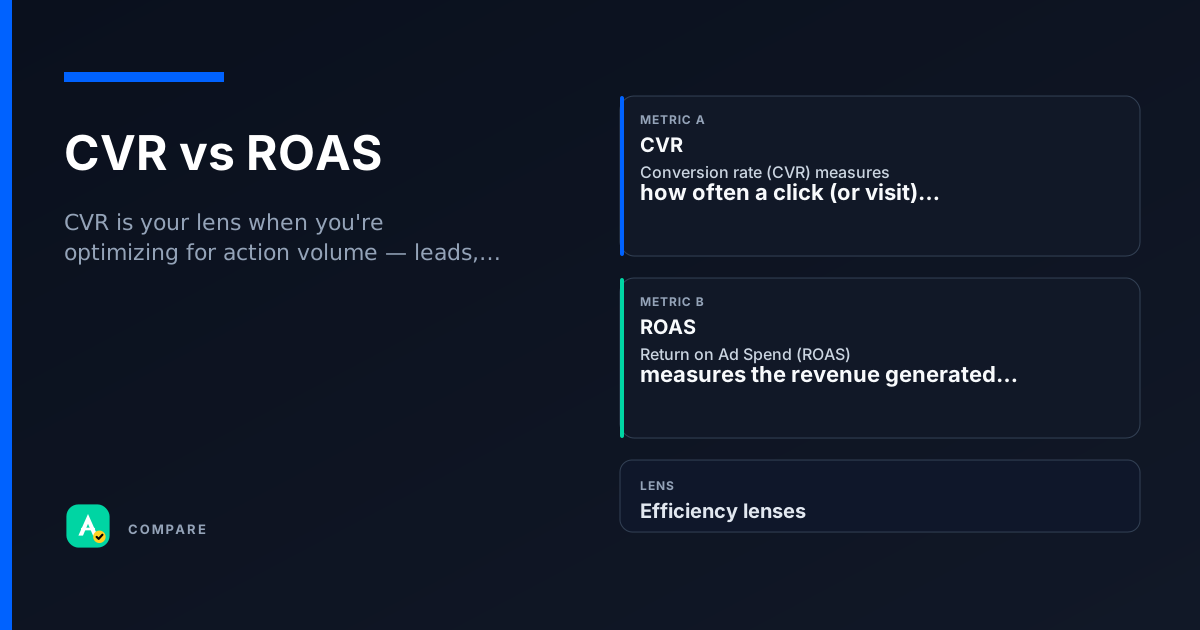
CVR (Conversion Rate) tells you how often clicks turn into actions. ROAS (Return on Ad Spend) tells you whether those actions earned back more than you spent. One measures efficiency, the other measures profitability.
Core difference: Efficiency vs. Profitability
The decision question: Did my ad just get people to act, or did it make money?
- CVR = Conversions / Clicks. It measures how well your landing page or offer converts traffic.
- ROAS = Revenue / Ad Spend. It measures the financial return on every dollar you invested.
A high CVR can still lose money if the product margin is thin or the average order value is low. A low CVR can still be profitable if each conversion brings high revenue.
Bottom line: CVR is a process metric; ROAS is a business metric.
Which to use when
Choose CVR when:
- You're A/B testing landing pages, forms, or checkout flows.
- You want to diagnose where traffic drops off in the funnel.
- Your goal is lead generation or sign-ups (no immediate revenue).
Choose ROAS when:
- You need to justify ad spend to stakeholders.
- You're optimizing for purchase value, not just volume.
- Margins matter — a high CVR with low AOV can still be unprofitable.
Use both when:
- You run e-commerce campaigns and need to balance conversion volume with profitability.
- You're scaling budgets and want to catch efficiency drops before they hurt returns.
How they diverge
What they measure
- CVR: Ratio of conversions to clicks (or impressions).
- ROAS: Ratio of revenue to ad spend.
CVR ignores revenue; ROAS ignores conversion volume.
Formula
- CVR: Conversions / Clicks × 100%.
- ROAS: Revenue / Ad Spend.
ROAS is a multiplier (e.g., 4.0 means $4 earned per $1 spent).
Optimization target
- CVR: Improve landing page, offer, or audience relevance.
- ROAS: Improve pricing, upsells, or reduce cost per click.
A CVR win can be a ROAS loss if the conversion value drops.
Where they overlap
Both are post-click ratios
Neither metric matters without a click or impression. Both require conversion tracking to be meaningful.
Both can be gamed by attribution
Changing the attribution window or model (last-click vs. linear) shifts both CVR and ROAS. Always compare apples to apples.
Both are used for campaign comparison
Ad platforms (Google Ads, Meta) let you optimize toward either CVR or ROAS via bid strategies like Target CPA or Target ROAS.
Real scenarios
High CVR, low ROAS — the margin trap
Setup: An e-commerce store runs a flash sale ad. CVR jumps to 8% (above average).
- What happened: The discount drove many small purchases. Average order value dropped.
- What they checked: ROAS was only 1.1 — barely breaking even after product costs.
Takeaway: High CVR can mask poor profitability. Always pair CVR with ROAS when margins are thin.
Low CVR, high ROAS — the premium niche
Setup: A luxury watch brand runs a display campaign. CVR is 0.5%.
- What happened: Few clicks converted, but each sale averaged $5,000.
- What they checked: ROAS was 8.0 — extremely profitable despite low conversion efficiency.
Takeaway: Low CVR is acceptable if the revenue per conversion is high enough. ROAS is the final judge.
How they work together
CVR is your lens when you're optimizing for action volume — leads, sign-ups, or downloads. It's the go-to metric for top-of-funnel diagnostics and landing page tests.
ROAS is your lens when the financial outcome matters — e-commerce, subscriptions, or any campaign where revenue per conversion varies. It tells you if you're actually making money.
Use both when you need to balance volume and value. Example: a campaign with CVR = 5% and ROAS = 1.2 may need a lower CVR but higher AOV to be sustainable.
Side-by-side snapshot
| Lens | CVR | ROAS |
|---|---|---|
| Formula | Conversions / Clicks | Revenue / Ad Spend |
| Unit | Percentage (%) | Multiplier (e.g., 3.5x) |
| Tells you | How well you convert traffic | How much profit per ad dollar |
| Best for | Lead gen, sign-ups, funnel diagnostics | E-commerce, subscriptions, revenue goals |
| Can be high while... | ROAS is low (cheap conversions, low value) | CVR is low (few conversions, high value) |
Common pitfalls
Optimizing CVR without checking ROAS
Why it's wrong: You can raise CVR by lowering prices or offering free shipping, but that may crush margins.
- What to do instead: Set a minimum ROAS floor before optimizing CVR. Use ROAS as the guardrail.
Comparing CVR across different funnels
Why it's wrong: A top-of-funnel ad (awareness) will have lower CVR than a retargeting ad (purchase intent). Comparing them directly leads to bad budget decisions.
- What to do instead: Segment by funnel stage. Compare CVR within the same stage, and use ROAS to judge overall campaign health.
Quick check
Test whether you can tell these metrics apart.
boolean
A high CVR always means a campaign is profitable.
Select an answer to continue
For learning only. Not advice on bids or spend.
You may also like
Metrics
Conversion Rate (CVR)
Conversion rate (CVR) measures how often a click (or visit) leads to a desired action — a purch…
PerformanceMetrics
Return on Ad Spend (ROAS)
Return on Ad Spend (ROAS) measures the revenue generated for every dollar spent on advertising.
PerformanceRelationships
Frequency vs Impression
RelationshipsRelationships
CTR vs Quality Score
Relationships