#relationships·Jul 17, 2026·6 min read
CPM vs CTR: Which Metric Tells You More About Campaign Performance?
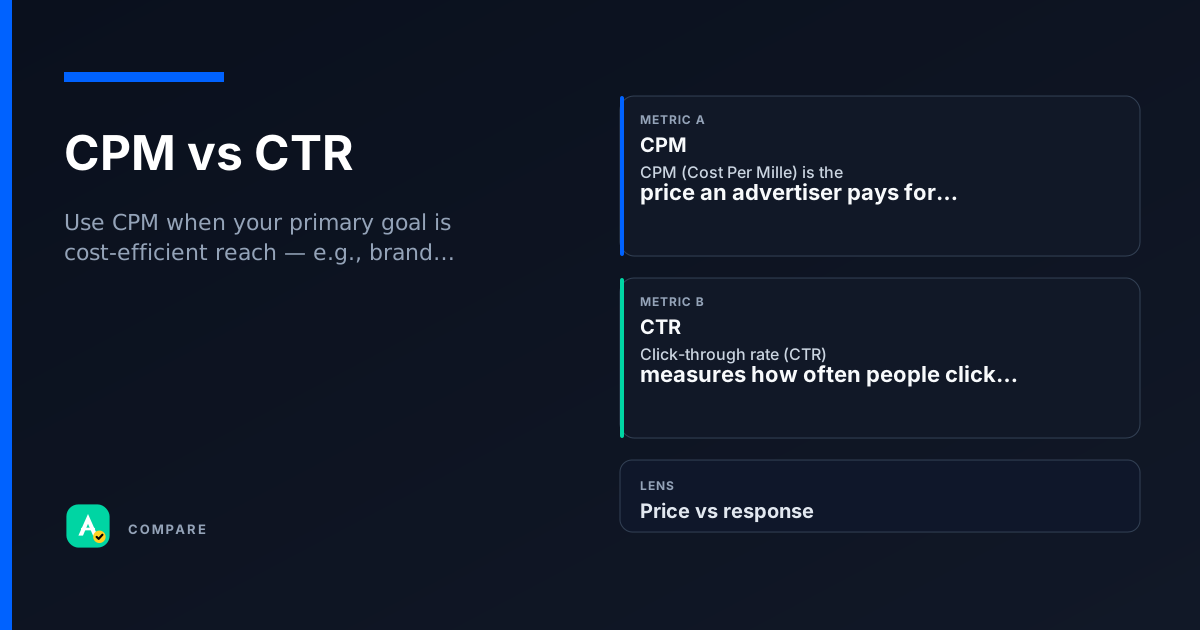
CPM (cost per mille) tells you how much you pay for 1,000 ad impressions. CTR (click-through rate) tells you the percentage of people who clicked after seeing the ad. One measures cost efficiency; the other measures engagement.
Core Difference: Cost vs. Engagement
The question these two metrics answer is: “Am I paying too much to be seen, and once seen, does anyone care?”
- CPM = Cost ÷ (Impressions / 1,000). It’s a pure cost-efficiency ratio. A low CPM means you’re buying reach cheaply.
- CTR = Clicks ÷ Impressions × 100. It’s a pure engagement ratio. A high CTR means the creative or offer resonates.
Why they don’t move together
- A low CPM can come from cheap, low-attention inventory (e.g., banner waste). That same inventory often yields a low CTR.
- A high CTR can come from a highly targeted, expensive placement (high CPM).
So what: CPM tells you about supply cost; CTR tells you about audience response. Optimizing one can hurt the other.
Which to Use When
Pick CPM when:
- You’re running a brand awareness or reach campaign.
- You care about cost efficiency of eyeballs, not clicks.
- You’re buying programmatic guaranteed or PMP deals.
Pick CTR when:
- You’re running a direct response or traffic campaign.
- You want to test creative variants (higher CTR = better hook).
- You’re optimizing for landing page visits.
Use both together when:
- You need to diagnose a campaign: low CTR + low CPM = cheap but ignored. High CPM + high CTR = expensive but engaging.
- You’re building a view-through attribution model.
How they diverge
What They Measure
- CPM measures cost per thousand impressions (supply-side efficiency).
- CTR measures clicks per impression (demand-side interest).
Optimization Goal
- CPM → Lower is better (cheaper reach).
- CTR → Higher is better (more engagement).
Typical Use Case
- CPM → Brand awareness, reach extension, video viewability.
- CTR → Traffic campaigns, A/B testing ad copy, retargeting.
Where they overlap
Both Use Impressions
Both metrics have impressions in the denominator. A change in impression count (e.g., due to ad fraud or viewability filtering) affects both.
Both Are Top-of-Funnel
Neither CPM nor CTR tells you about conversions, revenue, or ROI. They are early indicators of campaign health, not final outcomes.
Both Are Platform-Agnostic
You can compute CPM and CTR on any ad platform (Google Ads, Meta, LinkedIn, programmatic DSPs). They are universal benchmarks.
Real scenarios
Brand Awareness Campaign with Low CTR
Setup: A CPG brand runs a display campaign on a premium news site with a $10 CPM.
- What happened: CTR is 0.02%, far below the 0.10% benchmark.
- What they checked: They looked at CPM (good) and CTR (bad). The low CTR wasn’t a problem — the goal was reach, not clicks.
Takeaway: For brand campaigns, optimize CPM, not CTR. A low CTR is expected when the ad is not designed to drive clicks.
Direct Response Campaign with High CPM
Setup: A DTC brand runs a Facebook traffic campaign targeting high-intent audiences.
- What happened: CPM is $25 (high), but CTR is 3.5% (very high).
- What they checked: They compared CPM vs. CTR across ad sets. The high CPM was justified by the high CTR.
Takeaway: Don’t kill a high-CPM placement if CTR is strong. The cost per click (CPC) may still be acceptable.
How they work together
Use CPM when your primary goal is cost-efficient reach — e.g., brand awareness campaigns, video pre-roll, or OOH digital. You’re buying impressions, not actions.
Use CTR when you need to measure creative effectiveness or drive traffic to a landing page. It’s the go-to metric for A/B testing ad copy, images, and calls-to-action.
Use both when diagnosing a campaign: compare CPM vs. CTR across placements to spot cheap-but-ignored inventory (low CPM, low CTR) vs. expensive-but-engaging placements (high CPM, high CTR).
Side-by-side snapshot
| Lens | CPM | CTR |
|---|---|---|
| Formula | Cost / (Impressions / 1,000) | (Clicks / Impressions) × 100 |
| Unit | Currency per 1,000 impressions (e.g., $5 CPM) | Percentage (e.g., 0.50%) |
| What It Tells You | How cheaply you bought reach | How engaging your ad is |
| Optimization Direction | Lower is better | Higher is better |
| Typical Campaign Goal | Brand awareness, reach | Traffic, engagement, creative testing |
| Impact of Ad Fraud | Inflates CPM (paying for fake impressions) | Deflates CTR (fake impressions don’t click) |
Common pitfalls
Optimizing CPM Without Considering CTR
The confusion: “Lower CPM always means better performance.”
- What to do instead: A low CPM on junk inventory (e.g., pop-unders, low-viewability placements) will also have a low CTR. You save money but get no engagement. Always pair CPM with CTR to assess quality of reach.
Using CTR as a Proxy for Success in Brand Campaigns
The confusion: “If CTR is low, the campaign failed.”
- What to do instead: For brand awareness, CTR is often irrelevant. Users may see the ad, remember the brand, and convert later via search. Use brand lift studies or view-through conversions instead.
Quick check
Test whether you can tell these metrics apart.
single
Which metric is expressed as a percentage?
Select an answer to continue
For learning only. Not advice on bids or spend.
You may also like
Metrics
Cost Per Mille (CPM)
CPM (Cost Per Mille) is the price an advertiser pays for 1,000 ad impressions.
CostMetrics
Click-through rate (CTR)
Click-through rate (CTR) measures how often people click your ad after seeing it.
EngagementRelationships
CPM vs Reach
RelationshipsRelationships
Budget Pacing vs CPC
Relationships