#relationships·Jul 17, 2026·6 min read
CTR vs CPC: Which Ad Metric Should You Optimize For?
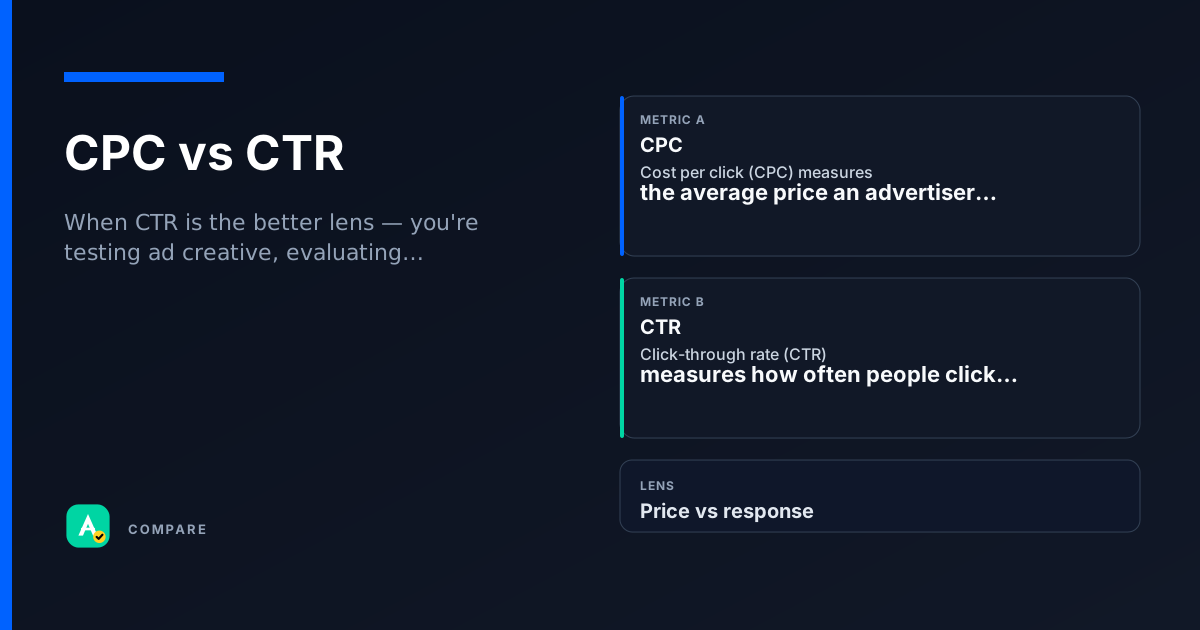
CTR (Click-Through Rate) measures how often people click your ad after seeing it. CPC (Cost Per Click) measures how much you pay for each of those clicks. Both are essential, but they answer different questions about your campaign's health.
Core Difference: Engagement vs. Cost Efficiency
CTR = (Clicks / Impressions) × 100%. It tells you how compelling your ad creative and targeting are.
CPC = Total Spend / Clicks. It tells you how efficiently you're buying those clicks.
- CTR focuses on user behavior: are people interested enough to click?
- CPC focuses on financial efficiency: are you getting clicks at a reasonable price?
A high CTR with a high CPC might mean your ad is relevant but in a competitive auction. A low CTR with a low CPC could mean your ad is cheap but ignored.
Which to Use When
Choose CTR when:
- Testing ad copy, images, or calls-to-action.
- Evaluating audience relevance (are you reaching the right people?).
- Brand awareness campaigns where engagement matters more than cost.
Choose CPC when:
- Managing budget and maximizing click volume for a fixed spend.
- Comparing auction efficiency across platforms (Google vs. Meta).
- Optimizing for conversions — lower CPC often means lower CPA, if conversion rate holds.
Use both together to spot problems: high CTR + high CPC = competitive niche; low CTR + low CPC = poor relevance but cheap.
How they diverge
What They Measure
CTR measures user engagement — the percentage of impressions that result in a click.
- CTR = Clicks / Impressions × 100%
- CPC = Total Cost / Clicks
CPC measures cost efficiency — the average price paid per click.
Optimization Focus
CTR is optimized by improving creative relevance: headlines, images, targeting, and ad copy.
CPC is optimized by improving auction performance: Quality Score, bid strategy, and audience competition.
Impact on Campaign Goals
CTR directly affects ad rank and Quality Score (Google Ads).
CPC directly affects budget consumption and ROAS (Return on Ad Spend).
A high CTR doesn't guarantee low CPC — competitive keywords can have both.
Where they overlap
Both Use Clicks as Input
Both metrics rely on the same click event. You can't calculate one without the other's raw data.
Both Are Ratios
They normalize performance so you can compare campaigns of different sizes or time periods.
Both Influence Quality Score
In Google Ads, a high CTR can lower your CPC by improving Quality Score — linking the two metrics indirectly.
Real scenarios
The Creative Refresh
A brand runs two ad sets with identical targeting but different headlines.
- What happened: Ad A has CTR 2.5%, Ad B has CTR 1.2%.
- What they checked: CPC was $0.80 for both — same audience, same bid.
Takeaway: CTR revealed which creative resonated. CPC was irrelevant here because cost per click was identical.
The Budget Squeeze
A small business needs to stretch a $500 monthly budget.
- What happened: Campaign X has CTR 3.0% but CPC $1.50; Campaign Y has CTR 1.0% but CPC $0.40.
- What they checked: With $500, Campaign X yields ~333 clicks, Campaign Y yields ~1,250 clicks.
Takeaway: CPC was the deciding factor — more clicks for the same budget, even with lower engagement.
How they work together
When CTR is the better lens — you're testing ad creative, evaluating audience relevance, or running a brand awareness campaign where engagement is the primary KPI.
When CPC is the better lens — you're managing a fixed budget, comparing cost efficiency across platforms, or optimizing for conversion volume (lower CPC often leads to lower CPA).
When you need both together — you're diagnosing campaign health: high CTR + high CPC = competitive but relevant; low CTR + low CPC = cheap but ignored. Use both to decide next steps.
Side-by-side snapshot
| Lens | CPC | CTR |
|---|---|---|
| Definition | Clicks / Impressions × 100% | Total Spend / Clicks |
| What It Tells You | How engaging your ad is | How much each click costs |
| Optimization Lever | Creative, targeting, ad copy | Bid strategy, Quality Score, competition |
| Impact on Budget | Indirect (via Quality Score) | Direct (cost per click) |
| Best Used For | A/B testing creative, brand awareness | Budget management, cost efficiency |
Common pitfalls
Chasing CTR at the Expense of CPC
Some advertisers optimize for high CTR using clickbait or overly broad targeting.
- Why it's wrong: High CTR can drive up CPC if the ad is irrelevant to the audience (low Quality Score).
- What to do instead: Balance CTR with CPC — a moderate CTR with a low CPC often outperforms a high CTR with a high CPC in terms of total conversions.
Ignoring CTR When CPC Is Low
A low CPC might feel like a win, but if CTR is also low, your ad is being ignored.
- Why it's wrong: Low CPC + low CTR means you're paying little for clicks nobody wants — wasted impressions.
- What to do instead: Use CTR as a relevance check. If CTR is below 0.5% (display) or 1% (search), refresh your creative even if CPC looks good.
Quick check
Test whether you can tell these metrics apart.
single
Which metric is calculated as Clicks / Impressions × 100%?
Select an answer to continue
For learning only. Not advice on bids or spend.
You may also like
Metrics
Cost per click (CPC)
Cost per click (CPC) measures the average price an advertiser pays each time someone clicks the…
CostMetrics
Click-through rate (CTR)
Click-through rate (CTR) measures how often people click your ad after seeing it.
EngagementRelationships
CPA vs ROI
RelationshipsRelationships
Auction Latency vs Win Rate
Relationships