#relationships·Jul 17, 2026·6 min read
Attribution vs CVR: Which Metric Tells the Full Story of Ad Performance?
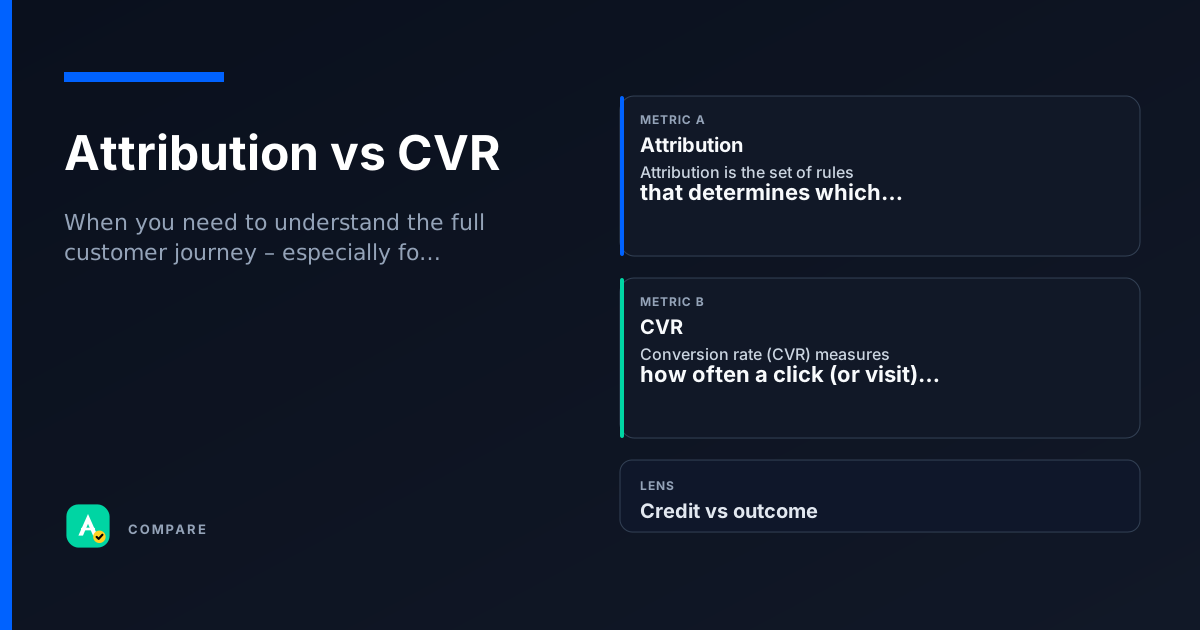
Attribution and CVR (Conversion Rate) are two sides of the same coin. Attribution reveals which touchpoints get credit for a conversion, while CVR measures how often a click or impression leads to a conversion.
Core Difference: Credit vs Rate
Attribution answers “Who gets the credit?” – it distributes conversion value across multiple touchpoints (first click, last click, linear, etc.).
CVR answers “How efficient is this channel?” – it’s a simple ratio: conversions / clicks (or impressions).
Key contrast
- Attribution is about path and weight.
- CVR is about immediate yield.
So what? High CVR doesn’t mean good attribution – a last-click channel may steal credit from earlier awareness touchpoints.
Which to use when
Pick Attribution when:
- You need to understand the full customer journey (multi-touch).
- You’re optimizing for brand awareness or upper-funnel channels.
- You want to reallocate budget across channels based on contribution.
Pick CVR when:
- You’re running direct-response campaigns (e.g., retargeting, shopping ads).
- You need a quick, intuitive performance check.
- You’re comparing similar channels with comparable attribution models.
Use both when:
- You want to validate that high CVR channels are not over-credited by last-click.
- You’re building a holistic measurement framework (e.g., media mix + attribution + CVR).
How they diverge
What they measure
Attribution measures credit distribution across touchpoints.
CVR measures conversion efficiency (conversions / clicks).
Time horizon
Attribution often looks at a window (e.g., 30-day click-through).
CVR is usually immediate (same session or day).
Optimization use
Attribution guides budget allocation and channel mix.
CVR guides ad creative and landing page optimization.
Where they overlap
Both need conversion tracking
Without a conversion event (purchase, sign-up, etc.), neither metric exists. Both rely on the same tracking infrastructure.
Both can be gamed
High CVR can be inflated by click fraud; attribution models can be manipulated by channel self-attribution. Both require careful data hygiene.
Both are used in reporting
Ad platforms (Google Ads, Meta) surface both metrics in dashboards. Practitioners often look at them side-by-side.
Real scenarios
The last-click trap
Setup: A retailer runs display ads (awareness) and search ads (retargeting). Search shows 5% CVR, display shows 0.5% CVR.
- What happened: Last-click attribution gives 100% credit to search.
- What they checked: Multi-touch attribution revealed display drove 40% of assisted conversions.
Takeaway: High CVR doesn’t mean high contribution – attribution reveals the hidden assist.
CVR as a sanity check
Setup: A SaaS company uses data-driven attribution. One channel shows 20% attributed conversions but only 1% CVR.
- What happened: The channel had high impression volume but low click-through – attribution over-credited it.
- What they checked: CVR flagged the inefficiency.
Takeaway: Use CVR to ground attribution in actual click performance.
How they work together
When you need to understand the full customer journey – especially for upper-funnel channels like display, video, or social awareness.
When you need a quick, comparable efficiency metric across campaigns, ad groups, or landing pages.
When you want to validate that high-CVR channels are not over-credited by last-click attribution. Use both to build a balanced view.
Side-by-side snapshot
| Lens | Attribution | CVR |
|---|---|---|
| Primary question | Which touchpoints get credit? | How efficient is this channel? |
| Calculation | Weighted distribution of conversion value across touchpoints | Conversions / Clicks (or Impressions) |
| Optimization focus | Budget allocation, channel mix | Ad creative, landing page, audience |
| Time window | Often multi-day (e.g., 30-day click-through) | Usually same session or day |
| Common pitfalls | Over-crediting last-click or first-click | Ignoring assisted conversions, click fraud |
Common pitfalls
Confusing rate with credit
Why the confusion is wrong: A channel with high CVR may still be a low contributor to overall conversions if it only reaches a small audience.
- What to do instead: Always pair CVR with attributed conversion volume or assisted conversions.
Over-relying on last-click attribution
Why the confusion is wrong: Last-click inflates CVR for bottom-funnel channels and hides awareness efforts.
- What to do instead: Use multi-touch attribution (e.g., linear, time-decay) to get a fairer view of channel performance.
Quick check
Test whether you can tell these metrics apart.
single
Which metric distributes credit across multiple touchpoints?
Select an answer to continue
For learning only. Not advice on bids or spend.
You may also like
Metrics
Attribution (Conversion Attribution)
Attribution is the set of rules that determines which touchpoints in a customer’s journey get c…
MeasurementMetrics
Conversion Rate (CVR)
Conversion rate (CVR) measures how often a click (or visit) leads to a desired action — a purch…
PerformanceRelationships
CPI vs ROAS
RelationshipsRelationships
CPI vs LTV
Relationships