#relationships·Jul 17, 2026·6 min read
CPA vs CPL: Which Cost Metric Should You Use for Your Campaigns?
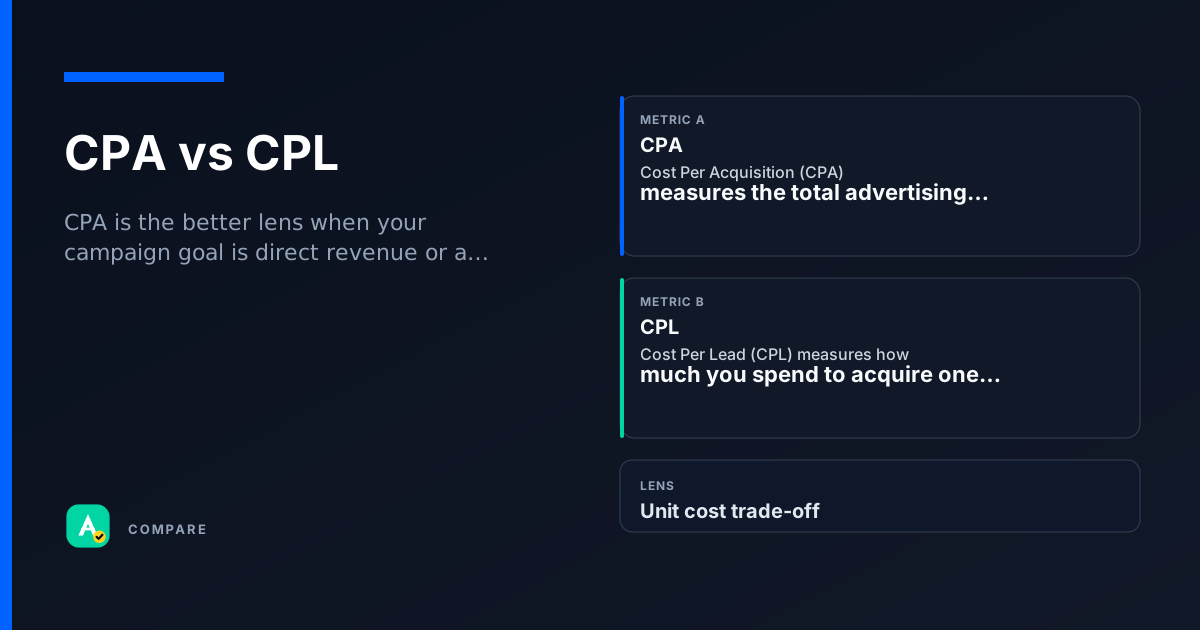
CPA (Cost Per Acquisition) and CPL (Cost Per Lead) both measure campaign cost efficiency, but they answer different questions. CPA tracks the cost of a completed sale or conversion, while CPL tracks the cost of capturing a prospect’s interest.
Core Difference: Action vs. Interest
CPA counts only when a user completes a desired action (e.g., purchase, sign-up, download). CPL counts every time a user submits their contact info or shows interest.
- CPA = total ad spend / number of acquisitions
- CPL = total ad spend / number of leads
Why it matters
- CPA is closer to revenue, so it’s better for bottom-line ROI.
- CPL is useful for top-of-funnel campaigns where you nurture leads later.
Example: A $100 campaign that generates 10 leads (CPL=$10) and 2 sales (CPA=$50).
Which to use when
Pick CPA when:
- Your goal is direct sales or sign-ups.
- You have a clear conversion funnel.
- You need to prove ROI to stakeholders.
Pick CPL when:
- You’re building a pipeline for future sales.
- Your product has a long sales cycle (e.g., B2B).
- You want to test messaging before optimizing for conversions.
Use both together when you want to see how lead quality affects final acquisition cost.
How they diverge
Definition of success
CPA counts a completed action (purchase, subscription). CPL counts a lead form submission.
- CPA: user must finish the full conversion.
- CPL: user only needs to show interest.
Funnel position
CPA is a bottom-of-funnel metric. CPL is a mid-funnel metric.
- CPA: measures final conversion.
- CPL: measures lead generation.
Optimization focus
CPA optimization targets conversion rate and checkout flow. CPL optimization targets form design and offer relevance.
- CPA: reduce friction in purchase.
- CPL: increase form completions.
Where they overlap
Cost-per-action models
Both are cost-per-action (CPA) models where you pay only when a user completes a predefined action.
Used in performance campaigns
Both are standard metrics in Google Ads, Meta Ads, and programmatic buying (OpenRTB).
Can be optimized via bidding
Both can be used as target metrics in automated bidding strategies (e.g., Target CPA, Target CPL).
Real scenarios
B2B SaaS free trial campaign
A company runs LinkedIn ads offering a free trial.
- What happened: They tracked CPL at $15, but CPA (trial-to-paid) was $150.
- What they checked: They compared CPL vs CPA to see that while leads were cheap, only 10% converted.
Takeaway: CPL alone hid the conversion problem; CPA revealed the real cost.
E-commerce flash sale
A retailer runs Facebook ads for a 24-hour sale.
- What happened: They optimized for CPA and got $12 per purchase. CPL was irrelevant because they didn’t need leads.
- What they checked: They ignored CPL and focused on CPA.
Takeaway: For direct sales, CPA is the only metric that matters.
How they work together
CPA is the better lens when your campaign goal is direct revenue or a clear conversion event. Use it for e-commerce, app installs, or subscription sign-ups.
CPL is the better lens when you’re building a lead pipeline for a high-consideration product. Use it for B2B, real estate, or education.
Use both together when you want to measure lead quality. A low CPL with a high CPA means leads are cheap but don’t convert — you need to improve targeting or nurture.
Side-by-side snapshot
| Lens | CPA | CPL |
|---|---|---|
| What it measures | Cost per completed action (purchase, sign-up) | Cost per lead (form submission, contact) |
| Funnel stage | Bottom of funnel | Middle of funnel |
| Best for | Direct response, e-commerce, app installs | Lead generation, B2B, long sales cycles |
| Formula | Total spend / number of acquisitions | Total spend / number of leads |
Common pitfalls
Confusing CPL with CPA
Why the confusion is wrong: Marketers sometimes treat a lead as a conversion, but a lead is not revenue.
- What to do instead: Always track both and calculate the lead-to-customer conversion rate.
Optimizing CPL without considering quality
Why the confusion is wrong: A low CPL can mean low-quality leads that never convert.
- What to do instead: Set a minimum lead quality score or track downstream CPA.
Quick check
Test whether you can tell these metrics apart.
single
Which metric tracks the cost of a completed purchase?
Select an answer to continue
For learning only. Not advice on bids or spend.
You may also like
Metrics
Cost Per Acquisition (CPA)
Cost Per Acquisition (CPA) measures the total advertising cost divided by the number of convers…
CostMetrics
Cost Per Lead (CPL)
Cost Per Lead (CPL) measures how much you spend to acquire one lead — a person who has taken a…
CostRelationships
Frequency vs Impression
RelationshipsRelationships
CPA vs CVR
Relationships