#relationships·Jul 17, 2026·6 min read
Bid Response vs Win Rate: Which Metric Tells You Your Bid Was Good Enough?
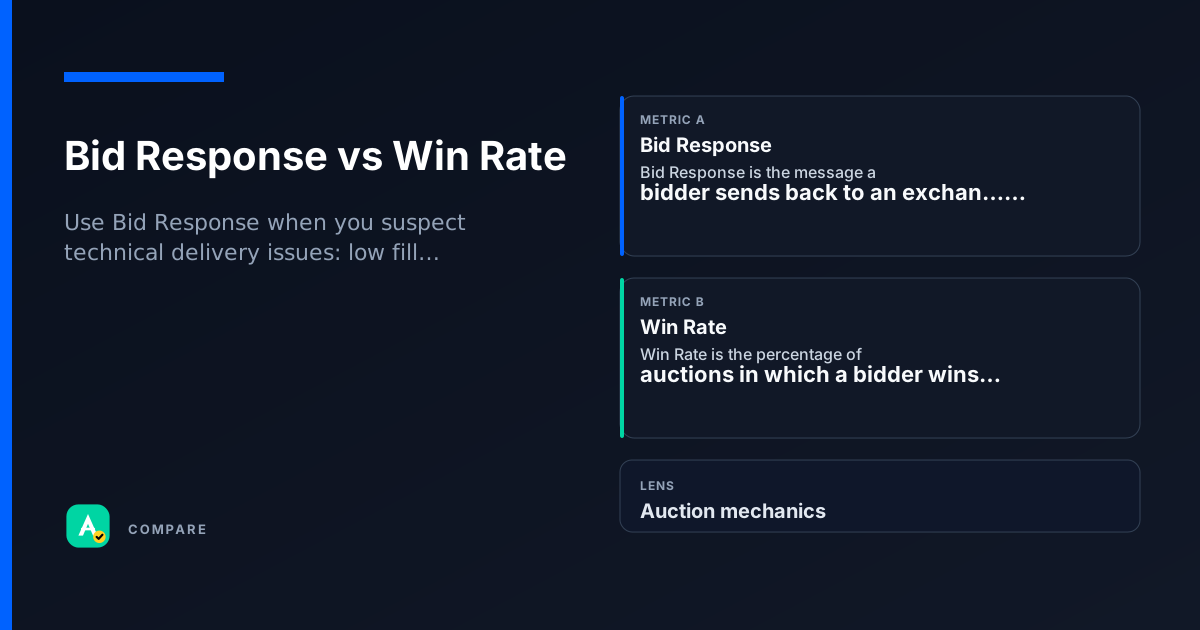
Bid Response measures whether your bid was received and processed by the exchange. Win Rate measures whether that processed bid actually won the auction. Together they diagnose if your problem is delivery or competitiveness.
Core Difference: Delivery vs. Competitiveness
Bid Response is a technical handshake metric. It tells you the percentage of bid requests where your bid was successfully sent, received, and acknowledged by the SSP/exchange. A low Bid Response means a connectivity or timeout issue.
Win Rate is a market outcome metric. It tells you the percentage of your responded bids that won the auction. A low Win Rate means your bid price, creative, or targeting was not competitive enough.
Key contrast
- Bid Response = Did my bid arrive?
- Win Rate = Did my bid win?
Why it matters
- Low Bid Response → fix integration, latency, or QPS limits.
- Low Win Rate → adjust bid price, audience segments, or creative quality.
Formula
- Bid Response = (Bids responded) / (Bid requests received) × 100
- Win Rate = (Won auctions) / (Bids responded) × 100
Which to use when
Choose Bid Response when:
- You suspect integration issues (timeouts, malformed requests).
- You are onboarding a new exchange or DSP.
- You see zero or very low impressions despite high bid requests.
Choose Win Rate when:
- Bid Response is healthy (>95%) but impressions are low.
- You are optimizing bid price or audience targeting.
- You want to compare competitiveness across different exchanges.
Use both together when:
- Building a full-funnel diagnostic: start with Bid Response, then Win Rate.
- Troubleshooting a sudden drop in fill rate.
- Reporting campaign health to stakeholders.
How they diverge
What each measures
- Bid Response: Technical delivery — was the bid accepted by the exchange?
- Win Rate: Market outcome — did the bid win the auction?
Primary use case
- Bid Response: Integration health, latency, connectivity.
- Win Rate: Pricing strategy, audience relevance, creative performance.
Typical benchmarks
- Bid Response: Target >95% for healthy integration.
- Win Rate: Varies widely (1-20% typical for open exchange; higher for PMP).
Where they overlap
Both are funnel ratios
Both metrics are calculated as a percentage of bid requests. Both sit in the same programmatic funnel: bid request → bid response → auction → win.
Both depend on latency
If your bid response is too slow, the exchange may time out — reducing both Bid Response and Win Rate.
Both are reported per-exchange
Both metrics are typically segmented by SSP, ad format, or device to pinpoint issues.
Real scenarios
Case 1: Low impressions despite high bid requests
Setup: A DSP campaign receives 1M bid requests/day but only 10K impressions.
- What happened: Bid Response was 98% (healthy), but Win Rate was 1%.
- What they checked: Bid price was too low for the target audience.
Takeaway: High Bid Response means the exchange accepted your bid; low Win Rate means you lost the auction. Adjust bid price or targeting.
Case 2: Sudden drop in fill rate
Setup: A publisher sees fill rate drop from 80% to 20% overnight.
- What happened: Bid Response dropped to 40% due to a timeout issue.
- What they checked: The DSP's server was overloaded.
Takeaway: Low Bid Response explains the fill rate drop. Fix server capacity before adjusting bid price.
How they work together
Use Bid Response when you suspect technical delivery issues: low fill rate, timeouts, or integration errors. It is your first diagnostic step.
Use Win Rate when Bid Response is healthy but impressions are low. It tells you if your bid is competitive enough.
Use both when building a full-funnel report. Start with Bid Response to confirm delivery, then Win Rate to assess competitiveness.
Side-by-side snapshot
| Lens | Bid Response | Win Rate |
|---|---|---|
| What it measures | Technical delivery (bid accepted by exchange) | Market outcome (bid won the auction) |
| Formula | Bids responded / Bid requests × 100 | Won auctions / Bids responded × 100 |
| Typical healthy range | >95% | 1-20% (varies by channel) |
| Primary lever to improve | Server latency, connection, QPS limits | Bid price, audience targeting, creative |
| Diagnostic role | First step: is my bid reaching the auction? | Second step: is my bid competitive? |
Common pitfalls
Pitfall: Optimizing Win Rate without checking Bid Response
Why it is wrong: If Bid Response is low, your bids are not even reaching the auction. Optimizing bid price or creative will not help.
- What to do instead: Always check Bid Response first. If it is below 95%, fix integration or latency before touching Win Rate.
Pitfall: Treating Win Rate as a standalone KPI
Why it is wrong: A high Win Rate can be misleading if you are bidding too high (low ROI). A low Win Rate can be fine if you are targeting premium inventory at a low price.
- What to do instead: Always pair Win Rate with cost per win or ROAS to ensure profitability.
Quick check
Test whether you can tell these metrics apart.
single
Which metric tells you if your bid was accepted by the exchange?
Select an answer to continue
For learning only. Not advice on bids or spend.
You may also like
Metrics
Bid Response (Bid Resp)
Bid Response is the message a bidder sends back to an exchange after receiving a Bid Request.
AuctionMetrics
Win Rate
Win Rate is the percentage of auctions in which a bidder wins the impression.
AuctionRelationships
eCPM vs Viewability
RelationshipsRelationships
CAC vs LTV
Relationships