#relationships·Jul 17, 2026·6 min read
Attribution vs ROAS: Which Metric Tells You What Worked?
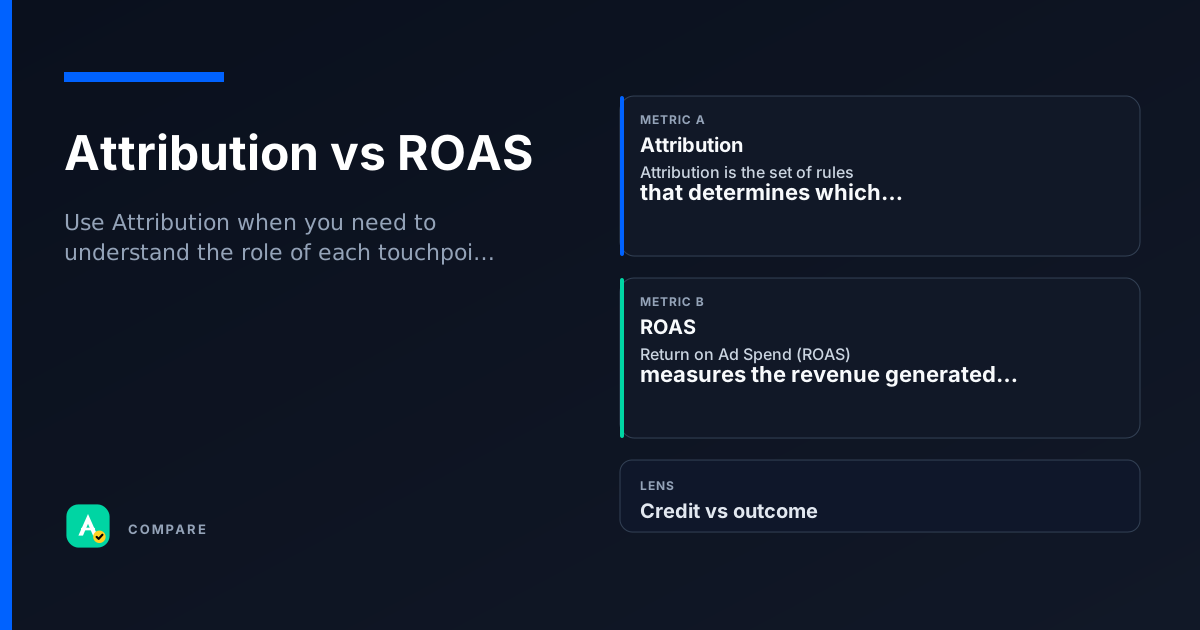
Attribution answers which touchpoints drove conversions. ROAS answers how much revenue each ad dollar generated. One is a path, the other is a ratio.
Attribution vs ROAS: The Core Difference
Attribution assigns credit across the customer journey (first click, last click, linear, data-driven).
ROAS (Return on Ad Spend) is a simple formula: Revenue / Ad Spend.
- Attribution is about which channels or creatives get credit.
- ROAS is about efficiency — did the spend pay back?
Example: A campaign may show high ROAS (revenue 5x spend) but attribution reveals the last click got all credit, hiding the top-of-funnel role of display ads.
Which to Use When
Pick Attribution when:
- You need to understand the customer journey.
- You are optimizing budget across channels.
- You want to credit upper-funnel efforts.
Pick ROAS when:
- You need a quick profitability check.
- You are comparing campaign efficiency at a glance.
- You report to executives who want a single number.
Use both when:
- You want to know which channels drive profit (attribution) and how much profit per dollar (ROAS).
How they diverge
What They Measure
Attribution measures credit distribution across touchpoints.
ROAS measures revenue per dollar spent.
- Attribution: fractional credit (e.g., 40% to email, 60% to search).
- ROAS: single ratio (e.g., 4.2x).
Output Format
Attribution outputs a set of percentages or weights.
ROAS outputs a single number.
- Attribution: "Display contributed 30% of conversions."
- ROAS: "Campaign returned $5 for every $1 spent."
Dependency on Model
Attribution is the model — changing the model changes results.
ROAS depends on the attribution model to define which conversions are counted.
- Attribution: model choice is the metric.
- ROAS: model choice is a hidden assumption.
Where they overlap
Both Require Conversion Tracking
Without a conversion pixel or event, neither metric can be calculated. Both rely on the same underlying data pipeline.
Both Are Used for Optimization
Advertisers use both to decide where to shift budget. Attribution shows which channel; ROAS shows how efficient that channel is.
Real scenarios
The Display Ad That Never Gets Credit
Setup: An e-commerce brand runs display ads + search ads.
- What happened: Last-click attribution gave 100% credit to search. ROAS for search looked great (8x), display ROAS looked poor (1.2x).
- What they checked: They switched to data-driven attribution and saw display contributed 35% of assisted conversions.
Takeaway: ROAS alone can mislead — attribution reveals hidden value.
The High ROAS Campaign That Didn't Scale
Setup: A mobile game runs a UA campaign with a 10x ROAS.
- What happened: The campaign hit 10x ROAS but couldn't scale past 500 installs/day.
- What they checked: Attribution showed the high ROAS came from a small, loyal segment; broad targeting had lower ROAS.
Takeaway: ROAS can hide scale limits — attribution shows which segments drive it.
How they work together
Use Attribution when you need to understand the role of each touchpoint in the conversion path — especially for multi-channel funnels.
Use ROAS when you need a quick profitability benchmark for a campaign or channel — especially for single-channel or last-click reporting.
Use both when you want to optimize budget allocation: attribution tells you where to shift, ROAS tells you how much return to expect.
Side-by-side snapshot
| Lens | Attribution | ROAS |
|---|---|---|
| Definition | Credit assignment across touchpoints | Revenue / Ad Spend |
| Output | Percentages or weights per channel | Single ratio (e.g., 4.5x) |
| Dependency on Model | The model is the metric | Depends on model for conversion count |
| Best Use | Understanding customer journey | Quick profitability check |
| Common Pitfall | Ignoring model assumptions | Treating as model-independent |
Common pitfalls
Treating ROAS as a Pure Metric
Why the confusion is wrong: ROAS depends entirely on the attribution model. A last-click ROAS of 5x can become 2x under linear attribution.
- What to do instead: Always state the attribution model when reporting ROAS. Compare apples to apples.
Optimizing Attribution Without ROAS
Why the confusion is wrong: Attribution tells you which channels get credit, but not whether those channels are profitable.
- What to do instead: Use attribution to allocate budget, then measure ROAS to confirm efficiency.
Quick check
Test whether you can tell these metrics apart.
boolean
ROAS is a ratio of revenue to ad spend.
Select an answer to continue
For learning only. Not advice on bids or spend.
You may also like
Metrics
Attribution (Conversion Attribution)
Attribution is the set of rules that determines which touchpoints in a customer’s journey get c…
MeasurementMetrics
Return on Ad Spend (ROAS)
Return on Ad Spend (ROAS) measures the revenue generated for every dollar spent on advertising.
PerformanceRelationships
Ad Density vs CTR
RelationshipsRelationships
LTV vs ROAS
Relationships