#relationships·Jul 17, 2026·6 min read
CPI vs ROAS: Cost per Install vs Return on Ad Spend – Which Metric Drives App Growth?
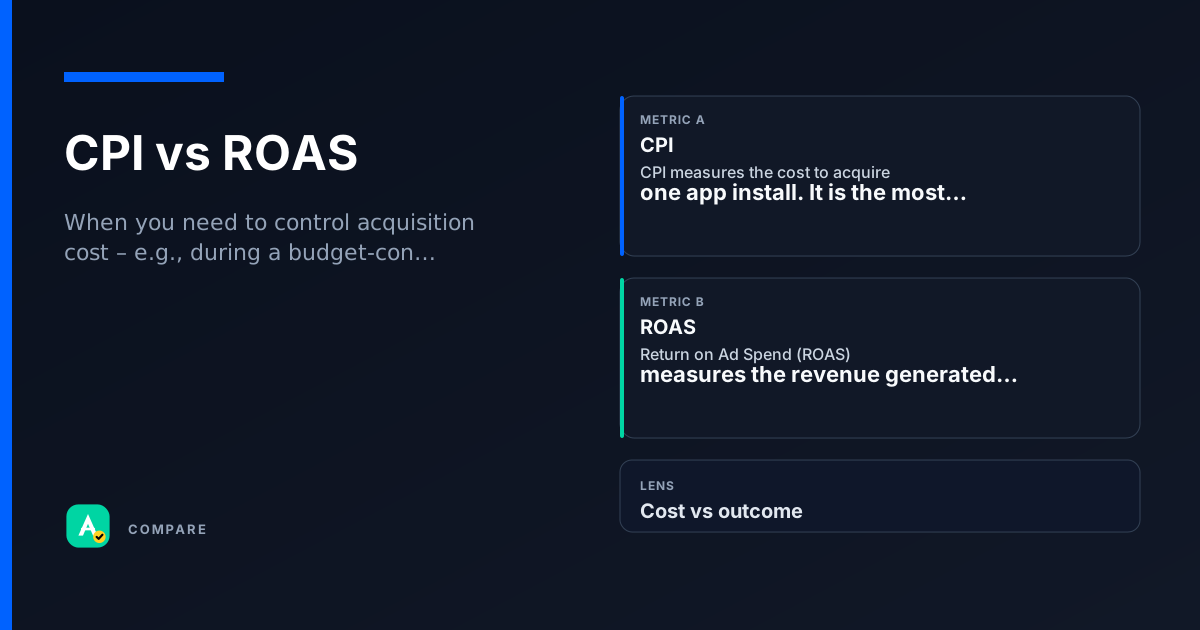
Should you optimize for CPI (Cost Per Install) or ROAS (Return on Ad Spend)? The short answer: CPI tells you how much you pay to acquire a user, while ROAS tells you how much revenue that user generates. One is a cost metric, the other a profitability metric.
Core Difference: Cost vs. Return
CPI measures the cost to acquire one install. ROAS measures the revenue generated per dollar spent.
- CPI = Total ad spend / Number of installs
- ROAS = Total revenue from attributed conversions / Total ad spend
Why it matters
- Low CPI doesn't guarantee profit if users don't spend.
- High ROAS can mask high acquisition costs if install volume is low.
In practice
- CPI is a volume & efficiency metric for user acquisition.
- ROAS is a profitability metric for campaign performance.
Which to use when
Pick CPI when
- You're in a scale phase – need to grow install volume fast.
- You're testing creative concepts and want to compare cost efficiency.
- You're running CPI-optimized campaigns (e.g., Meta's App Install objective).
Pick ROAS when
- You're in a profitability phase – need to ensure each dollar spent returns >$1.
- You're running in-app purchase (IAP) or subscription monetization.
- You're comparing retargeting vs. prospecting campaigns.
Use both together when
- You want to balance volume and value – e.g., target CPI < $2 AND ROAS > 3x.
- You're building a cohort-based LTV model to set bid caps.
How they diverge
What they measure
- CPI: Cost per install – a pure cost metric.
- ROAS: Return on ad spend – a revenue-to-cost ratio.
Optimization goal
- CPI: Lower is better (cheaper installs).
- ROAS: Higher is better (more revenue per dollar).
Attribution window
- CPI: Typically measured within 24–48 hours post-click.
- ROAS: Often measured over 7, 14, or 30 days post-install (depends on conversion window).
Where they overlap
Both require attribution
Both metrics depend on accurate tracking of installs and in-app events via MMPs (e.g., AppsFlyer, Adjust).
Both are campaign-level KPIs
Advertisers use both to compare performance across channels, ad sets, or geos.
Real scenarios
Gaming app: Low CPI, low ROAS
Setup: A hyper-casual game runs CPI-optimized campaigns and achieves $0.30 CPI.
- What happened: Install volume is high, but in-app purchase rate is <1%.
- What they checked: ROAS was 0.8x – losing money on every install.
Takeaway: Low CPI alone is dangerous without ROAS validation.
Subscription app: High CPI, high ROAS
Setup: A meditation app targets high-intent users with a $5 CPI.
- What happened: Install volume is low, but 20% of users convert to a $10/month subscription.
- What they checked: ROAS was 4x after 30 days.
Takeaway: High CPI is acceptable if ROAS exceeds target.
How they work together
When you need to control acquisition cost – e.g., during a budget-constrained launch or when testing new ad formats.
When you need to validate revenue efficiency – e.g., before scaling a campaign or when comparing paid vs. organic cohorts.
When you're building a full-funnel strategy – e.g., use CPI to cap cost per install, then use ROAS to ensure those installs generate positive returns.
Side-by-side snapshot
| Lens | CPI | ROAS |
|---|---|---|
| Formula | Ad spend / Installs | Revenue / Ad spend |
| Unit | Currency per install (e.g., $2.50) | Ratio (e.g., 3.0x or 300%) |
| Optimization direction | Lower is better | Higher is better |
| Attribution window | Short (24–48h post-click) | Longer (7–30 days post-install) |
| Best for | Volume & cost control | Revenue & profitability |
Common pitfalls
Optimizing CPI alone leads to low-quality users
Why the confusion is wrong: A low CPI campaign may attract cheap but non-engaged users who never convert.
- What to do instead: Set a minimum ROAS threshold and optimize toward both metrics.
Optimizing ROAS alone can cap volume
Why the confusion is wrong: A high ROAS target may exclude large segments of potential users, limiting scale.
- What to do instead: Use ROAS as a floor, not a ceiling – allow campaigns to spend as long as they exceed the minimum ROAS.
Quick check
Test whether you can tell these metrics apart.
boolean
A low CPI always means a campaign is profitable.
Select an answer to continue
For learning only. Not advice on bids or spend.
You may also like
Metrics
Cost Per Install (CPI)
CPI measures the cost to acquire one app install.
CostMetrics
Return on Ad Spend (ROAS)
Return on Ad Spend (ROAS) measures the revenue generated for every dollar spent on advertising.
PerformanceRelationships
CPC vs CPM
RelationshipsRelationships
First-Price Auction vs Floor Price
Relationships