#relationships·Jul 17, 2026·6 min read
CPC vs eCPM: Which Metric Tells You More About Campaign Performance?
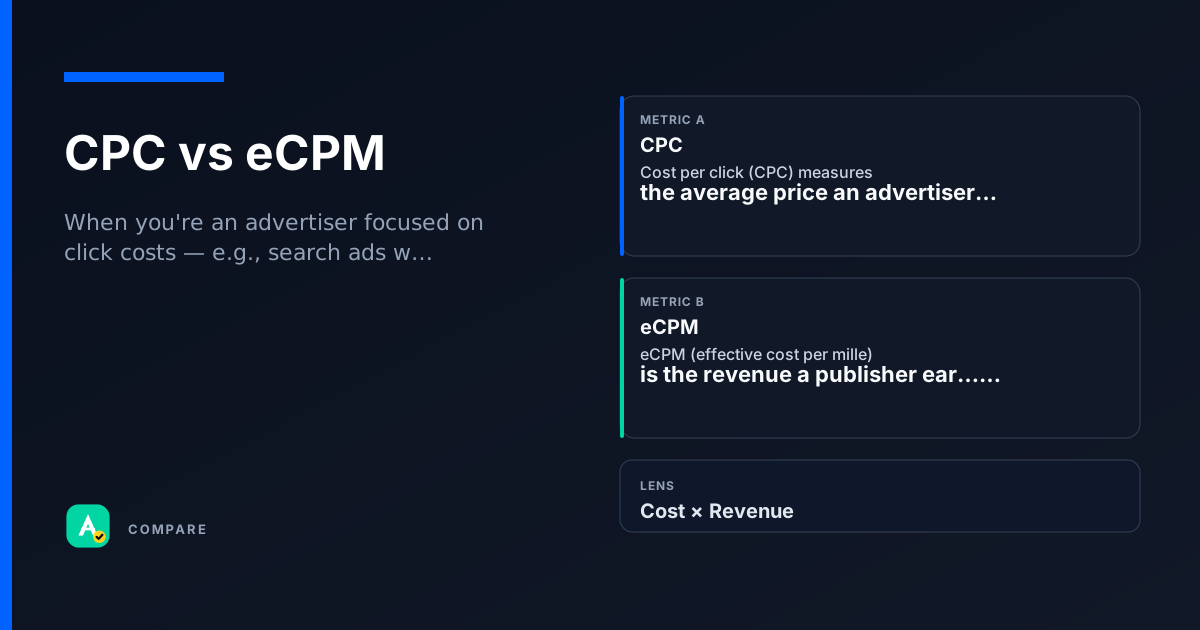
CPC (Cost Per Click) tells you how much you pay for each click. eCPM (effective Cost Per Mille) estimates the revenue you'd earn per 1,000 impressions. They answer different questions: CPC focuses on click efficiency, eCPM on overall revenue generation.
Core Difference: Click Cost vs. Revenue per Thousand
CPC = Cost / Clicks. It's the advertiser's cost per individual click. eCPM = (Total Revenue / Total Impressions) × 1000. It's the publisher's or platform's revenue per thousand impressions, regardless of clicks.
- CPC is an advertiser-side metric: "How much do I pay for each click?"
- eCPM is a publisher-side metric: "How much revenue do I earn per 1,000 ad views?"
They are inversely related in some ways: a high CPC can lead to a high eCPM if click-through rate (CTR) is also high. But eCPM can be high even with low CPC if CTR is very high, or low even with high CPC if CTR is very low.
Which to Use When
Use CPC when:
- You're an advertiser focused on click costs.
- You want to control cost per action (if clicks are your conversion event).
- You're running search ads or PPC campaigns.
Use eCPM when:
- You're a publisher optimizing ad revenue.
- You're comparing different ad formats or networks.
- You need a holistic view of revenue generation, not just clicks.
Use both together when:
- You're a programmatic buyer evaluating both cost efficiency and revenue potential.
- You're running a performance campaign where both clicks and impressions matter.
How they diverge
Perspective
CPC is an advertiser's cost metric. eCPM is a publisher's revenue metric.
- CPC: "How much do I pay per click?"
- eCPM: "How much do I earn per 1,000 impressions?"
Calculation
CPC = Cost / Clicks. eCPM = (Total Revenue / Total Impressions) × 1000.
- CPC ignores impressions; eCPM ignores clicks.
- A campaign with zero clicks has undefined CPC but a valid eCPM (if revenue > 0).
Optimization Goal
CPC optimization aims to reduce cost per click. eCPM optimization aims to increase revenue per thousand impressions.
- Lower CPC is usually better for advertisers.
- Higher eCPM is usually better for publishers.
Where they overlap
Monetary Metrics
Both are expressed in currency (e.g., USD, EUR) and used to evaluate financial performance of ad campaigns.
Standardized Across Platforms
Both are reported by major ad platforms (Google Ads, Meta, Amazon Ads) and programmatic systems (OpenRTB).
Used for Comparison
Both allow apples-to-apples comparison across campaigns, ad units, or time periods.
Real scenarios
Advertiser vs. Publisher: Different Goals
Setup: A brand runs a display campaign. The advertiser sees a low CPC ($0.50) and is happy. The publisher sees a low eCPM ($2.00) and is unhappy.
- What happened: The campaign had low CTR (0.4%), so even though clicks were cheap, revenue per impression was low.
- What they checked: Advertiser checked CPC; publisher checked eCPM.
Takeaway: One metric doesn't tell the whole story. Low CPC doesn't guarantee high eCPM.
High CPC, High eCPM: A Good Campaign?
Setup: A campaign has a high CPC ($5.00) but also a high eCPM ($50.00).
- What happened: The CTR was very high (10%), so even though each click was expensive, the revenue per thousand impressions was excellent.
- What they checked: Both metrics together revealed a high-performing campaign.
Takeaway: High CPC can be acceptable if eCPM is also high — the tradeoff is worth it.
How they work together
When you're an advertiser focused on click costs — e.g., search ads where each click is a potential conversion.
When you're a publisher or media buyer evaluating revenue per impression — e.g., display ads where impressions drive brand awareness.
When you need a full picture — e.g., a programmatic campaign where you want to control costs (CPC) while maximizing revenue (eCPM).
Side-by-side snapshot
| Lens | CPC | eCPM |
|---|---|---|
| Full Name | Cost Per Click | Effective Cost Per Mille (thousand) |
| Formula | Cost / Clicks | (Revenue / Impressions) × 1000 |
| Perspective | Advertiser (cost) | Publisher (revenue) |
| Denominator | Clicks | Impressions |
| When Zero Denominator | Undefined (no clicks) | Valid (if revenue > 0) |
| Optimization Goal | Lower is better | Higher is better |
Common pitfalls
Confusing CPC with eCPM
Why the confusion is wrong: They measure different things — cost per click vs. revenue per thousand impressions.
- What to do instead: Always check the denominator: clicks vs. impressions. If you're an advertiser, focus on CPC. If you're a publisher, focus on eCPM.
Optimizing Only One Metric in Isolation
Why the confusion is wrong: Lowering CPC might reduce eCPM if it also lowers CTR.
- What to do instead: Monitor both together. A balanced approach often yields better overall performance.
Quick check
Test whether you can tell these metrics apart.
single
Which metric is calculated as Cost / Clicks?
Select an answer to continue
For learning only. Not advice on bids or spend.
You may also like
Metrics
Cost per click (CPC)
Cost per click (CPC) measures the average price an advertiser pays each time someone clicks the…
CostMetrics
Effective Cost Per Mille (eCPM)
eCPM (effective cost per mille) is the revenue a publisher earns per thousand ad impressions, r…
RevenueRelationships
CAC vs CPA
RelationshipsRelationships
CTR vs Impression
Relationships