#relationships·Jul 17, 2026·6 min read
Budget Pacing vs CPA: Which Metric Controls Your Ad Spend?
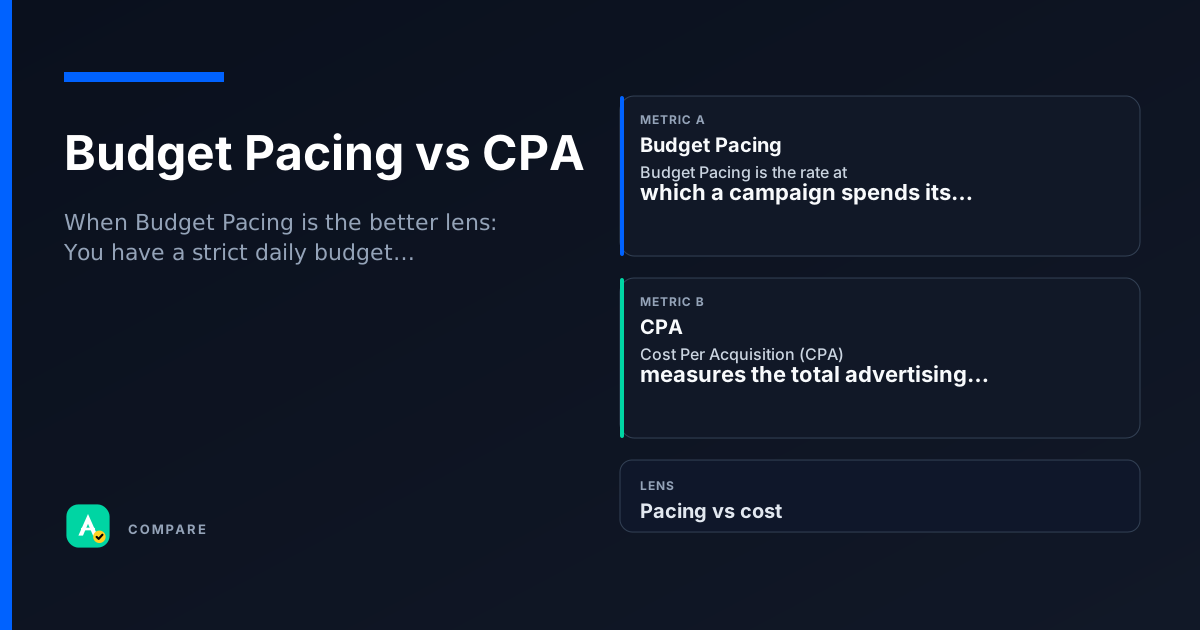
Budget pacing tracks how evenly your daily budget is spent, while CPA (Cost Per Acquisition) measures the average cost of a conversion. Pacing prevents exhausting your budget too early; CPA ensures you're not overpaying for results.
Core Difference: Spend Control vs Cost Efficiency
Budget pacing is a delivery metric — it answers "Am I spending my daily budget at the right speed?"
CPA is a performance metric — it answers "Am I getting conversions at an acceptable cost?"
- Pacing is about when money leaves your account.
- CPA is about what you get for that money.
A campaign can pace perfectly (spending $100/day evenly) yet have a terrible CPA ($50 per $10 product). Conversely, a great CPA can come from a campaign that spends 80% of its budget in the first hour.
Which to Use When
Pick Budget Pacing when:
- You have a fixed daily budget that must last the full day.
- You're running time-sensitive campaigns (e.g., flash sales, live events).
- You want to avoid a spike in spend early in the day.
Pick CPA when:
- Your primary goal is cost-efficient conversions.
- You're optimizing for ROAS or profit margin.
- You can tolerate some budget fluctuation as long as CPA stays low.
Use both together when:
- You need to hit a daily spend target and keep acquisition costs under control.
- Example: Set a CPA target in your bidding strategy, then monitor pacing to ensure you're not under- or over-spending.
How they diverge
Focus
Budget pacing focuses on spend rate (how fast money is used). CPA focuses on cost per result (how much each conversion costs).
Time Horizon
Budget pacing is a daily/hourly metric — you check it multiple times per day. CPA is often evaluated over days or weeks to gather enough conversion data.
Action Trigger
Budget pacing triggers a budget increase or decrease (e.g., raise daily cap if pacing too slow). CPA triggers a bid or creative change (e.g., lower bid if CPA is too high).
Where they overlap
Both Prevent Waste
Pacing prevents exhausting budget early; CPA prevents overpaying for conversions. Both protect your ROI.
Both Require Real-Time Monitoring
You can't fix pacing or CPA after the campaign ends. Both need dashboards with hourly or daily updates.
Both Are Platform Metrics
Google Ads, Meta Ads, and most DSPs report both pacing and CPA natively. They are standard in ad manager UIs.
Real scenarios
Flash Sale Campaign
Setup: A retailer runs a 24-hour flash sale with a $2,000 budget.
- What happened: The campaign spent $1,800 in the first 6 hours (pacing alarm). CPA was excellent ($8), but the budget was nearly gone.
- What they checked: Pacing rate vs. time elapsed. They realized the ad set was too aggressive.
Takeaway: Great CPA doesn't matter if you run out of budget before the sale ends. Pacing saved the campaign from ending early.
Lead Gen with High CPA
Setup: A B2B company runs a LinkedIn campaign with a $100/day budget.
- What happened: Pacing was perfect (spent $100/day evenly), but CPA was $150 per lead — way above target.
- What they checked: CPA trend. They paused the ad set and switched to a narrower audience.
Takeaway: Perfect pacing can hide a terrible CPA. Always check both.
How they work together
When Budget Pacing is the better lens: You have a strict daily budget that must be spread evenly (e.g., a $500/day cap for a 30-day campaign). Pacing ensures you don't run out of money before the day ends.
When CPA is the better lens: Your primary KPI is cost per lead or sale. You're willing to let daily spend fluctuate as long as each conversion stays under a target cost.
When you need both together: You want to hit a daily spend target and keep CPA low. Use CPA bidding with a budget cap, then monitor pacing to adjust if you're under- or over-delivering.
Side-by-side snapshot
| Lens | Budget Pacing | CPA |
|---|---|---|
| Primary Question | Am I spending my budget at the right speed? | Am I getting conversions at an acceptable cost? |
| Unit | Percentage of daily budget spent vs. time elapsed | Currency per conversion (e.g., $12.50) |
| Optimization Action | Adjust daily budget or bid strategy | Change targeting, creative, or bid |
| Typical Monitoring Frequency | Hourly or multiple times per day | Daily or weekly |
Common pitfalls
Confusing Pacing with Performance
Why the confusion is wrong: A campaign that spends its budget evenly is not necessarily successful. Pacing only measures spend rate, not results.
- What to do instead: Always pair pacing with a performance metric like CPA or ROAS.
Ignoring Pacing When Optimizing for CPA
Why the confusion is wrong: If you only optimize for CPA, you might let the algorithm spend aggressively early in the day, exhausting the budget.
- What to do instead: Set a daily budget cap and monitor pacing to ensure even delivery.
Quick check
Test whether you can tell these metrics apart.
single
Which metric tells you if your daily budget is being spent too quickly?
Select an answer to continue
For learning only. Not advice on bids or spend.
You may also like
Metrics
Budget Pacing
Budget Pacing is the rate at which a campaign spends its daily or lifetime budget relative to t…
OpsMetrics
Cost Per Acquisition (CPA)
Cost Per Acquisition (CPA) measures the total advertising cost divided by the number of convers…
CostRelationships
IVT Rate vs Viewability
RelationshipsRelationships
Bid Request vs Bid Response
Relationships