#relationships·Jul 17, 2026·6 min read
Bid Request vs Match Rate: Which Tells You If Your Audience Is Actually Reachable?
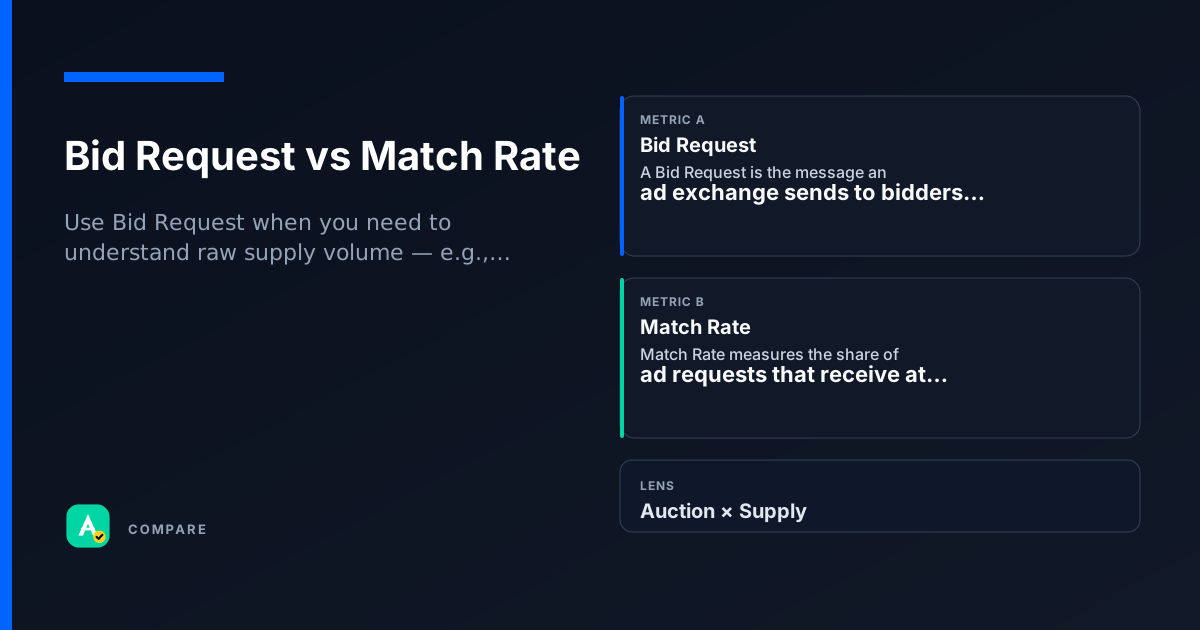
Bid Request counts every opportunity an ad server sends to a DSP. Match Rate measures how often those requests carry a recognized user ID. If bid requests are the volume of doors that open, match rate is the share of doors where you already know who’s inside.
Core difference: Volume vs. Recognizability
Bid Request is a raw count of ad opportunities sent to a demand-side platform (DSP). It tells you how much inventory is available.
Match Rate is the percentage of those bid requests that contain a cookie, device ID, or other identifier the DSP can recognize. It tells you how much of that inventory is addressable.
- Bid Request = supply volume
- Match Rate = supply quality (in terms of targeting capability)
Formula
- Bid Request = count of requests
- Match Rate = (matched requests / total bid requests) × 100%
Why it matters
A high bid request count with a low match rate means you see lots of inventory but can’t target most of it. A low bid request count with a high match rate means limited scale but strong addressability.
Which to use when
Pick Bid Request when:
- You want to assess overall supply volume from a publisher or exchange.
- You’re diagnosing whether you’re seeing enough opportunities to meet campaign reach goals.
- You’re comparing inventory scale across different sources.
Pick Match Rate when:
- You want to know how much of that supply is targetable (e.g., for retargeting or frequency capping).
- You’re evaluating a new data partner or cookie-sync setup.
- You need to decide whether to invest in improving identity resolution.
Use both together when:
- You’re building a supply-path optimization (SPO) score — bid request volume × match rate gives a rough “addressable reach” estimate.
- You’re troubleshooting low win rates: low match rate may explain why bids aren’t being placed.
How they diverge
What they measure
Bid Request counts raw opportunities. Match Rate measures the proportion of those opportunities that carry a recognized identifier.
- Bid Request: volume (integer)
- Match Rate: percentage (0–100%)
Impact on campaign performance
Bid Request affects potential reach. Match Rate affects targeting precision.
- High bid requests + low match rate = lots of blind inventory
- Low bid requests + high match rate = narrow but targetable supply
Optimization levers
Bid Request is influenced by publisher integration, deal types, and traffic volume. Match Rate is influenced by cookie-sync success, identity graph coverage, and privacy changes.
- To increase bid requests: add more publishers or open exchange paths
- To increase match rate: improve cookie-sync or adopt alternative IDs
Where they overlap
Both are pre-auction metrics
Neither metric depends on winning a bid or serving an impression. They describe the supply before any demand-side decision.
Both are used for inventory evaluation
Buyers use both to decide which publishers or exchanges to prioritize. A publisher with high bid requests but low match rate may be deprioritized for targeted campaigns.
Both can be affected by privacy changes
Browser cookie restrictions and IDFA opt-outs reduce both the number of bid requests (e.g., via Safari’s ITP) and the match rate (fewer identifiers to match on).
Real scenarios
High bid requests, low match rate — blind inventory
A DSP sees 10M bid requests per day from a large publisher but only a 20% match rate.
- What happened: The publisher has high traffic, but the DSP’s cookie sync with that publisher is poor.
- What they checked: They compared bid request volume vs. matched request volume and found only 2M addressable impressions.
Takeaway: High bid request volume can be misleading if match rate is low. The DSP needs to improve identity resolution or deprioritize that publisher for targeted campaigns.
Low bid requests, high match rate — niche but targetable
A niche publisher sends only 500K bid requests per day but has a 90% match rate.
- What happened: The publisher’s traffic is small but highly authenticated (e.g., logged-in users).
- What they checked: The DSP saw that 450K requests had a recognized ID, making it ideal for frequency-capped campaigns.
Takeaway: Match rate can make low-volume inventory valuable for performance campaigns. Don’t dismiss low bid request counts if match rate is high.
How they work together
Use Bid Request when you need to understand raw supply volume — e.g., checking if a new publisher integration is sending traffic, or estimating maximum possible reach for a broad awareness campaign.
Use Match Rate when you need to know how much of that supply is targetable — e.g., for a retargeting campaign that requires a known user ID, or when evaluating a data-management platform’s sync coverage.
Use both when you’re diagnosing low campaign fill rates or win rates. For example, if bid requests are high but match rate is low, the problem may be that the DSP can’t recognize users to bid on. Together they give a complete picture of addressable supply.
Side-by-side snapshot
| Lens | Bid Request | Match Rate |
|---|---|---|
| Definition | Count of ad opportunities sent to a DSP | Percentage of bid requests with a recognized user ID |
| Unit | Integer (count) | Percentage (0–100%) |
| What it tells you | How much inventory is available | How much inventory is targetable |
| Optimization focus | Increase publisher integrations, traffic, or deal access | Improve cookie-sync, adopt alternative IDs, expand identity graph |
| Impact of privacy changes | Can reduce overall request volume (e.g., ITP limiting cookies) | Can reduce the share of requests with recognized IDs |
| Typical use case | Supply volume analysis, reach estimation | Targeting capability assessment, data partner evaluation |
Common pitfalls
Confusing bid request volume with addressable reach
It’s tempting to assume 10M bid requests = 10M potential impressions. But if match rate is 30%, only 3M of those requests can be targeted.
- What to do instead: Always multiply bid requests by match rate to estimate addressable supply. Use that number for campaign planning.
Optimizing match rate in isolation
A 100% match rate is useless if you only receive 100 bid requests. Match rate is a ratio — it can be high simply because volume is low.
- What to do instead: Look at both metrics together. A healthy supply path has both sufficient volume (bid requests) and strong recognizability (match rate).
Quick check
Test whether you can tell these metrics apart.
single
Which metric is expressed as a percentage?
Select an answer to continue
For learning only. Not advice on bids or spend.
You may also like
Metrics
Bid Request (OpenRTB)
A Bid Request is the message an ad exchange sends to bidders (DSPs) to describe available inven…
AuctionMetrics
Match Rate
Match Rate measures the share of ad requests that receive at least one bid response from a dema…
SupplyRelationships
CPA vs ROAS
RelationshipsRelationships
First-Price Auction vs Floor Price
Relationships